
Therion
Curtis, 1829
Species Guides
7Therion is a of ichneumon wasps in the Ichneumonidae, Anomaloninae. The genus contains at least 20 described distributed across North America, Europe, and Asia. Members are external or internal of caterpillars, with several species serving as agents of pest species. The genus has been subject to recent taxonomic revision in Japan, where four species are now recognized.
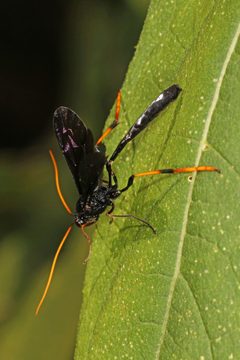
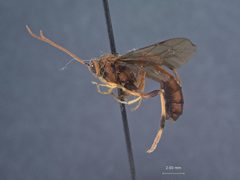

Pronunciation
How to pronounce Therion: //ˈθɛɹiˌɒn//
These audio files are automatically generated. While they are not always 100% accurate, they are a good starting point.
Identification
Therion can be distinguished from other Anomaloninae by a combination of morphological characters detailed in regional identification keys. Japanese species are readily separated using the key provided by Shimizu & Bennett (2021), which emphasizes diagnostic features of the mesosoma and coloration patterns. Females possess a short, spine-like ovipositor that is not used for defense.
Images
Habitat
occur in deciduous forest understories and similar wooded environments. Therion morio has been observed in forest understory in Wisconsin.
Distribution
Widespread across the Holarctic region. Therion morio ranges from Nova Scotia south to Florida and west to Washington, northwest Nevada, southeast Kansas, and Mexico. European records include France and Scandinavia (Denmark, Norway, Sweden). Asian occur in Japan, with T. circumflexum and T. giganteum also present in Europe.
Seasonality
Therion morio has been recorded in in June in Wisconsin. Japanese flight periods are documented in the revision by Shimizu & Bennett (2021), though specific months are not provided in the available source.
Host Associations
- Hyphantria cunea - Fall Webworm; larval of T. morio
- Cycnia inopinatus - tiger moth; larval of T. morio
- Spilosoma virginica - Virginia Tiger Moth; larval of T. morio
- Estigmene acrea - Saltmarsh Caterpillar; larval of T. morio
- Lophocampa maculata - Spotted Tiger Moth; larval of T. morio
- Dendrolimus spectabilis - lasiocampid ; newly recorded of T. giganteum in Japan
Life Cycle
Therion morio larvae develop as internal within caterpillar . The is laid in a caterpillar, and the offspring emerges from the 's pupal stage.
Ecological Role
agent of pests. Therion morio parasitizes several pest including the Fall Webworm (Hyphantria cunea), contributing to natural of these defoliators.
Human Relevance
Considered beneficial for of caterpillar pests. Therion morio and related help suppress of tiger moths and other defoliating larvae without posing stinging risk to humans—the visible ovipositor is not a defensive stinger.
Similar Taxa
- Sceliphron caementariumTherion morio appears to be a mimic of this black and yellow mud dauber in size and coloration, though it lacks the defensive sting and instead has a non-venomous ovipositor.
More Details
Taxonomic Note
The has undergone recent revision in Japan (Shimizu & Bennett, 2021), resulting in description of two new (T. carinatum, T. nigrigasterum) and re-synonymization of T. rufomaculatum with T. circumflexum. A new European species, T. acronictum, was described from France in 2021.
Mimicry
Therion morio exhibits apparent mimicry of stinging (Sceliphron caementarium), a common defensive strategy in Ichneumonidae that lack functional stingers.
Sources and further reading
- BugGuide
- Wikipedia
- GBIF taxonomy match
- iNaturalist taxon
- NCBI Taxonomy
- Catalogue of Life
- Bug Eric: Wasp Wednesday: Therion morio
- A systematic revision of the Japanese species of the genus Therion (Hymenoptera: Ichneumonidae: Anomaloninae)
- Liste et clé d’identification pour les Anomaloninae de la faune de France, avec la description d’une espèce nouvelle du genre Therion (Hymenoptera, Ichneumonidae)