
Anomaloninae
Tribe Guides
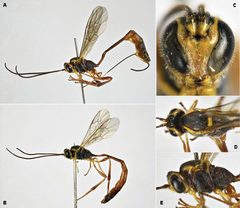
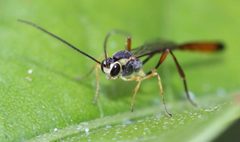
2Anomaloninae is a of in the Ichneumonidae. Members are slender, ranging from small to large, and typically black or brownish with yellow markings on the and legs. The subfamily is divided into two tribes: Anomalonini, which parasitize Coleoptera larvae (Tenebrionidae and Elateridae) and some Lepidoptera larvae (Noctuidae and Tortricidae), and Gravenhorstiini, which parasitize Lepidoptera larvae. They are distinguished from other ichneumonid subfamilies by a highly reticulated propodeum, slender metasoma, fore wing with 3 rs-m absent, and swollen hind in males.
Pronunciation
How to pronounce Anomaloninae: /ˌænəˈmɑːlənɪniː/
These audio files are automatically generated. While they are not always 100% accurate, they are a good starting point.
Identification
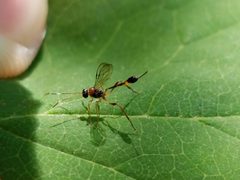
Distinguished from other Ichneumonidae by the combination of a highly reticulated propodeum, slender metasoma, absence of fore wing 3 rs-m, and swollen hind in males. The overall slender build and characteristic slow posture—with metasoma elevated, outstretched, and legs held out behind—aid in field recognition.
Images
Habitat
Occurs in nearly all forested including mixed forests, coniferous forests, and beech forests. Unlike most other ichneumonid groups, Anomaloninae are fairly common in dry habitats such as steppes and forest-steppe regions. In the Ukrainian Carpathians, have been recorded from elevations ranging from 200 to 1700 meters, including subalpine zones.
Distribution
worldwide. Documented from Palaearctic, Oriental, Holarctic, Afrotropical (sub-Saharan Africa), Australian, and Neotropical (Peru, Ecuador) regions. Specific regional records include France (15 , 62 ), Ukraine (Carpathians), Japan, sub-Saharan Africa (10 genera), and Australia (23 species).
Seasonality
periods vary by and region; in the Ukrainian Carpathians, seasonal dynamics have been documented across different elevations, though specific months are not detailed in available sources.
Host Associations
- Coleoptera larvae (Tenebrionidae) - Anomalonini tribe
- Coleoptera larvae (Elateridae) - Anomalonini tribe
- Lepidoptera larvae (Noctuidae) - Anomalonini tribe
- Lepidoptera larvae (Tortricidae) - Anomalonini tribe
- Lepidoptera larvae (general) - Gravenhorstiini tribe
- Dendrolimus spectabilis (Lasiocampidae) - of Therion giganteum in Japan
- Paracles tapina (Erebidae: Arctiinae) - of Habronyx nigrofasciata in Peru/Ecuador
Life Cycle
Koinobiont endoparasitoids. Females lay into larval , but the host is allowed to continue development to the pupal stage. emerge from the host pupa.
Behavior
Flies slowly in a characteristic pose with the metasoma elevated, outstretched, and legs held out behind the body. Some prefer dry such as steppes and forest-steppe regions, unlike many other ichneumonid groups that are restricted to moist environments.
Ecological Role
of Coleoptera and Lepidoptera larvae. Acts as a agent, with several providing beneficial services by attacking forest or orchard pests.
Human Relevance
Several are of potential economic importance as agents of forest and orchard pests. Specific species have been noted for their value in managing lepidopteran pests in forestry and agriculture.
Similar Taxa
- Other Ichneumonidae subfamiliesAnomaloninae are distinguished by the highly reticulated propodeum, absence of fore wing 3 rs-m, and swollen hind in males—features not combined in other .
More Details
Tribal classification
The is divided into two tribes: Anomalonini ( of Coleoptera larvae in Tenebrionidae and Elateridae, and some Lepidoptera larvae in Noctuidae and Tortricidae) and Gravenhorstiini (parasitoids of Lepidoptera larvae).
Taxonomic diversity
The includes at least 15 in France, 10 genera in sub-Saharan Africa, 8 genera documented from the Ukrainian Carpathians, and 23 in Australia. Notable genera include Anomalon, Agrypon, Aphanistes, Barylypa, Heteropelma, Perisphincter, Therion, Trichomma, Habronyx, Parania, and Erigorgus.
Sources and further reading
- BugGuide
- Wikipedia
- iNaturalist taxon
- NCBI Taxonomy
- A review of the Anomaloninae (Hymenoptera, Ichneumonidae, Anomaloninae) from the Ukrainian Carpathians
- A Revision of the Anomaloninae (Hymenoptera: Ichneumonidae) of Australia.
- A synopsis of the Anomaloninae (Hymenoptera: Ichneumonidae) of sub-Saharan Africa with special reference to species of potential economic importance
- A systematic revision of the Japanese species of the genus Therion (Hymenoptera: Ichneumonidae: Anomaloninae)
- Habronyx Förster (Hymenoptera: Ichneumonidae: Anomaloninae) in Peru and Ecuador: three new species, a range extension, and a new host record
- Liste et clé d’identification pour les Anomaloninae de la faune de France, avec la description d’une espèce nouvelle du genre Therion (Hymenoptera, Ichneumonidae)