
Spilosoma virginica
(Fabricius, 1798)
Virginian Tiger Moth, Yellow Woolly Bear, Yellow Bear Caterpillar
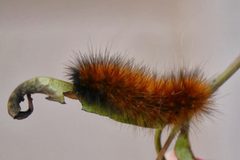
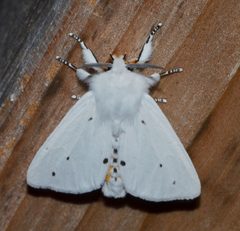
Spilosoma virginica is a tiger moth (Arctiinae) found throughout northern North America. The caterpillar, known as the yellow woolly bear or yellow bear, is densely covered in uniform yellow to orange setae without the black bands seen in its relative Pyrrharctia isabella. are white with a dark and lack the prominent dark of the similar agreeable tiger moth. The is and has two to three per year in temperate regions, with one generation as larvae.
Pronunciation
How to pronounce Spilosoma virginica: //ˌspaɪloʊˈsoʊmə vɜrˈdʒɪnɪkə//
These audio files are automatically generated. While they are not always 100% accurate, they are a good starting point.
Identification
distinguished from Spilosoma congrua (agreeable tiger moth) by absence of prominent dark on . Caterpillars distinguished from Pyrrharctia isabella (banded woolly bear) by lack of black terminal bands—S. virginica is uniformly yellow-orange. Caterpillar color varies individually but is consistent within a single specimen, without odd tufts or separately colored .
Images
Habitat
Low-growing vegetation in open areas; common in yards, gardens, agricultural fields, and roadsides. Larvae frequently found on ground cover plants.
Distribution
Throughout northern North America; present across the United States and southern Canada (Alberta, Manitoba, Saskatchewan, Vermont, and broadly). More common in the western half of its range.
Seasonality
Two to three per year in temperate climates; active in spring through fall depending on region; larvae present spring through late summer, with late summer cohort most abundant; one generation overwinters as larvae.
Diet
; larvae feed on wide range of low-growing herbaceous plants and ground cover including grasses (Poaceae), clover (Trifolium), dandelion (Taraxacum), plantain (Plantago), violets (Viola), cherry (Prunus), and honeysuckle (Lonicera). Late summer larvae sometimes reach pest levels on crops. feed on nectar.
Life Cycle
Complete : → larva (caterpillar) → pupa → . Female lays 20–100 eggs in single layer on leaf undersides. Young larvae gregarious, becoming solitary as they grow. Larvae overwinter in protected locations (under logs, stones, debris). in spring after brief feeding period. Two to three annually in temperate regions.
Behavior
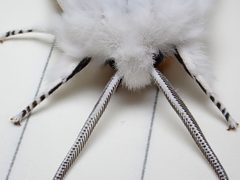
Larvae are defoliators that skeletonize leaves. Late summer caterpillars sometimes abundant enough to cause noticeable crop damage. rest with wings tented over body rather than spread flat. Males locate females by detecting with large, feathered , flying zigzag search patterns.
Ecological Role
Herbivore and defoliator; serves as prey for birds, , and other . Late summer larval abundance may influence local plant structure in disturbed .
Human Relevance
Caterpillars occasionally minor agricultural pests, particularly late summer . Bristles may cause allergic reactions in sensitive individuals, though not venomous. Sometimes mistaken for weather-predicting woolly bears (folklore applies to Pyrrharctia isabella, not this ).
Similar Taxa
- Pyrrharctia isabella (banded woolly bear)Similar and appearance; distinguished by black bands at both ends of caterpillar and orange-brown middle band. Folklore about winter weather prediction applies to this , not S. virginica.
- Spilosoma congrua (agreeable tiger moth) very similar; distinguished by prominent dark on , which S. virginica lacks.
- Hypercompe scribonia (giant leopard moth)Caterpillar also called 'woolly bear' and entirely black; distinguished by much larger size and defensive curling into spiny ball.
Misconceptions
Caterpillars are sometimes mistakenly believed to predict winter weather severity based on color band width. This folklore specifically refers to Pyrrharctia isabella (banded woolly bear), whose orange band varies with age. S. virginica lacks black bands entirely, making it unsuitable for this folklore, though it is sometimes confused with the 'true' woolly bear.
Sources and further reading
- BugGuide
- Wikipedia
- GBIF taxonomy match
- iNaturalist taxon
- Catalogue of Life
- Dashing caterpillars predicting weather: Woolly bears, Pyrrharctia Isabella; yellow bears, Spilosoma virginica; and leopard moths, Hypercompe scribionia — Bug of the Week
- Stylish Lepidoptera: Ermine Moth, Atteva aurea; Yellow-Collared Scape Moth, Cisseps fulvicollis; Pearl Crescent, Phyciodes tharos; Variegated Fritillary, Euptoieta claudia — Bug of the Week
- Archive — Bug of the Week
- Carpenter bees defending territories: Large carpenter bee, Xylocopa virginica — Bug of the Week
- The Third of Florida’s Three Metallic Tiger Beetles | Beetles In The Bush
- Influence of iridoid glycoside containing host plants on midgut β-glucosidase activity in a polyphagous caterpillar, Spilosoma virginica Fabricius (Arctiidae)