
Spilosoma congrua
Walker, 1855
Agreeable Tiger Moth
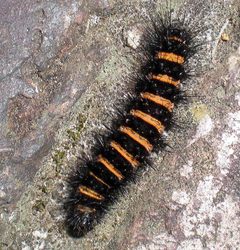
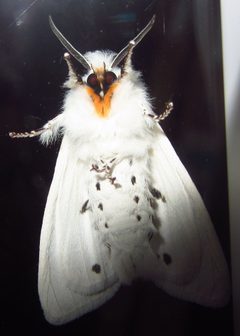
Spilosoma congrua, commonly known as the agreeable tiger moth, is a white tiger moth native to North America. are distinguished from similar species by their pronounced black , white , and orange "bib" or collar. The species tents its wings when at rest, a characteristic shared with its the Virginia tiger moth. It is one of three common white tiger moth species in the United States.
Pronunciation
How to pronounce Spilosoma congrua: /ˌspaɪləˈsoʊmə ˈkɑːŋɡruə/
These audio files are automatically generated. While they are not always 100% accurate, they are a good starting point.
Identification
Distinguished from the Virginia tiger moth (Spilosoma virginica) and other white tiger moths by the combination of pronounced black , white , and orange "bib" or collar on the . When at rest, wings are tented over the body. The overall coloration is white with black spotting on the wings.
Images
Distribution
North America, with records from Canada (Alberta, Manitoba, Saskatchewan) and the United States (Vermont and presumably throughout eastern and central regions).
Host Associations
- Hyphantria cunea - Fall Webworm caterpillars serve as for Therion morio, which also parasitizes related tiger moths
Behavior
have been observed tented over the body when at rest.
Similar Taxa
- Spilosoma virginicaVirginia tiger moth; lacks the pronounced black and orange "bib" of S. congrua, though both tent wings at rest and share white base coloration with black spotting
More Details
Parasitoid relationships
The ichneumon Therion morio is known to parasitize caterpillars of tiger moths in the Spilosoma, including related such as Spilosoma virginica. The wasp lays in caterpillar , with offspring emerging from the 's pupal stage.
Sources and further reading
- BugGuide
- GBIF taxonomy match
- iNaturalist taxon
- NCBI Taxonomy
- Catalogue of Life
- Dashing caterpillars predicting weather: Woolly bears, Pyrrharctia Isabella; yellow bears, Spilosoma virginica; and leopard moths, Hypercompe scribionia — Bug of the Week
- Stylish Lepidoptera: Ermine Moth, Atteva aurea; Yellow-Collared Scape Moth, Cisseps fulvicollis; Pearl Crescent, Phyciodes tharos; Variegated Fritillary, Euptoieta claudia — Bug of the Week
- Bug Eric: Wasp Wednesday: Therion morio
- Archive — Bug of the Week