
Lophocampa maculata
Harris, 1841
spotted tussock moth, yellow-spotted tussock moth, mottled tiger, spotted halisidota
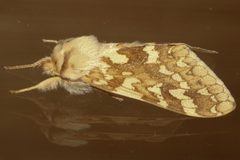
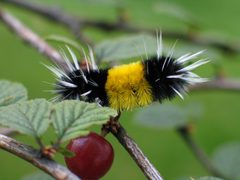
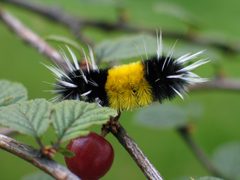
Lophocampa maculata is a tiger moth in the Erebidae, commonly known as the spotted tussock despite not being a true tussock moth (family ). The was first described by Harris in 1841. fly from May to July with one per year. The caterpillar is notable for its distinctive coloration: black at both ends with a yellow or orange middle section marked with black spots in some . The species is found across Canada, the western United States, and southward in the Appalachians to South Carolina and Kentucky.
Pronunciation
How to pronounce Lophocampa maculata: //ˌloʊfoʊˈkæmpə ˌmækjuˈleɪtə//
These audio files are automatically generated. While they are not always 100% accurate, they are a good starting point.
Identification
can be distinguished from similar tiger moths by the combination of tan forewings with irregular dark spotting and pale yellow hindwings. The caterpillar is highly distinctive: the black-yellow-black banded pattern with tufts of hair separates it from most other North American caterpillars. Similar Lophocampa argentata (silver-spotted tiger moth) has more uniform silver-gray forewings with sharper markings. True tussock moths (Orgyia spp., ) have different adult and larval hair arrangements. Lophocampa caryae (hickory tussock moth) has predominantly white caterpillars with black tufts.
Images
Habitat
Deciduous and mixed forests, woodlands, and riparian areas. Associated with tree including poplars, willows, alders, basswoods, birches, maples, and oaks. are attracted to light. Elevation range extends from lowlands to montane forests, including subalpine areas in parts of its range.
Distribution
North America: across Canada from British Columbia to the Atlantic provinces; western United States including Pacific Northwest, Rocky Mountains, and Great Basin region; southward in the Appalachian Mountains to South Carolina and Kentucky; southeastern Alaska. Three recognized: L. m. maculata (widespread), L. m. agassizii (California, British Columbia), and L. m. texana (Texas).
Seasonality
fly from May to July, with peak activity varying by latitude and elevation. Larvae present from July to September. One per year (). stage not explicitly documented in sources but inferred to be pupal or based on typical arctiine .
Diet
Larva feeds on leaves of broadleaf trees and shrubs: Populus (poplars, aspens), Salix (willows), Alnus (alders), Tilia (basswoods/lindens), Betula (birches), Acer (maples), and Quercus (oaks). feeding habits not documented in sources.
Host Associations
- Populus - larval foodplantpoplars, aspens
- Salix - larval foodplantwillows
- Alnus - larval foodplantalders
- Tilia - larval foodplantbasswoods, lindens
- Betula - larval foodplantbirches
- Acer - larval foodplantmaples
- Quercus - larval foodplantoaks
Life Cycle
Complete with four stages: , larva, pupa, . Larva passes through five instars. Single per year. Larval development July–September. presumably in silk cocoon among leaf litter or on plant, though specific details not documented in sources. Adults emerge following spring.
Behavior
are and attracted to light. Larvae are solitary feeders on foliage. The 'tussock ' refers to the caterpillar's hair tufts, but this does not exhibit the gregarious or defensive hair-flicking of true tussock moths in .
Ecological Role
Larva functions as a folivore (leaf-feeder) in deciduous forest . Defoliation is typically localized and not economically significant. Serves as prey for various and ; documented for the ichneumon Therion morio, which parasitizes the caterpillar and emerges from the 's pupal stage. may contribute to pollination through incidental contact with flowers.
Human Relevance
Caterpillar's distinctive appearance makes it a frequently encountered and photographed . Occasionally mistaken for stinging caterpillars due to hair tufts, but not known to possess urticating spines. No significant economic impact as a pest; minor defoliator of ornamental and forest trees. Scientific interest due to relationships and as a model for studying tiger moth chemical .
Similar Taxa
- Lophocampa argentataSilver-spotted tiger moth; similar size and distribution but has more uniform silver-gray forewings with sharper, more regular markings; caterpillar has different color pattern.
- Lophocampa caryaeHickory tussock moth; caterpillar predominantly white with black tufts, not yellow-banded; forewings more uniformly light brown.
- Orgyia spp.True tussock moths ( ); have reduced wings in females, different overall ; larvae have distinct hair arrangement with paired tussocks and pencil tufts.
Misconceptions
The 'tussock ' is misleading: this is a tiger moth (Arctiinae), not a true tussock moth (). The hair tufts on the caterpillar resemble those of true tussock moths but the evolutionary relationship is distant. Some sources suggest the caterpillar may cause skin irritation, but it lacks the urticating spines characteristic of genuinely hazardous caterpillars like those in Euproctis or Megalopyge.
More Details
Nomenclature
First described by Thaddeus William Harris in 1841. The specific epithet 'maculata' refers to the spotted appearance. Three are recognized based on geographic distribution and subtle morphological differences.
Chemical ecology
As a tiger moth, likely produces defensive compounds (e.g., or other secondary metabolites) sequestered from plants or synthesized de novo, though specific compounds not documented for this in available sources.
Parasitoid relationships
Documented for Therion morio (Ichneumonidae), a that attacks caterpillars and emerges from the pupal stage of the .
Sources and further reading
- BugGuide
- Wikipedia
- GBIF taxonomy match
- iNaturalist taxon
- NCBI Taxonomy
- Catalogue of Life
- Bug Eric: Blodgett Peak Bioblitz Report
- Bug Eric: July 2011
- Be careful around baldfaced hornets, Dolichovespula maculata — Bug of the Week
- An inside look at baldfaced hornets, Dolichovespula maculata — Bug of the Week
- High fiber diets for baldfaced hornets? Nah, construction materials for enlarging nests: Baldfaced hornets, Dolichovespula maculata — Bug of the Week
- Bug Eric: Window-winged Moths