
Lophocampa caryae
Harris, 1841
Hickory Tussock Moth, Hickory Halisidota, Hickory Tiger Moth
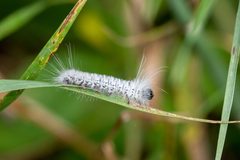
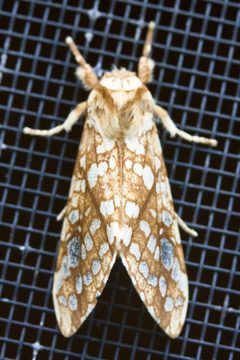
Lophocampa caryae is a tiger moth in the Erebidae, widely distributed across eastern North America. The has one per year, with flying in May and June. The caterpillar is covered in dense white and black hair tufts and can cause contact dermatitis in humans through its barbed setae. Despite anecdotal claims of venomous properties, no venom has been isolated; adverse reactions are characterized as irritant contact dermatitis.
Pronunciation
How to pronounce Lophocampa caryae: //ˌloʊfoʊˈkæmpə ˈkɛriˌeɪ//
These audio files are automatically generated. While they are not always 100% accurate, they are a good starting point.
Identification
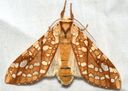
distinguished by yellowish-brown forewings with distinctive white stained-glass patterning and mostly white hindwings. Larvae recognized by dense white hair tufts with contrasting black tufts and four prominent black hair pencils (two , two ). The black-spotted sides and black capsule further aid identification. Similar to other Lophocampa but association and geographic range help differentiate.
Images
Habitat
Associated with deciduous forests containing hickory, pecan, walnut, and related tree . Larvae feed on foliage of trees; pupae overwinter in leaf litter.
Distribution
Widely distributed in the eastern half of North America.
Seasonality
fly in May and June. Later-instar caterpillars observed between July and October. One per year.
Diet
Larvae primarily feed on hickory (Carya), pecan, and walnuts (Juglans). Also recorded feeding on ash, elm, oak, willow, and other plants.
Host Associations
- Carya - primary hickory
- Juglans - primary walnut
- Fraxinus - secondary ash
- Ulmus - secondary elm
- Quercus - secondary oak
- Salix - secondary willow
Life Cycle
One per year. hatch into larvae that feed gregariously in early instars, skeletonizing leaves in groups of approximately 100. Older larvae become solitary. Larvae pupate in loose cocoons woven with setae, which overwinter in leaf litter. emerge in spring.
Behavior
Early-instar larvae feed in groups of approximately 100 individuals, skeletonizing leaves. Older larvae are solitary. Larval setae are microscopically barbed and can detach easily.
Ecological Role
Herbivore that occasionally causes local defoliation of nut trees, though high densities typically do not persist long enough to cause significant damage. Serves as prey for various .
Human Relevance
Caterpillar setae cause itchy rashes (contact dermatitis) in many people, particularly those prone to allergies. Reactions may resemble urushiol exposure. Setae can rarely cause serious medical complications if transferred from hands to . Over 350 documented cases showed most were asymptomatic within 24 hours with no anaphylaxis. Despite claims of venom, no venom has been isolated; reactions are irritant contact dermatitis, not envenomation.
Similar Taxa
- Lophocampa maculataSimilar spotted tussock moth appearance; distinguished by different associations and geographic overlap
- Other Lophocampa speciesShare general tussock ; require examination of color pattern details and plants for separation
Misconceptions
Widely but incorrectly believed to be venomous. Despite anecdotal claims, no venom has been isolated or identified from this . Adverse reactions to larval setae are properly characterized as irritant contact dermatitis caused by mechanical irritation from barbed hairs, not envenomation.
More Details
Medical significance
Over 350 documented cases of human exposure exist in medical literature. Most cases resolve within 24 hours without serious complications. Rare complications involve exposure from hand transfer of setae.
Defensive adaptations
Aposematic coloration and suggest chemical protection in larvae, though alkaloid or other chemical analyses have not been performed. Related in Arctiinae acquire chemical defenses from plants.
Sources and further reading
- BugGuide
- Wikipedia
- GBIF taxonomy match
- iNaturalist taxon
- NCBI Taxonomy
- Catalogue of Life
- Gall darn it! Gall insects on hickory, oak, and elm, Phylloxera caryaecaulis, Andricus palustris, Colopha ulmicola — Bug of the Week
- When is a locust borer not a locust borer? | Beetles In The Bush
- Bug Eric: Blodgett Peak Bioblitz Report
- Bug Eric: February 2009
- Pseudoscorpiones | Beetles In The Bush
- Megacyllene comanchei revisited | Beetles In The Bush