
Loxostege
Hübner, 1825
webworms, meadow moths
Species Guides
20- Loxostege albiceralis(Tan-edge Loxostege)
- Loxostege allectalis(Wolfberry Loxostege Moth)
- Loxostege anartalis
- Loxostege brunneitincta
- Loxostege cereralis(Alfalfa Webworm)
- Loxostege commixtalis(alfalfa webworm)
- Loxostege ephippialis
- Loxostege floridalis(Christmas-berry webworm moth)
- Loxostege immerens
Loxostege is a of in the Crambidae, commonly known as webworms or meadow moths. The genus includes economically significant agricultural pests, particularly L. sticticalis (beet webworm/meadow moth), which is a causing substantial crop damage across North America, Europe, and Asia. Species in this genus exhibit complex including larval , long-distance capabilities, and high reproductive potential. Many species are characterized by dynamics with cyclic explosions.
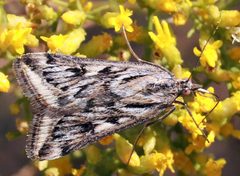
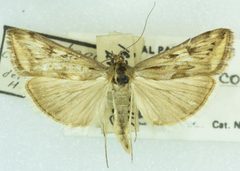
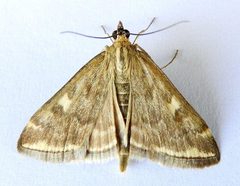
Pronunciation
How to pronounce Loxostege: //lɒkˈsɒstɪdʒi//
These audio files are automatically generated. While they are not always 100% accurate, they are a good starting point.
Images
Habitat
Agricultural fields, meadows, and areas with abundant herbaceous vegetation; includes cultivated crops such as sugar beet, corn, potato, cotton, tobacco, alfalfa, clover, pea, sunflower, vegetables, and grains; also colonizes field edges, roadsides, and uncultivated areas with wild plants including Chenopodium and Convolvulus. Larvae of diapausing overwinter in soil cocoons near the surface.
Distribution
Holarctic distribution encompassing North America, Europe, and Asia. Documented from Canada (Alberta, Ontario), United States (widespread including Vermont, Montana, Colorado), Mexico, Northern Europe (Denmark, Norway, Sweden), and across Eurasia including Russia, Ukraine, Mongolia, China, Turkey, Iraq, and Azerbaijan. Some show transcontinental patterns.
Diet
Larvae are herbivores feeding on over 250 plant . Major include sugar beet, corn, potato, cotton, tobacco, alfalfa, clover, peas, sunflower, barley, wheat, sorghum, rapeseed, flax, grapes, melons, gourds, and various vegetables. feed on nectar and compete with such as honey bees for floral resources.
Life Cycle
Complete with variable time depending on latitude and temperature. Development includes , larva (typically 5-6 instars), pupa (in soil cocoon), and stages. Generations per year range from 1 in cold regions to 3-4 in southern areas. Embryonic development: 7-15 days at 28°C. Larval stage: 10-30 days (14-17 days at optimal 25-30°C). : 14-30 days. Adult lifespan: 4-20 days (typically 4-5 weeks). Larval occurs in response to short-day ; larvae cold- to -30°C.
Behavior
Mass cycles occur every 6-10 years. Two distinct strategies: active for 20-25 km seeking flowering plants and oviposition sites, and passive long-distance via air currents up to 900-1000 km. are and , hiding in dense vegetation during hot sunny days. Adults easily disturbed during daytime. Young larvae web leaves together; older larvae feed openly and are highly mobile, capable of migrating between fields.
Ecological Role
Major agricultural pest causing 50-100% crop loss during mass . Serves as for diverse natural enemies including (Braconidae, Ichneumonidae), tachinid flies, parasitoids (Trichogamma), and predatory mites. Preyed upon by birds and ground beetles (Carabidae). Competition with honey bees for nectar resources may reduce honey yields.
Human Relevance
Significant economic impact as agricultural pest; L. sticticalis added to China's National Class I list of crop insect pests in 2020. Subject of research including agents, -based monitoring, and resistance studies. Pheromone chemistry characterized for and trapping programs. Climate change may be expanding frequency and geographic range.
Sources and further reading
- BugGuide
- GBIF taxonomy match
- iNaturalist taxon
- NCBI Taxonomy
- Catalogue of Life
- Bug Eric: Wasp Wednesday: Euodynerus annulatus
- Bug Eric: August 2012
- A Dangerous Polyphagous Pest of Agricultural Crops, the Meadow Moth (Loxostege sticticalis L.) in Azerbaijan
- Functional Characterization of Pheromone Receptors in the Beet Webworm, Loxostege sticticalis (Lepidoptera: Pyralidae)
- DATA ON THE DISTRIBUTION OF MEADOW MOTH LOXOSTEGE (MARGARITIA) COMMIXTALIS (LEPIDOPTERA: PYRALOIDEA, PYRAUSTIDAE) IN EASTERN PALAEARCTIC
- İklim Değişikliği, Düzce'de Çayır tırtılı ( Loxostege sticticalis L.)’nın Birinci Nesil Kelebeklerinin Salgınına Neden Oldu Climate change caused an epidemic of first generation butterflies of the Meadow moth (Loxostege sticticalis L.) in Duzce
- The biology of Phytodietus pulcherrimus (Cress.) (Ichneumonidae, Tryphoninae) parasitic of Loxostege sticticalis L. in North America
- The Biology of the Parasites of Loxostege sticticalis, L., in North America—Meteorus loxostegei, Vier. (Braconidae, Meteorinae)
- The Biology of the Parasites of Loxostege sticticalis, L., in North America—Bracon vulgaris (Cress.) (Braconidae, Agathinae)
- Comparison of distinct gut bacterial communities in different stage of prediapause and nondiapause larvae in Loxostege sticticalis
- The Effect of Certain Climatic Factors on the Distribution of the Beet Webworm (Loxostege Sticticalis L.) In North America
- Larval diapause enhances the flight capacity in postdiapause adults of beet webworm, Loxostege sticticalis (Lepidoptera: Pyralidae)
- New data on the ultrastructure of Tubulinosema loxostegi Malysh, Tokarev et Issi, 2013 (Microsporidia) and genetic divergence of T. loxostege isolates†
- Growth, Development and Reproduction of Meadow Moth Loxostege sticticalis Fed on Pea Seedlings Grown Under Elevated CO2
- Analysis of Sublethal and Lethal Effects of Chlorantraniliprole on Loxostege sticticalis Based on Age-Stage, Two-Sex Life Table
- Juvenile hormone changes associated with diapause induction, maintenance, and termination in the beet webworm, Loxostege sticticalis (lepidoptera: pyralidae)
- Suitability of webworm Loxostege sticticalis L. (Lepidoptera: Crambidae) eggs for consumption by immature and adults of the predatory mite Neoseiulus pseudolongispinosus (Xin, Liang and Ke) (Acarina: Phytoseiidae)
- Aerial Trajectories and Meteorological Drivers of Transboundary Loxostege sticticalis Migration Across Northern China and Mongolia, 2022.