
Estigmene
Hübner, 1820
Ermine Moths
Species Guides
2- Estigmene acrea(Salt Marsh Moth)
- Estigmene albida
Estigmene is a of tiger moths in the Erebidae, erected by Jacob Hübner in 1820. in this genus are native to North and Central America. The genus has undergone taxonomic revision, with many African and Asian species formerly included now separated into different genera. The most well-known species is Estigmene acrea, commonly called the saltmarsh caterpillar or woollybear, which is a widespread herbivore and occasional agricultural pest.
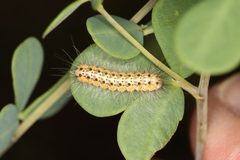
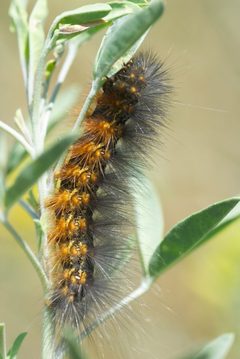
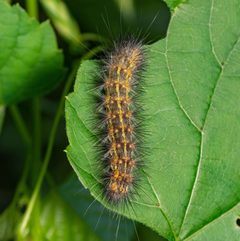
Pronunciation
How to pronounce Estigmene: /ɛˈstɪɡməˌni/
These audio files are automatically generated. While they are not always 100% accurate, they are a good starting point.
Identification
Members of Estigmene can be distinguished from related tiger moth by genitalia characteristics and wing venation patterns. typically have white or pale wings with dark spotting or patterning. Larvae are densely hairy ('woolly'), with variable coloration ranging from yellow to orange to black depending on and instar. E. acrea larvae are distinguished from the banded woolly bear (Pyrrharctia isabella) by their lack of distinct black bands and more uniform orange or yellow coloration.
Images
Habitat
Open fields, meadows, agricultural areas, and disturbed where plants grow. Larvae are commonly found on low-growing herbaceous vegetation.
Distribution
North and Central America. The is native to this region, with E. acrea specifically recorded throughout the United States, extending to Central America and southern Canada (Ontario and Quebec).
Seasonality
are active during warmer months. In temperate regions, larvae are most commonly observed in late summer and autumn, often seen dashing across roads and paths seeking sites. E. acrea appears to be (one per year) in northern parts of its range, with adults emerging in August.
Diet
Larvae are herbivores feeding on a broad range of woody and herbaceous plants. E. acrea has been documented feeding on dandelion (Taraxacum), plantain, violets, cherry, honeysuckle, and various agricultural crops including corn, sugarbeet, and field beans.
Life Cycle
Complete with , larva, pupa, and stages. E. acrea eggs hatch in approximately 6 days. Larvae feed through spring, summer, and autumn, as partially grown caterpillars. In spring, they resume feeding briefly before pupating. The from egg to adult takes about 6 weeks under favorable conditions. Adults emerge in mid to late summer.
Behavior
Larvae are and often seen actively moving across open ground in autumn seeking sheltered sites beneath logs, stones, or leaf litter. females exhibit calling ( release) during the scotophase (dark period), with peak calling activity between 4-6 hours and again at 10 hours after dark onset. Males form where they display inflated abdominal coremata to attract females. Mated females produce significantly less pheromone than virgin females. Larvae show food-aversion learning capabilities, avoiding plants that have previously caused illness.
Ecological Role
Larvae serve as prey for various and . E. acrea is a known for the ichneumon Therion morio, a parasitoid that lays in caterpillars. The functions as a herbivore in early successional and agricultural .
Human Relevance
E. acrea is occasionally a pest of agricultural crops including corn, sugarbeet, and field beans, particularly in the southern United States. The saltmarsh caterpillar is also known for its winter weather folklore, though unlike the banded woolly bear, it lacks predictive banding patterns. The has been widely used in entomological research on chemical , , and insect-plant interactions.
Similar Taxa
- Pyrrharctia isabellaBoth are tiger moth larvae with dense hair covering; P. isabella has distinct black bands at and tail with orange band in middle, while Estigmene acrea lacks this banded pattern and is more uniformly colored.
- Hypercompe scriboniaBoth are large, hairy tiger moth caterpillars; H. scribonia is entirely black with crimson rings between body segments when disturbed, while E. acrea is typically orange or yellow without black bands.
- Spilosoma virginicaBoth are tiger moths with hairy larvae; S. virginica larvae are yellow with black stripes and longer, softer hair compared to the denser, shorter hair of E. acrea.
Misconceptions
The saltmarsh caterpillar (E. acrea) is sometimes mistaken for the banded woolly bear (Pyrrharctia isabella) in winter weather folklore. Unlike the banded woolly bear, whose orange band width is claimed to predict winter severity, the uniformly orange or yellow saltmarsh caterpillar has no such predictive value. The 'saltmarsh caterpillar' is somewhat misleading as the is not restricted to salt marsh but occurs broadly in fields, meadows, and agricultural areas.
Sources and further reading
- BugGuide
- Wikipedia
- GBIF taxonomy match
- iNaturalist taxon
- NCBI Taxonomy
- Catalogue of Life
- Managing Insect Pests of Texas Sunflowers - AgriLife Extension Entomology
- Dashing caterpillars predicting weather and preparing for winter: Banded woolly bear, Pyrrharctia Isabella, Giant woolly bear, Hypercompe scribonia, and Saltmarsh caterpillar, Estigmene acrea — Bug of the Week
- Dashing caterpillars predicting weather- Woolly bears, Pyrrharctia isabella, saltmarsh caterpillar, Estigmene acrea, and leopard moths, Hypercompe scribonia — Bug of the Week
- Bug Eric: Blodgett Peak Bioblitz Report
- Archive — Bug of the Week
- Bug Eric: Wasp Wednesday: Therion morio
- Saltmarsh Caterpillar, Estigmene acrea (Drury) (Insecta: Lepidoptera: Arctiidae)
- Protease activity associated with the capsule protein of Estigmene acres granulosis virus
- NOTES ON THE LIFE HISTORY OF ESTIGMENE PRIMA SLOSSON.
- Male Lek Formation and Female Calling in a Population of the Arctiid Moth Estigmene acrea
- Food‐aversion learning in two polyphagous caterpillars, Diacrisia virginica and Estigmene congrua
- An Artificial Diet for Rearing the Salt Marsh Caterpillar, Estigmene acrea (Lepidoptera: Arctiidae), with Notes on the Biology of the Species12
- Behavioral Responses of Larvae and Adults ofEstigmene acrea(Lepidoptera: Arctiidae) to Light of Different Wavelengths
- Loss of gustatory responses to pyrrolizidine alkaloids after their extensive ingestion in the polyphagous caterpillar Estigmene acrea
- Diel periodicity and influence of age and mating on female sex pheromone titre in Estigmene acrea (Lep., Arctiidae)