
Hypercompe scribonia
(Stoll, 1790)
Giant Leopard Moth, Great Leopard Moth, Giant Woolly Bear (larval stage), Black Woolly Bear (larval stage), Eyed Tiger Moth
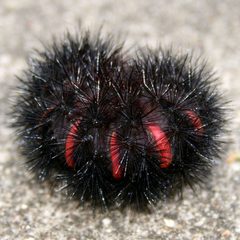
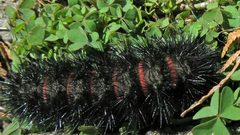
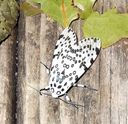
Hypercompe scribonia, the giant leopard , is the largest eastern tiger moth in North America. are striking white moths with black circular spots and bars, while larvae are known as giant woolly bears—large, densely hairy black caterpillars with red rings visible between body segments when curled. The is , with males frequently attracted to lights. Larvae overwinter and complete development in spring, feeding on a broad range of herbaceous and woody plants.
Pronunciation
How to pronounce Hypercompe scribonia: /haɪˈpɜr.kɒm.pi ˌskrɪˈboʊ.ni.ə/
These audio files are automatically generated. While they are not always 100% accurate, they are a good starting point.
Identification
distinguished from other tiger moths by large size and distinctive white wings with black circular and linear markings. Larva identified by solid black hair coat (no orange band), large size, and red intersegmental rings visible when curled defensive. Differs from banded woolly bear (Pyrrharctia isabella) which has alternating black and orange bands; from saltmarsh caterpillar (Estigmene acrea) which may be orange or yellow and lacks dense black hair; from yellow woolly bear (Spilosoma virginica) which is yellow or tan.
Images
Habitat
Found in diverse including meadows, fields, and areas with mixed herbaceous and woody vegetation. associated with areas where larval plants occur. Males aggregate at bright lights in suitable habitat.
Distribution
Widespread across eastern and southern North America: southern Ontario, New England, eastern and southern United States, Mexico, and Panama. Present in Vermont and throughout eastern US.
Seasonality
active nocturnally, primarily in warmer months. Larvae most visible in late summer and autumn when they leave feeding sites to seek shelter. Overwinter as larvae; resume feeding briefly in spring before .
Diet
Larvae feed on diverse woody and herbaceous plants including dandelion (Taraxacum), plantain (Plantago), violets (Viola), cherry (Prunus), and honeysuckle (Lonicera). feeding habits not explicitly documented.
Life Cycle
laid on vegetation hatch into larvae that feed through spring, summer, and autumn. Larvae do not pupate in autumn; instead they seek protected locations (under logs, stones, loose bark, or leaf litter) to overwinter. In spring, larvae resume brief feeding, spin cocoon, and pupate. emerge to complete cycle. Single per year inferred from larval stage.
Behavior
Larvae exhibit defensive curling : when disturbed, roll into tight ball presenting dense spines and revealing red intersegmental rings as aposematic display. ; males strongly attracted to artificial lights, sometimes appearing in large numbers at bright lights in good .
Ecological Role
Larval herbivore contributing to nutrient cycling through plant consumption. Defensive suggests role in aposematic coloration studies. pollination potential not documented.
Human Relevance
Subject of winter weather folklore (incorrectly, as solid black coloration was misinterpreted as severe winter harbinger). Popular among naturalists for striking appearance and distinctive larval defenses. Occasionally encountered in residential areas when larvae seek sites. No economic significance documented.
Similar Taxa
- Pyrrharctia isabella (banded woolly bear/Isabella tiger moth)Larva has alternating black and orange-brown bands rather than solid black; smaller; different defensive posture.
- Estigmene acrea (saltmarsh caterpillar)Larva variable in color (orange, yellow, black) but lacks dense uniform black hair coat; associated with salt marshes and weedy areas; does not curl into tight spiny ball.
- Spilosoma virginica (yellow woolly bear/Virginia tiger moth)Larva predominantly yellow or tan with black hairs, not solid black; different coloration.
Misconceptions
Larva was historically confused with banded woolly bear in winter weather prediction folklore. Solid black coloration was misinterpreted as predicting severe winters, but this is a different with no meteorological predictive ability. The orange band width in Pyrrharctia isabella is actually age-related (older larvae have wider orange bands), not weather-related.
More Details
Taxonomic History
Formerly placed in , now classified in Arctiinae of family Erebidae. Obsolete name Ecpantheria scribonia occasionally encountered in older literature.
Cryoprotection
Like other woolly bear caterpillars, larvae survive winter through supercooling and production of cryoprotectants (glycerol, sorbitol) that prevent lethal ice crystal formation, allowing survival below freezing temperatures.
Sources and further reading
- BugGuide
- GBIF taxonomy match
- iNaturalist taxon
- NCBI Taxonomy
- Catalogue of Life
- UC Davis Lecture by Science Journalist Richard Harris: Why You Shouldn't Miss This | Bug Squad
- Bug Squad
- Stylish Lepidoptera: Ermine Moth, Atteva aurea; Yellow-Collared Scape Moth, Cisseps fulvicollis; Pearl Crescent, Phyciodes tharos; Variegated Fritillary, Euptoieta claudia — Bug of the Week
- Archive — Bug of the Week
- Dashing caterpillars predicting weather- Woolly bears, Pyrrharctia isabella, saltmarsh caterpillar, Estigmene acrea, and leopard moths, Hypercompe scribonia — Bug of the Week
- Dashing caterpillars predicting weather and preparing for winter: Banded woolly bear, Pyrrharctia Isabella, Giant woolly bear, Hypercompe scribonia, and Saltmarsh caterpillar, Estigmene acrea — Bug of the Week
- Giant Woolly Bear (larva), Giant or Great Leopard Moth (adult) Hypercompe scribonia (Stoll 1790) (Lepidoptera: Erebidae: Arctiinae)