
Arctia parthenos
Harris, 1850
St. Lawrence tiger moth
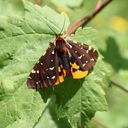
Arctia parthenos, commonly known as the St. Lawrence tiger , is a medium-sized moth in the Erebidae. It was first described by Thaddeus William Harris in 1850. The inhabits North America across a broad latitudinal range from Alaska to Labrador, with southern extensions into the Rocky and Appalachian Mountains. are active from late May to early August with one per year. The larvae feed on woody plants including willow, alder, and birch.
Pronunciation
How to pronounce Arctia parthenos: //ˈɑːrk.ti.ə ˈpɑːr.θə.nɒs//
These audio files are automatically generated. While they are not always 100% accurate, they are a good starting point.
Identification
Forewing length of 28–33 mm distinguishes this from some smaller relatives. The combination of distribution, riparian and mixed forest preference, and period from late May to early August provides diagnostic context. Formerly placed in Platarctia, this species was transferred to Arctia based on molecular and morphological studies that consolidated several related .
Images
Habitat
Riparian areas and mixed hardwood-conifer forests at middle to high elevations. The shows affinity for moist forested environments associated with watercourses and transitional zones between deciduous and coniferous vegetation.
Distribution
North America from Alaska to Labrador, extending southward to New Mexico and Arizona in the Rocky Mountains and to North Carolina in the Appalachian Mountains.
Seasonality
are on wing from late May until early August. The has one per year ().
Diet
Larvae feed on various plants including Salix (willow), Alnus (alder), and Betula (birch) .
Host Associations
- Salix - larval foodplantwillow
- Alnus - larval foodplantalder
- Betula - larval foodplantbirch
Life Cycle
Complete with , larva, pupa, and stages. One per year. Specific details of egg-laying , larval instar number, site, and stage are not documented in available sources.
Similar Taxa
- Other Arctia speciesFormerly separated in the Platarctia, A. parthenos was synonymized with other Arctia based on phylogenetic studies that demonstrated the paraphyly of the previously recognized genera Platarctia, Acerbia, Pararctia, Parasemia, and Platyprepia.
More Details
Taxonomic History
This was formerly classified in the Platarctia. It was transferred to Arctia along with species from the genera Acerbia, Pararctia, Parasemia, Platarctia, and Platyprepia based on integrated molecular and morphological studies that demonstrated these genera were not monophyletic.
Conservation Status
Not assessed in major conservation listings. The has a broad geographic range and appears to maintain stable in suitable .