
Arctiina
Genus Guides
5- Apantesis(tiger moths)
- Arctia(tiger moths)
- Chelis(tiger moths)
- Sonorarctia
- Virbia(Virbia Moths)
Arctiina is a subtribe of tiger moths within the Erebidae, historically treated as the tribe Arctiini before taxonomic reclassification lowered its rank while retaining its content. The subtribe contains approximately 5 valid following extensive synonymization in 2016, with distributed across the Palaearctic and Neotropical regions. Members exhibit classic tiger moth characteristics including aposematic coloration and, in males, eversible androconial glands (coremata) used for during courtship.
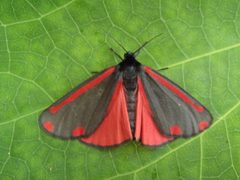
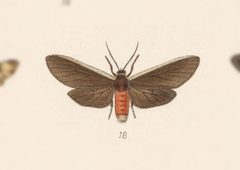
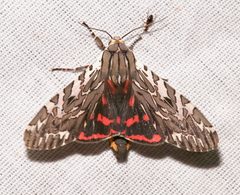
Pronunciation
How to pronounce Arctiina: /ɑrkˈtiː.ɪnə/
These audio files are automatically generated. While they are not always 100% accurate, they are a good starting point.
Identification
Arctiina can be distinguished from other subtribes within Arctiini by morphological criteria including genitalia structure and wing venation patterns, though definitive identification often requires dissection and/or . The subtribe was historically defined by the Arctia and allies, but generic boundaries remain provisional pending ongoing taxonomic revision. From similar tiger moth subtribes: Arctiina lacks the specialized crystal found in some Phaegopterina, and differs from Lithosiini in forewing venation and male genitalia structure. Species-level identification is complicated by extensive geographic variation and cryptic diversity, as demonstrated in the Arctia villica complex where molecular data revealed multiple cryptic species.
Images
Habitat
vary by and . The type genus Arctia occurs in steppe, grassland, and open woodland habitats across the Palaearctic. In the Neotropics, Arctiina species have been documented in lowland rainforest, including disturbed agricultural sites, regenerating secondary forest, and old-growth forest, with vertical stratification from understorey to .
Distribution
Palaearctic: Europe, North Africa, Asia Minor, Caucasus, Transcaucasia, northern Iran, and steppe belt to southwestern Siberia. Neotropical: documented from Chocó Rainforest in northwest Ecuador. Individual show restricted distributions: Arctia angelica is to the Iberian Peninsula and North Africa; Arctia konewkaii is restricted to Sicily.
Behavior
Males of at least some evert androconial glands (coremata) during courtship to disperse ; these glands are inflated by air or blood pressure and have been likened to aphrodisiacs that communicate male to females. In Arctia and related , males sequester or cardiac glycosides from larval plants, incorporating these toxins into their bodies and converting them into pheromone components that demonstrate genetic quality to prospective mates.
Similar Taxa
- PhaegopterinaFormerly included Euerythra and Kodiosoma, now transferred to Phaegopterina; distinguished by different morphological characteristics and, in some , presence of novel crystal at androconial organs.
- LithosiiniAnother tribe within Arctiinae; differs in forewing venation, male genitalia structure, and typically more cryptic coloration. The Chocó Rainforest study found Lithosiini had only 26% of formally described versus 82% in the more conspicuous Pericopina, indicating different ecological strategies.
- PericopinaNeotropical subtribe with higher description rate (82%) due to conspicuous aposematic coloration; differs in distribution and morphological features from the primarily Palaearctic Arctiina.
More Details
Taxonomic History
The subtribe underwent significant rank changes in recent reclassifications: the was lowered to Arctiinae within Erebidae; original subfamilies became tribes; and the original tribe Arctiini became the subtribe Arctiina. This triggered cascading suffix changes in . The 2016 study by Rönkä et al. synonymized 33 into 5 valid genera, substantially reducing generic diversity.
Research Significance
Arctiina serves as an important group for studying delimitation, with the Arctia villica complex demonstrating that traditional morphospecies concepts can obscure cryptic diversity. (COI marker) has proven effective for species delimitation in this group, with interspecific divergences of 2.0–3.5% distinguishing valid species.
Sources and further reading
- BugGuide
- Wikipedia
- iNaturalist taxon
- Sheep Moths Draw Attention at Bohart Museum of Entomology Open House | Bug Squad
- Oh, What a (Moth) Night This Will Be! A Conversation With Bohart's Lepidoptera Curator Jeff Smith | Bug Squad
- “Candy” Scales Discovered in Dozens of Moth Species
- Bug Eric: Wasp Wednesday: Not Wasp VIII
- Bug Eric: October 2017
- Nota Lepidopterologica welcomes new Editor-in-Chief Marcin Wiorek
- Illustrated Catalogue and Phylogenetic Relationships of 330 Species of Arctiinae Moth Species from the Chocó Rainforest in NW Ecuador: Most Species are Undescribed.
- DNA barcoding and morphology reveal European and western Asian Arctiavillica (Linnaeus, 1758) as a complex of species (Lepidoptera, Erebidae, Arctiinae).