
Euproctis chrysorrhoea
(Linnaeus, 1758)
Brown-tail Moth
Euproctis chrysorrhoea, the brown-tail , is a forest pest with a highly larval stage. exhibit phenological plasticity, with larval timing and winter feeding varying based on plant foliage persistence. The demonstrates sequential host plant utilization during mass and shows evidence of host-associated genetic divergence. Larvae possess urticating setae that pose human health risks.
Pronunciation
How to pronounce Euproctis chrysorrhoea: /juːˈprɒktɪs krɪsɔːˈriːə/
These audio files are automatically generated. While they are not always 100% accurate, they are a good starting point.
Identification
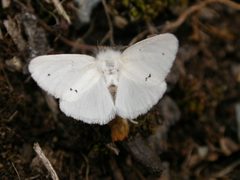
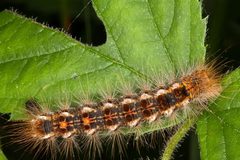
identified by white wings and conspicuous brown hair tuft at tip. Larvae distinguished from similar lymantriine by paired tufts of and dark coloration with white stripes. Distinguished from Lymantria dispar by smaller size, different hair tuft arrangement, and preference for younger foliage. Microscopic examination of genitalia may be required for definitive identification in some regions.
Images
Appearance
have white wings with a brownish tipped with conspicuous golden-brown hairs, giving the its . Larvae are dark with white longitudinal stripes and possess numerous urticating (stinging) hairs arranged in tufts along the body. Full-grown larvae reach approximately 30 mm in length.
Habitat
Primarily associated with forested and semi-forested environments. Found in oak-dominated woodlands, mixed deciduous forests, and areas with fruit tree . on evergreen (Arbutus unedo) occupy Mediterranean scrub and maquis vegetation. Occurs from sea level to montane elevations, with local to host plant .
Distribution
Native to Palearctic region: Europe (widespread from Scandinavia to Mediterranean), North Africa (Algeria, Morocco, Mauritania, Tunisia), and Asia (Turkey, Iran, Syria, China, Japan, Korea, Sakhalin). Introduced to North America (northeastern USA, eastern Canada), where established occur in Maine and adjacent regions. Present in Belgium, Netherlands, Germany, France, Spain, Portugal, Italy, and throughout Central and Eastern Europe.
Seasonality
with one per year. laid in July; egg stage lasts approximately one month. Larval stage extends nine months, with as young larvae. occurs in spring for approximately one month. typically in July, though delayed emergence has been observed in dry conditions. on evergreen Arbutus unedo exhibit shifted with winter feeding from October to March.
Diet
Highly folivore. Larvae feed on diverse woody plants including oak (Quercus), elm (Ulmus), poplar (Populus), hawthorn (Crataegus), and fruit trees (Prunus, Malus). During mass , exhibits sequential plant utilization, switching between in a defined order as preferred hosts become depleted or pressure increases. On evergreen strawberry tree (Arbutus unedo), larvae engage in winter feeding with arrested development during a true period of approximately two months.
Host Associations
- Quercus - larval primary , major damage in oak forests
- Ulmus - larval deciduous with typical
- Populus - larval recorded
- Crataegus - larval recorded
- Prunus - larval fruit tree
- Arbutus unedo - larval evergreen with shifted and winter feeding
Life Cycle
Complete with four stages: , larva, pupa, . Eggs laid in clusters on foliage. Larvae pass through multiple instars over nine months, typically entering as young larvae in autumn. in silken cocoon on plant or in ground litter. Adults non-feeding, short-lived. time one year. exhibit cyclical dynamics with 4-6 year cycles reported.
Behavior
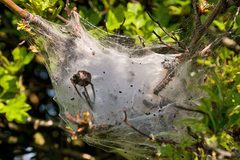
Larvae are gregarious, particularly in early instars, and construct silken webs for shelter. Sequential plant switching occurs during , with larvae moving between plant in a predictable order. Winter feeding observed on evergreen hosts represents a true with arrested development, not continuous feeding. Larval by ballooning on silk threads has been reported. are and attracted to light.
Ecological Role
Defoliator of broadleaf trees and shrubs; can function as pest causing significant forest damage. Serves as for diverse including and flies. Microsporidian (Nosema, Endoreticulatus) regulate in some regions. Provides food source for insectivorous birds including storks, starlings, and finches. contribute to anti- defense and may affect vertebrate foraging.
Human Relevance
Significant forest and orchard pest causing economic damage to timber, fruit, and ornamental trees. Urticating larval hairs cause dermatitis, respiratory irritation, and allergic reactions in humans and livestock, necessitating caution during management. Subject to efforts using bird conservation and release. Chemical control complicated by resistance development and non-target effects on and beneficial insects. Subject to and management efforts in invaded North American range.
Similar Taxa
- Lymantria disparSimilar lymantriine with larvae; distinguished by larger size, different larval color pattern (blue and red rather than dark with white stripes), and more pronounced in
- Euproctis similisCongeneric with similar appearance; requires genitalia examination or molecular analysis for definitive separation
- Sphrageidus similisFormerly confused with E. chrysorrhoea; distinguished by and larval hair arrangement
More Details
Host race formation
Evidence suggests sympatric -associated genetic divergence, with on different host plants exhibiting phenological differences and potential reproductive isolation. Populations on evergreen Arbutus unedo show shifted compared to those on deciduous hosts, yet retain common communication systems.
Population dynamics
typically develop from rather than external . Severity correlates with including drought and temperature. range expands with outbreak intensity, following a predictable sequence of plant utilization.
Phenotypic plasticity
Larval development on evergreen versus deciduous demonstrates local to host plant . Presence of foliage is a key driver of phenological shifts, with winter feeding on evergreen hosts accompanied by a true period rather than continuous development.
Sources and further reading
- BugGuide
- GBIF taxonomy match
- iNaturalist taxon
- NCBI Taxonomy
- Catalogue of Life
- Euproctis chrysorrhoea . [Distribution map].
- Euproctis chrysorrhoea . [Distribution map].
- Die Reihenfolge der Wirtspflanzen beim Massenauftreten von Euproctis chrysorrhoea L.
- IMPACTS OF EUPROCTIS CHRYSORRHOEA ON OAK FORESTS IN ARMENIA. FEEDING BEHAVIOR, DEFOLIATION PATTERNS, AND IMPLICATIONS FOR FOREST VULNERABILITY
- Euproctis chrysorrhoea Linnaeus, 1758 (Lepidoptera: Lymantriidae) biology and determination of damage Yedisu, Bingöl, Türkiye
- Common pheromone use among host-associated populations of the browntail moth, Euproctis chrysorrhoea, displaying different adult phenologies
- Parasitoids Attacking the Browntail Moth, Euproctis chrysorrhoea (Lepidoptera: Erebidae), during a Regional Outbreak in Maine, and Factors Influencing Their Abundance
- Genetic divergence and evidence for sympatric host-races in the highly polyphagous brown tail moth, Euproctis chrysorrhoea (Lepidoptera: Erebidae)
- Winter feeding leads to a shifted phenology in the browntail moth Euproctis chrysorrhoea on the evergreen strawberry tree Arbutus unedo
- First report on the distribution of microsporidian infections of browntail moth (Euproctis chrysorrhoea L.) populations in Bulgaria*
- Differences in Midgut Phosphatases Activity and Hemolymph Composition in Lymantria dispar and Euproctis chrysorrhoea Larvae Exposed to the Polycyclic Aromatic Hydrocarbon Fluoranthene.