
Meteorus
Haliday, 1835
Species Guides
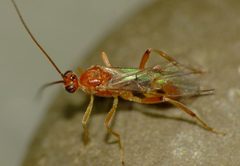
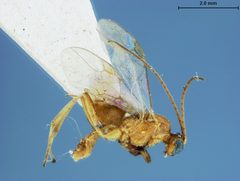
1Meteorus is a large of in the Braconidae, comprising over 330 described worldwide. These wasps are distinguished from other braconids by two key morphological features: a second submarginal in the forewing and a (stalked) first tergite. The genus includes species with remarkable behavioral adaptations, such as Meteorus stellatus, which constructs star-shaped communal cocoon masses suspended by threads up to 1 meter long. Meteorus species function as agents, parasitizing diverse insects including caterpillars of and beetles.

Pronunciation
How to pronounce Meteorus: /mɛˈteɪərəs/
These audio files are automatically generated. While they are not always 100% accurate, they are a good starting point.
Identification
Meteorus is distinguished from other braconid by two consistent wing and abdominal characters: the forewing possesses a second submarginal (a feature not found in most other braconids), and the first tergite of the is , meaning it is constricted at the base into a stalk-like structure. These traits allow reliable genus-level identification even when -level characters are ambiguous.
Images
Habitat
vary by . Meteorus corax has been recorded from standing dead pine and firewood. Meteorus stellatus occurs in subtropical environments of the Ryukyu Islands. Many species are associated with agricultural and forest where their insects are present.
Distribution
Worldwide distribution with over 330 described. Documented from Finland and Russian Karelia (M. corax), Ecuador (M. desmiae), the Ryukyu Islands of Japan (M. stellatus), and North America including Florida (M. autographae).
Host Associations
- Pyralidae - for multiple Meteorus
- Noctuidae - Includes soybean looper (Chrysodeixis includens) as for M. autographae
- Sphingidae - Hawk moth larvae serve as for M. stellatus
- Cerambycidae - Monochamus galloprovincialis and Callidium violaceum recorded as for M. corax
- Pythidae - Pytho depressus recorded as for M. corax; first parasitic hymenopteran recorded from this
Life Cycle
Larvae develop as endoparasitoids inside insects, consuming the host from the inside. Upon completing feeding, larvae emerge and spin cocoons. In M. stellatus, larvae form communal star-shaped cocoon masses (7–14 mm wide, 9–23 mm long, containing over 100 cocoons) suspended by a thread up to 1 meter in length, rather than individual cocoons.
Behavior
Some exhibit gregarious cocoon construction . Meteorus stellatus larvae cooperatively build star-shaped pendulous cocoon masses, with the spherical arrangement reducing exposed surface area of individual cocoons and the suspending thread providing protection from ground-dwelling such as ants. have been observed escaping from larvae and immediately initiating cocoon construction.
Ecological Role
Primary of herbivorous insects, contributing to natural of and larvae. Serve as biocontrol agents in agricultural systems. Some may be attacked by hyper-parasitoids (parasitoids of parasitoids), against which communal cocoon structures appear to provide defense.
Human Relevance
Used as agents for agricultural pests, particularly against cabbage pests and soybean loopers in soybean production. The star-shaped cocoon masses of M. stellatus have attracted scientific and public interest due to their unusual .
Similar Taxa
- Other BraconidaeMeteorus is distinguished by the combination of a second submarginal in the forewing and a first tergite; most other braconids lack one or both of these features.
More Details
Species diversity
The contains over 330 described , with new species continuing to be discovered and described, including M. stellatus from Japan (2021) and new species from Ecuador associated with Pyralidae .
Cocoon structure evolution
The star-shaped communal cocoon masses of M. stellatus represent a derived behavioral trait whose evolutionary origins remain unresolved; researchers have identified this as a priority for future investigation.
Sources and further reading
- BugGuide
- Wikipedia
- iNaturalist taxon
- NCBI Taxonomy
- Catalogue of Life
- Journal of Hymenoptera Research | Blog - Part 3
- biodiversity | Blog - Part 22
- new species | Blog - Part 15
- Bug Eric: Winter 'pillars
- <i>Meteorus corax</i> Marshall, 1898 (Hymenoptera: Braconidae), a new species to Finland and Russian Karelia, with an overview of northern species of <i>Meteorus</i> parasitizing beetles
- Wasp Parasitoid Meteorus autographae Muesebeck (Insecta: Hymenoptera: Braconidae)
- MeteorusHaliday (Hymenoptera: Braconidae) parasitoids of Pyralidae: description and biology of two new species and first record ofMeteorus desmiaeZitani, 1998 from Ecuador