
Chrysodeixis includens
(Walker, 1858)
Soybean Looper Moth, Soybean Looper, Falso Medidor
Chrysodeixis includens, the soybean looper , is a significant agricultural pest in the Noctuidae. The derives its from its preferred plant (soybean, Glycine max) and the characteristic looping movement of its larvae. Native to the Americas, it ranges from southern Canada through the United States to Central and South America, the Caribbean, and the Galápagos Islands. The species is migratory and has expanded its economic importance in recent decades, becoming established in Brazil and Argentina where it has developed resistance to multiple .
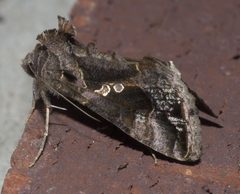
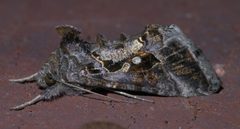
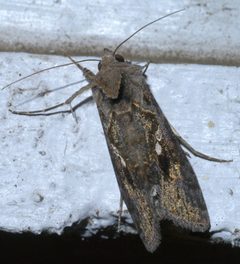
Pronunciation
How to pronounce Chrysodeixis includens: /ˌkɹɪsəˈdeɪksɪs ɪnˈkluːdɛnz/
These audio files are automatically generated. While they are not always 100% accurate, they are a good starting point.
Identification
can be distinguished from the similar Rachiplusia nu (sunflower looper) by wing pattern: C. includens has two separated spots on the forewings, while R. nu has two joined kidney-shaped spots. Larvae of the two are morphologically similar but can be distinguished by shape (R. nu has a more triangular spinneret, C. includens more conical), though this requires dissection. In practice, R. nu larvae often appear darker with a smoky-blue cast compared to the bright yellow-green of C. includens, and R. nu shows distinct patches of tiny black asperites on the thoracic venters not apparent in C. includens. C. includens larvae have three pairs of , distinguishing them from true inchworms (Geometridae) which have only two pairs.
Images
Habitat
Primarily agricultural , especially soybean fields. Also found in other cultivated areas supporting its broad plant range. The has been observed in alfalfa, flax, sunflower, and various vegetable crop systems.
Distribution
Native to the Americas. Found from southern Quebec and southern Ontario through the eastern and southern United States to Central America, South America, the Antilles, and the Galápagos Islands. Established occur throughout Brazil and northern Argentina, where it has become an increasingly important pest in recent years. The is known to be migratory.
Seasonality
are on wing from April to November depending on location. In temperate regions, multiple occur during the growing season. In subtropical and tropical regions, continuous breeding is possible.
Diet
Highly . Larvae feed on foliage of numerous plant across multiple . Primary include Glycine max (soybean), Phaseolus vulgaris (common bean), Gossypium hirsutum (cotton), Nicotiana tabacum (tobacco), Solanum lycopersicum (tomato), Brassica oleracea, Lactuca sativa (lettuce), Helianthus annuus (sunflower), Zea mays (maize), Medicago sativa (alfalfa), Arachis hypogaea (peanut), and many others. Young larvae typically feed on lower leaf surfaces between , creating "window pane" damage; older larvae consume entire tissues while avoiding veins, resulting in skeletonized foliage.
Host Associations
- Glycine max - primary Preferred ; larvae feed on foliage, causing significant defoliation
- Phaseolus vulgaris - Larvae feed on foliage
- Gossypium hirsutum - Larvae feed on foliage
- Nicotiana tabacum - Larvae feed on foliage
- Solanum lycopersicum - Larvae feed on foliage
- Helianthus annuus - Larvae feed on foliage
- Medicago sativa - Larvae feed on foliage
Life Cycle
are laid on leaf undersides, primarily in middle or upper . Larvae pass through five instars; early instars have black capsules, second instars light brown, later instars lightly colored with distinct bristles. Larvae display characteristic looping movement due to reduced number (three pairs). occurs in soil or leaf litter. Multiple per year in favorable climates. Developmental rate varies with temperature, instar, and larval weight.
Behavior
Larvae exhibit characteristic looping locomotion due to having only three pairs of , arching the body to bring the rear prolegs forward to meet the thoracic legs. Young larvae feed on lower leaf between ; older larvae skeletonize leaves by consuming tissue while avoiding vascular bundles. are and migratory. Females exhibit clear oviposition preferences for position based on plant growth stage.
Ecological Role
Significant agricultural pest causing defoliation and yield loss in soybean and other crops. Serves as for multiple including Trichogramma spp. ( parasitoids), Microplitis demolitor and Copidosoma floridanum (larval parasitoids), and Tetrastichus howardi (pupal parasitoid). Preyed upon by including Podisus maculiventris (spined soldier bug) and Tadarida brasiliensis (Mexican free-tailed bat). influenced by fungi under moist conditions.
Human Relevance
Major economic pest of soybean in North and South America. Larval feeding causes defoliation and yield reduction; damage thresholds exceed approximately 15% foliage loss during reproductive stages. Has developed resistance to most used for control, complicating management. Subject of research using (ChinNPV), (Steinernema carpocapsae), and conservation. Bt-traited soybeans have been developed for management. Misidentification with similar (especially Rachiplusia nu) leads to control failures due to differing susceptibilities.
Similar Taxa
- Rachiplusia nuLarval extremely similar; distinguished by joined versus separated forewing spots; larvae distinguished by shape and subtle coloration differences; differs in susceptibility and geographic distribution
- Trichoplusia ni (cabbage looper)Larval similar with three pairs; distinguished by preferences and geographic patterns; C. includens has black true legs, different capsule coloration in early instars
- Anticarsia gemmatalis (velvetbean caterpillar)Co-occurs in soybean; distinguished by having five pairs of (not looping), different (flattened spherical, pinkish with age), and different larval coloration and movement
- Spodoptera spp. (armyworms)Co-occur in soybean; distinguished by four pairs of , presence of pinaculae with stout setae, and different capsule markings
- Helicoverpa zea (soybean podworm)Co-occurs in soybean; distinguished by larger size, different (barrel-shaped, laid on multiple plant parts including pods), and pod-feeding in addition to foliage feeding
Sources and further reading
- BugGuide
- Wikipedia
- GBIF taxonomy match
- iNaturalist taxon
- NCBI Taxonomy
- Catalogue of Life
- Scientists Reveal New Method to Characterize Physiological Responses to Parasitism | Bug Squad
- ID Challenge #14 | Beetles In The Bush
- “Sunflower looper” – Rachiplusia nu | Beetles In The Bush
- Noctuidae | Beetles In The Bush | Page 2
- A Revision of Soybean Caterpillar Pest Information for U.S. Soybean
- owlet moths | Beetles In The Bush
- Chrysodeixis includens nucleopolyhedrovirus (ChinNPV) Affects on Immature Stages of Chrysodeixis includens (Lepidoptera: Noctuidae)
- Soybean Looper Chrysodeixis includens (Walker) (Insecta: Lepidoptera: Noctuidae)
- Host plants of Chrysodeixis includens (Walker) (Lepidoptera, Noctuidae, Plusiinae)
- Parasitism of Tetrastichus howardi (Ollif, 1893) (Hymenoptera: Eulophidae) on Chrysodeixis includens (Walker, [1858]) (Lepidoptera: Noctuidae) pupae at different ages
- Population dynamics, vertical distribution and natural parasitism of eggs ofChrysodeixis includensbyTrichogrammaspp.in soybean
- Sublethal effects of Bacillus thuringiensis biopesticides and insecticides combinations on Chrysodeixis includens larvae: insights on pest management
- Generation of Variability in Chrysodeixis includens Nucleopolyhedrovirus (ChinNPV): The Role of a Single Variant
- Partial Life History ofChrysodeixis includens(Lepidoptera: Noctuidae) on Summer Hosts
- The Effects of Adjuvants on Steinernema Carpocapsae Efficacy Against Chrysodeixis Includens and Suspension Stability.