
Trichoplusia ni
(Hübner, 1803)
Cabbage Looper Moth, Cabbage Looper
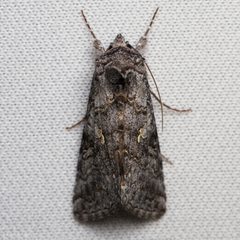
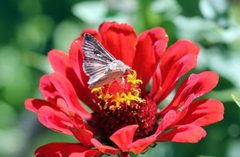
The () is a noctuid whose larvae are significant agricultural pests of cruciferous vegetables and other crops. The derives its from the larva's distinctive looping locomotion, caused by having only two pairs of abdominal rather than the typical four. are medium-sized brownish moths with a silvery figure-eight or Y-shaped marking on the forewings. The species has a broad distribution and is particularly problematic in commercial vegetable production due to its feeding habits and capacity for rapid growth.
Pronunciation
How to pronounce Trichoplusia ni: /ˌtrɪkoʊˈplusiə ˈnaɪ/
These audio files are automatically generated. While they are not always 100% accurate, they are a good starting point.
Identification
distinguished from similar Plusiinae by the silvery figure-eight marking on forewings (more complete than in Chrysodeixis ). Larvae distinguished from soybean looper (Chrysodeixis includens) by mandibular ridges that extend fully to the edge of the (visible with hand lens); soybean looper ridges stop short of the edge. Distinguished from other loopers by green coloration with white lateral stripes and black thoracic legs. Geometrid caterpillars have only two total and different structure.
Images
Habitat
Agricultural fields, gardens, and weedy areas where plants occur. Thrives in cultivated environments with abundant brassicaceous crops. are and attracted to lights.
Distribution
distribution; native to Europe, now found worldwide including North America, Central and South America, Asia, Africa, and Australia. Present throughout temperate and tropical regions where suitable plants grow.
Seasonality
Multiple per year in most regions; continuous breeding possible in warm climates. active year-round in subtropical areas; peak activity in spring through fall in temperate zones. Overwinters as pupae in soil or plant debris in colder regions.
Diet
Larvae are foliage feeders with strong preference for Brassicaceae (cruciferous vegetables): cabbage, broccoli, cauliflower, kale, bok choy, Brussels sprouts, collards, and mustard. Also feeds on lettuce, spinach, tomato, potato, beets, peas, celery, and numerous weeds including wild mustard and shepherd's purse. feed on nectar from various flowers.
Host Associations
- Brassica oleracea - larval food plantcabbage, broccoli, cauliflower, kale, Brussels sprouts
- Brassica rapa - larval food plantturnip, bok choy
- Lactuca sativa - larval food plantlettuce
- Spinacia oleracea - larval food plantspinach
- Solanum lycopersicum - larval food planttomato
Life Cycle
Complete . laid singly on underside of leaves. Larvae pass through five to six instars over 2-4 weeks. occurs in silken cocoon on soil surface. time approximately 3-4 weeks under favorable conditions; multiple generations per year. Overwinters as pupa in temperate climates.
Behavior
Larvae are primarily feeders, hiding in leaf axils or soil during daylight. Characteristic looping locomotion due to reduced —larva arches middle body upward when moving, creating a loop shape. When disturbed, larvae may drop from plants on silken threads. are strong fliers, nocturnal, and readily attracted to artificial light sources.
Ecological Role
Significant herbivore in agricultural and natural ; larvae consume large quantities of leaf tissue. Serves as prey for , predatory insects, and birds. function as when feeding on nectar.
Human Relevance
Major agricultural pest causing substantial economic damage to vegetable crops worldwide. Larval feeding reduces yield and renders produce unmarketable. Subject to extensive research. lines derived from this (Tn-5, High Five cells) are widely used in biotechnology for recombinant protein production and research. Resistance to multiple classes has been documented.
Similar Taxa
- Chrysodeixis includensSoybean looper; larvae nearly identical in appearance and , distinguished only by mandibular ridge structure visible under magnification. have less complete silvery marking on forewings.
- Autographa californicaAlfalfa looper; similar looping larvae and wing pattern, but larvae have small on segments 3 and 4 that lacks.
- Chrysodeixis eriosomaGreen garden looper; similar appearance and habits, distinguished by wing markings and larval mandibular structure.
More Details
Biotechnology Importance
lines, particularly Tn-5 (derived from ovarian tissue) and its clonal derivative High Five, are among the most widely used insect cell lines for recombinant protein production using expression systems. These cell lines enable complex post-translational modifications not possible in bacterial systems.
Insecticide Resistance
have developed resistance to multiple chemical classes including , , and carbamates, complicating management in commercial agriculture. Resistance management is a major focus of research.
Sources and further reading
- BugGuide
- GBIF taxonomy match
- iNaturalist taxon
- NCBI Taxonomy
- Catalogue of Life
- Soybean Insects: Mid-to-Late Season Pests (V8 to Maturity) - AgriLife Extension Entomology
- What's Not to Love About 'Boys' Night Out'? | Bug Squad
- New Insect Cell Line Database to Help Researchers Across the Globe
- ID Challenge #14 | Beetles In The Bush
- NIAs - are we Improving Nature? - Buglife Blog - Buglife
- Nitro-Nosh: Why Termites' Molted Exoskeletons Never Go to Waste