
Autographa californica
(Speyer, 1875)
Alfalfa Looper
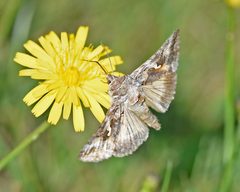
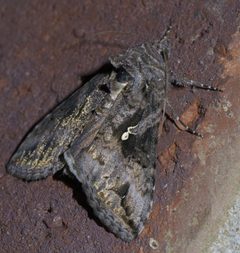
Autographa californica, the alfalfa looper, is a in the Noctuidae, Plusiinae. It is a widespread agricultural pest in western North America, recognized by its looping larval locomotion and broad polyphagy. The species was first described by Adolph Speyer in 1875. are medium-sized moths with wingspans of 36–42 mm, flying from July to October. Larvae are notable for having on abdominal segments 5 and 6 but lacking them on segments 3 and 4, producing the characteristic looping gait.
Pronunciation
How to pronounce Autographa californica: /ɔːˈtɒɡrəfə kælɪˈfɔːrnɪkə/
These audio files are automatically generated. While they are not always 100% accurate, they are a good starting point.
Identification
Distinguished from geometrid loopers (inchworms) by having on two abdominal segments (5 and 6) rather than one or two at the end; geometrids typically have only segments 4 and 6 or 5 and 6 with reduced prolegs. Separated from related noctuid loopers such as Chrysodeixis includens (soybean looper) and Trichoplusia ni (cabbage looper) by subtle differences in larval capsule patterning, body markings, and wing patterns; precise identification often requires examination of adult genitalia or molecular methods. Adults recognized by the characteristic silvery stigma on the forewing and overall size.
Images
Habitat
Found in diverse environments including agricultural fields, rangelands, gardens, and natural vegetation . Associated with areas supporting its broad plant range. are and attracted to light.
Distribution
Western North America from southern British Columbia through Washington, Oregon, and California to Baja California; eastward to Manitoba, South Dakota, Colorado, and New Mexico. Also recorded in Oceania (likely introduced).
Seasonality
fly from July to October, with timing varying by latitude and elevation. Multiple per year in favorable climates.
Diet
Larvae are highly , feeding on plants across at least 25 including Apiaceae, Asteraceae, Brassicaceae, Cucurbitaceae, Fabaceae, Malvaceae, Rosaceae, Solanaceae, and many others. Specific recorded include alfalfa (Medicago sativa), beans, beets, clover, lettuce, peas, potatoes, squash, and numerous wild and cultivated . diet not specified in sources.
Host Associations
- Medicago sativa - larval food plant source; major agricultural
- Phaseolus vulgaris - larval food plantBeans
- Pisum sativum - larval food plantPeas
- Solanum tuberosum - larval food plantPotatoes
- Cucurbita spp. - larval food plantSquash and related crops
- Beta vulgaris - larval food plantBeets
- Lactuca sativa - larval food plantLettuce
- Trifolium spp. - larval food plantClover
Life Cycle
Holometabolous complete : , larva (5–6 instars), pupa, . Larvae pupate in soil or leaf litter. Multiple per year; overwinters as pupa or possibly adult depending on climate. Specific developmental rates and stage not detailed in sources.
Behavior
Larvae exhibit characteristic looping locomotion due to reduced number, arching the body to bring the prolegs forward to meet the thoracic legs. feeding habit in larvae. are nocturnal, attracted to light sources.
Ecological Role
Significant agricultural pest due to broad range and larval feeding damage. Serves as prey for and . may contribute to pollination, though this role is not well documented.
Human Relevance
Major economic pest of alfalfa, beans, lettuce, and numerous vegetable and field crops. Larval feeding causes defoliation and direct damage to marketable plant parts. Subject to programs including , cultural practices, and selective use. "alfalfa looper" derives from association with alfalfa .
Similar Taxa
- Chrysodeixis includensAlso a noctuid looper with similar larval and looping gait; historically confused with A. californica. Distinguished by wing patterns and larval capsule markings.
- Trichoplusia niCabbage looper, another plusiine noctuid with similar and appearance. have different forewing pattern; larvae often with more distinct lateral stripes.
- Pseudoplusia includensSynonym of Chrysodeixis includens; same distinguishing features apply.
More Details
Taxonomic note
The was originally described as Plusia gamma var. californica by Speyer in 1875, later elevated to species status and transferred to Autographa. The Autographa is characterized by the distinctive silvery or white stigma on the forewing, resembling a written signature.
Research significance
The name Autographa californica is also associated with Autographa californica multiple (AcMNPV), a widely used in , biotechnology, and insect culture (Sf9 cells derived from Spodoptera frugiperda). This virus is a model system for baculovirus and protein expression, though the natural relationship with A. californica itself is not the primary research focus; the virus has broader host range in noctuids.
Sources and further reading
- BugGuide
- Wikipedia
- GBIF taxonomy match
- iNaturalist taxon
- NCBI Taxonomy
- Catalogue of Life
- The Big 43: The California Native Plants, Plus One, Studied in UC Davis Research | Bug Squad
- Bohart Museum: Learn about California's State Insect on UC Davis Picnic Day | Bug Squad
- A Mural Like No Other | Bug Squad
- A Flash of Orange: Welcome, California Tortoiseshell! | Bug Squad
- California Dogface Butterfly: What the Fire Did | Bug Squad
- ID Challenge #14 | Beetles In The Bush
- Identification of the nucleolar localization signal in Autographa californica multiple nucleopolyhedrovirus multifunctional protein Ac16.