
Autographa
Hübner, 1821
Looper moths, Plusiine moths
Species Guides
15- Autographa ampla(Large Looper Moth)
- Autographa bimaculata(Two-spotted Looper Moth)
- Autographa californica(Alfalfa Looper)
- Autographa corusca(Caramel Looper)
- Autographa flagellum(Silver Whip Moth)
- Autographa labrosa
- Autographa mappa(Wavy Chestnut Y Moth)
- Autographa metallica(Shaded Gold Spot)
- Autographa pasiphaeia
Autographa is a of noctuid in the Plusiinae, commonly known as looper moths. The genus includes with distinctive wing markings, including the Silver Y (A. gamma), a notable long-distance migrant in Europe. Autographa species have caterpillars that feed on diverse herbaceous plants, with some species considered agricultural pests.
Pronunciation
How to pronounce Autographa: /ɔːˈtɒɡrəfə/
These audio files are automatically generated. While they are not always 100% accurate, they are a good starting point.
Identification
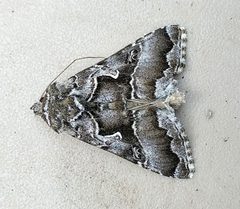
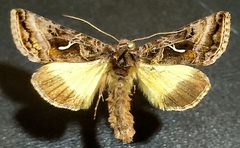
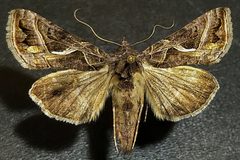
Distinguished from similar Plusiinae (Chrysodeixis, Trichoplusia) by specific wing pattern details: Autographa gamma has a distinct silver Y-shaped mark on forewing; A. californica shows mottled brown/gray forewings without prominent Y. From Geometridae loopers: Autographa larvae have three pairs of (segments 5–6 plus anal), versus two pairs in geometrids. rest with wings folded tent-like or flat depending on .
Images
Habitat
Diverse open including agricultural fields, gardens, meadows, and disturbed areas. Associated with herbaceous vegetation for larval feeding. often found nectaring at flowers.
Distribution
Holarctic distribution with greatest diversity in North America and Eurasia. Records from Denmark, Norway, Sweden, Vermont (USA), and broader North American range. Individual vary: A. gamma is widespread in Europe; A. californica ranges from southern British Columbia to Baja California and east to Manitoba, South Dakota, Colorado, and New Mexico.
Seasonality
active primarily spring through autumn depending on and latitude. A. californica adults observed in California from March onward. A. gamma undergoes long-distance in Europe with peak activity varying by region.
Life Cycle
Complete : → larva ( caterpillar) → pupa → . Larvae feed on leaves of herbaceous plants; occurs in silken cocoon. Multiple per year in favorable climates.
Behavior
of some (e.g., A. californica) are semi- to quite , flying and nectaring during daylight hours. Adults are capable but somewhat awkward fliers. Some species (notably A. gamma) are renowned long-distance migrants, traveling hundreds to thousands of kilometers.
Ecological Role
Larvae function as herbivores on diverse plants. serve as when nectaring. Migratory contribute to nutrient and transfer across regions. Larvae are prey for and .
Human Relevance
Several are agricultural pests: A. californica (alfalfa looper) and A. gamma (Silver Y) feed on crops including alfalfa, beans, lettuce, artichoke, cotton, and tomatoes. A. californica is often mistaken for cabbage looper (Trichoplusia ni). Subject of scientific research: A. californica multiple (AcMNPV) is an important model used in insect culture and biotechnology.
Similar Taxa
- Chrysodeixis includens (soybean looper)Formerly placed in Plusia/Pseudoplusia; similar larvae and wing patterns. Distinguished by specific forewing markings and larval coloration.
- Trichoplusia ni (cabbage looper)Similar and larval looping ; have different forewing pattern with more uniform coloration. Larvae often confused in agricultural settings.
- Geometridae (geometer moths)Larvae also called 'loopers' or 'inchworms' but have only two pairs of versus three in Autographa; typically rest with wings spread flat or folded vertically, not tent-like.
More Details
Migration biology
Autographa gamma (Silver Y) is one of Europe's most studied migratory . Mass have been documented, including an incident where large numbers entered Stade de Paris during a 2016 football match. Migration helps escape unfavorable conditions and colonize new areas.
Viral research importance
Autographa californica multiple (AcMNPV), first isolated from this , is the most widely used expression system (BEVS) for recombinant protein production in biotechnology. The virus has been extensively studied for its , though most laboratory work uses cultured Spodoptera frugiperda (fall armyworm) rather than Autographa .
Sources and further reading
- BugGuide
- Wikipedia
- GBIF taxonomy match
- iNaturalist taxon
- NCBI Taxonomy
- Catalogue of Life
- Do Moths Usually Land with Their Wings Down? | Bug Squad
- In the Loop--on the Mustard | Bug Squad
- Bug Squad
- Insect Migration (Part 1) - Buglife Blog - Buglife
- Mudo Pryfed (Rhan 1) - Buglife Blog - Buglife
- ID Challenge #14 | Beetles In The Bush
- Identification of the nucleolar localization signal in Autographa californica multiple nucleopolyhedrovirus multifunctional protein Ac16.