
Plusia
Ochsenheimer, 1816
Species Guides
5- Plusia contexta(Connected Looper Moth)
- Plusia magnimacula(Large-spotted Looper Moth)
- Plusia nichollae(West Coast Plusia)
- Plusia putnami(Putnam's Looper Moth)
- Plusia venusta(White-streaked Looper Moth)
Plusia is a of in the Noctuidae, Plusiinae. in this genus are commonly known as loopers or plusias. The genus includes several agricultural pest species whose larvae feed on various crop plants. are typically and exhibit specific mating including female release and wing fanning. Some species display migratory behavior in young adults.
Pronunciation
How to pronounce Plusia: /ˈpluːsiə/
These audio files are automatically generated. While they are not always 100% accurate, they are a good starting point.
Identification
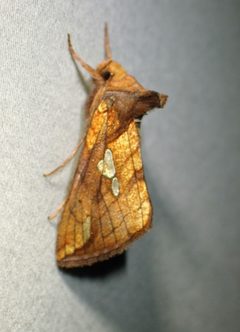
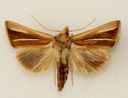
Larvae have three pairs of on abdominal segments 3-6, distinguishing them from geometrid caterpillars which have only two pairs. This characteristic looping gait gives the "loopers" to many . typically have a wingspan of 30-40 mm with characteristic silver or gold markings on the forewings, including a distinctive Y-shaped or spot-like pattern. Specific species identification requires examination of genitalia or molecular markers.
Images
Distribution
Records from Denmark, Norway, Sweden, Vermont (USA), and other locations in the United States. Individual have wider distributions: Plusia gamma occurs across Europe and parts of Asia; Plusia chalcites has been recorded in Europe and North Africa; Plusia festucae occurs in Europe.
Behavior
activity shows circadian patterns with lowered light thresholds for flight during the first three days after . Mating involves complex courtship: females protrude the and fan their wings while settled; males approach from below, fan wings, and touch the female with before moving alongside; females curve the abdomen toward the male to enable copulation. Peak mating activity occurs approximately two hours before light onset under laboratory conditions. Calling behavior ( release) in females is restricted to specific time windows and shows in pheromone titre.
Human Relevance
Several are significant agricultural pests. Larvae feed on soybean, tomato, alfalfa, cabbage, and other crops, causing defoliation and economic damage. Plusia chalcites (tomato looper) and related species are targets for programs. Bt-traited crops have been developed to manage these pests.
Similar Taxa
- ChrysodeixisFormerly included now placed in Chrysodeixis; Chrysodeixis includens (soybean looper) was historically classified as Pseudoplusia includens. Molecular and morphological differences in genitalia structure distinguish the .
- TrichoplusiaTrichoplusia ni (cabbage looper) is morphologically similar and shares the looper larval form with three pairs of ; distinguished by specific wing pattern markings and male genitalia characteristics.
- AutographaAutographa (including A. californica, alfalfa looper) are similar in appearance and ; distinguished by forewing pattern details and genitalia . Some Autographa species have leg structures on segments 3 and 4 that Plusia lacks.
Sources and further reading
- BugGuide
- GBIF taxonomy match
- iNaturalist taxon
- NCBI Taxonomy
- Catalogue of Life
- Optical coherence tomography scan: Plusia festucae, "gold spot" moth eye - Entomology Today
- ID Challenge #14 | Beetles In The Bush
- Mating behavior of the three spotted plusia, Plusia agnata Staudinger (lepidoptera:noctuidae).
- FLIGHT ACTIVITY OF PLUSIA GAMMA IN THE LABORATORY
- Sexual behaviour and pheromone titre in the tomato looper, Plusia chalcites (Esp.) (Lepidoptera: Noctuidae)
- The genome sequence of the Golden Plusia, Polychrysia moneta (Fabricius, 1787) (Lepidoptera: Noctuidae).
- Chromosome-level genome assembly of Ctenoplusia agnata and its potential application in Plusiinae pest management.
- The genome sequence of the Gold Spot moth, Plusia festucae (Linnaeus, 1758).