
Anticarsia gemmatalis
Hübner, 1818
Velvetbean Caterpillar, Velvetbean Moth, Velvetbean Caterpillar Moth
Anticarsia gemmatalis is a tropical whose larvae are among the most significant lepidopteran pests of soybean throughout the Americas. The undergoes northward from tropical areas, reaching as far north as Wisconsin in the United States. Larvae feed on foliage of leguminous crops, with velvet bean, soybean, and peanut being primary . The species has been studied in spaceflight experiments, where moths reared in microgravity exhibited altered compared to earth-reared individuals.
Pronunciation
How to pronounce Anticarsia gemmatalis: /ˌæntɪˈkɑːrʃə dʒɛmˈmætəlɪs/
These audio files are automatically generated. While they are not always 100% accurate, they are a good starting point.
Identification
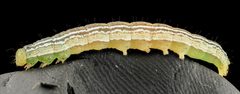
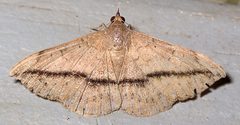
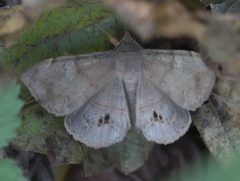
Larvae distinguished from similar noctuid caterpillars by : when disturbed, they regurgitate a brownish substance, spring into the air, and exhibit vigorous writhing movements. resemble other brown noctuids but can be identified by the distinctive zigzag wing pattern combined with association with legume . are intermediate in size among common soybean lepidopteran pests and uniquely flattened-spherical in shape.
Images
Habitat
Agricultural and natural areas supporting leguminous plants. In North America, primarily soybean fields in the lower Mississippi River delta and southeastern Coastal Plain. In South America, occurs across nearly the entire soybean production region. Also found on velvet bean, peanut, and wild legumes including kudzu.
Distribution
Native to tropical and subtropical Americas. reaches Gulf Coast states of USA, with sporadic occurrence north to Wisconsin. Established throughout South America from Argentina to Brazil. Overwinters in tropical regions.
Seasonality
migrate northward from tropical areas as temperatures permit. Multiple occur during growing season in temperate zones. Activity ceases with onset of winter in northern parts of range.
Diet
Larvae are folivores feeding on leguminous plants. Documented include: velvet bean (Mucuna pruriens), soybean (Glycine max), peanut (Arachis hypogaea), cotton (Gossypium hirsutum), kudzu (Pueraria montana), alfalfa (Medicago sativa), cowpea (Vigna unguiculata), horse bean (Vicia faba), snap bean (Phaseolus vulgaris), lima bean (Phaseolus lunatus), and coffeeweed (Sesbania spp.).
Host Associations
- Glycine max - larval food plantPrimary economic ; major pest of soybean throughout New World
- Mucuna pruriens - larval food plantOriginal derived from this
- Arachis hypogaea - larval food plantSignificant pest of peanut in southern USA
- Pueraria montana - larval food plantWild supporting in non-crop areas
Life Cycle
Holometabolous with complete . laid singly on undersides of leaves throughout . Larvae pass through five instars feeding on foliage. occurs in soil. Multiple per year in favorable climates. Optimal egg viability at 25°C; higher temperatures reduce viability based on laboratory observations across three generations.
Behavior
Larvae exhibit distinctive defensive when disturbed: regurgitation of brownish fluid, jumping or springing into air, and vigorous writhing movements. are and attracted to light. reared in microgravity during spaceflight experiments used wings primarily for gliding rather than powered , in contrast to earth-reared moths that flapped wings actively.
Ecological Role
Major herbivore in agricultural . Larvae function as primary consumers converting plant . Serve as prey for including predatory stink bugs (Podisus maculiventris, Euthyrhynchus floridanus) and other natural enemies. can cause significant defoliation and yield loss in soybean and peanut production.
Human Relevance
Significant agricultural pest causing economic damage to soybean, peanut, and other legume crops. Subject of extensive research on resistance and . Has been studied in NASA spaceflight experiments examining effects of microgravity on insect and development. references historical importance as pest of velvet bean .
Similar Taxa
- Chrysodeixis includensSoybean looper is co-occurring noctuid pest of soybean with similar larval and damage . Distinguished by looping locomotion, smaller more spherical (~10,000 per gram), and lack of defensive jumping . Eggs laid preferentially in middle to upper rather than distributed throughout.
- Spodoptera frugiperdaFall armyworm occasionally feeds on soybean seedlings. Distinguished by masses covered with and setae rather than single eggs, and larvae with distinctive white inverted Y on and four pinaculae per abdominal segment.
- Helicoverpa zeaSoybean podworm feeds on soybean pods in addition to foliage, causing direct seed damage. Distinguished by larger barrel-shaped (~3,500 per gram) laid on all plant parts including pods and stems, not just leaf undersides.
More Details
Spaceflight Research
Anticarsia gemmatalis was among insect studied on NASA missions to examine effects of microgravity on . that eclosed in space exhibited fundamentally altered flight strategy, using wings as gliders with minimal flapping rather than powered flight. This demonstrated developmental plasticity in response to gravitational environment.
Temperature and Climate Effects
Laboratory studies indicate viability is maximized at 25°C with reduced to higher temperatures over three . This thermal sensitivity suggests complex responses to climate change: potential reduction in tropical areas already at optimal temperature, but range expansion and increased damage in currently cooler regions warming toward 25°C.
Global Distribution
While a major pest throughout the Americas, the has more recently been recorded in other regions. In Africa, it has been reported from Nigeria and potentially other West African countries, though establishment status in these areas requires confirmation.
Sources and further reading
- BugGuide
- Wikipedia
- GBIF taxonomy match
- iNaturalist taxon
- NCBI Taxonomy
- Catalogue of Life
- A Revision of Soybean Caterpillar Pest Information for U.S. Soybean
- Noctuidae | Beetles In The Bush | Page 2
- Bugs in Orange and Black, Part II: A spooky southern predator heads north in a warming world – Florida predatory stink bug, Euthyrhynchus floridanus — Bug of the Week
- Pentatomidae | Beetles In The Bush | Page 2
- T.G.I.Flyday: Soybean nodule fly | Beetles In The Bush
- Insect Astronauts: Eclipse Watchers Learn About Entomology in Orbit