
Monochamus
Dejean, 1821
sawyer beetles, sawyers
Species Guides
8- Monochamus carolinensis(Carolina Pine Sawyer)
- Monochamus clamator(spotted pine sawyer)
- Monochamus maculosus(spotted pine sawyer)
- Monochamus marmorator(Balsam Fir Sawyer)
- Monochamus notatus(northeastern pine sawyer)
- Monochamus obtusus
- Monochamus scutellatus(white-spotted sawyer)
- Monochamus titillator(Southern Pine Sawyer)
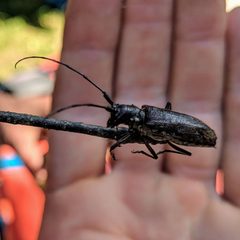
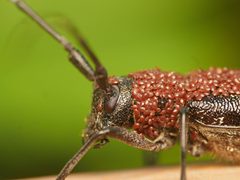
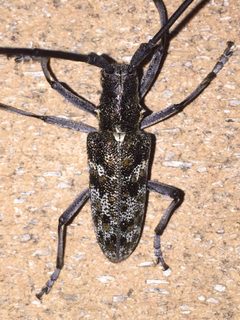
Monochamus is a large of longhorn beetles (Cerambycidae) distributed worldwide. Commonly known as sawyer , in this genus are characterized by larvae that bore into dead or dying coniferous trees, particularly pines. Several species serve as for the pine wood (Bursaphelenchus xylophilus), the causative agent of . The genus exhibits strong in length, with males typically bearing antennae twice as long as their bodies.
Pronunciation
How to pronounce Monochamus: //moʊˈnɒkəməs//
These audio files are automatically generated. While they are not always 100% accurate, they are a good starting point.
Identification
are black or mottled gray with vertically oriented and mouthparts typical of Lamiinae. The scape (first antennal segment) bears a distinctive circatrix—a carinate ring or scar-like area near the tip. is pronounced: female are approximately body-length, while male antennae are twice as long or longer. Tarsal claws are divergent. Larvae are wood-borers with typical cerambycid .
Images
Habitat
Associated with coniferous forests, particularly pine stands. are found in forest and around dead or dying trees. Larvae develop within the wood of dead, dying, injured, fire-scorched, or recently-felled conifers including pines, true firs, Douglas fir, and spruce.
Distribution
Worldwide distribution with occurring across North America, Europe, Asia, and Africa. In North America, species range from Canada through the United States; M. notatus occurs east of the Rocky Mountains. European species include M. galloprovincialis in southwestern Europe.
Seasonality
typically emerge in spring and are active through summer months. duration ranges from one to two years depending on and environmental conditions.
Diet
feed on bark and cambium of healthy conifer trees, particularly within crowns. Larvae feed on wood of dead or dying conifers, tunneling under bark and deep into wood, sometimes reaching heartwood.
Life Cycle
are deposited in slits chewed into bark of dead or dying trees. Larvae hatch and develop through several instars while tunneling in wood. occurs in a constructed near the wood surface. emerge by chewing through remaining wood, with sometimes audible to humans. Newly emerged adults remain in pupal cavities while hardens.
Behavior
Males produce (monochamol) that attract both sexes to oviposition sites. Larger males with longer engage in combat using antennae and to establish dominance at optimal oviposition resources. Males exhibit mate guarding , remaining with females during and after copulation while females oviposit. are capable fliers; M. galloprovincialis can sustain of approximately 1 km individually and up to 16 km total, with flight capacity increasing through adult life.
Ecological Role
Primary decomposers of dead conifer wood, contributing to nutrient cycling in forest . Serve as prey for woodpeckers and other . Several act as for pine wood (Bursaphelenchus xylophilus), transmitting this forest during feeding and oviposition. Engage in intraguild and competition with bark beetles, while also utilizing bark beetle as .
Human Relevance
Larvae can cause 30–40% value loss in freshly cut pine logs through tunneling damage; rapid processing or water storage of logs is recommended to minimize economic impact. Several are significant forest pests as of . Some species affect agricultural crops—M. leuconotus is known as the white coffee stem borer in Africa. Subject to research using .
Sources and further reading
- BugGuide
- Wikipedia
- GBIF taxonomy match
- iNaturalist taxon
- NCBI Taxonomy
- Catalogue of Life
- Bug Eric: Mate Guarding and Oviposition in the White-spotted Sawyer, Monochamus scutellatus (Coleoptera: Cerambycidae)
- Bug Eric: July 2009
- Bug Eric: Lab Excitement
- Bug Eric: An Insect "State of the Summer" Report
- Uncategorized | Blog - Part 43
- Bug Eric: Results of the Red Rock Canyon Open Space Bioblitz
- The effects of host and habitat preferences in mate location of Monochamus maculosus , Monochamus notatus , and Monochamus scutellatus (Coleoptera: Cerambycidae)
- Monochamus leuconotus (white coffee stem borer).
- The effect of feeding behavior of Monochamus alternatus (Coleoptera: Cerambycidae) on the departure of pine wood nematode, Bursaphelenchus xylophilus (Nematoda: Aphelenchoididae)
- Étude des capacités de dispersion de Monochamus galloprovincialis vecteur du nématode du pin Bursaphelenchus xylophilus
- The effect of feeding behavior of Monochamus alternatus (Coleoptera: Cerambycidae) on the departure of pine wood nematode, Bursaphelenchus xylophilus (Nematoda: Aphelenchoididae)
- Sensilla on the antennal flagellum of the sawyer beetles Monochamus notatus (Drury) and Monochamus scutellatus (Say) (Coleoptera: Cerambycidae)
- Single Sensillum Recordings Reveal Antennal Responses of Monochamus alternatus and Monochamus saltuarius (Coleoptera: Cerambycidae) to Pheromones and Host Volatiles.