
Euphorinae
Tribe Guides
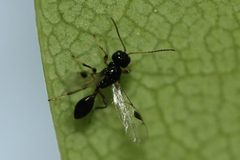
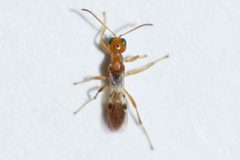
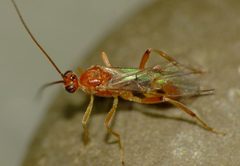
9The Euphorinae are a large of Braconidae comprising over 1,270 described worldwide. They are characterized as koinobiont endoparasitoids, typically attacking insects or nymphs of hemimetabolous —a notably broad host range among parasitoid wasps. The subfamily is sister to the Meteorinae and has been used in biological pest control programs.
Pronunciation
How to pronounce Euphorinae: /juːˈfɔːrɪnaɪ/
These audio files are automatically generated. While they are not always 100% accurate, they are a good starting point.
Images
Distribution
Worldwide distribution.
Host Associations
- Adult beetles (Coleoptera) - Tribe Dinocampini specifically parasitizes beetles.
- Hemimetabolous insect nymphs - include nymphs of hemimetabolous insects.
- Hawk moth larvae (Lepidoptera) - for Meteorus stellatus.
- Scolytinae bark beetles (Coleoptera) - for Cryptoxilos .
- Alydidae (Hemiptera) - for Aridelus flavicans.
- Pentatomidae (Hemiptera) - for Aridelus rufotestaceus.
- Curculionidae weevils (Coleoptera) - for Centistini including Allurus, Centistes, and Centistoides.
- Lygus plant bugs (Miridae) - for Leiophron and Peristenus .
Ecological Role
Euphorinae function as koinobiont endoparasitoids, with some exhibiting solitary development and others rarely gregarious. They serve as agents against agricultural pests, particularly for plant bugs (Lygus spp.) and pests. The includes species with distinctive such as the construction of star-shaped communal cocoon masses in Meteorus stellatus.
Human Relevance
Some have been used for biological pest control, particularly against Lygus plant bugs in agricultural systems. The introduced Peristenus digoneutis has established in North America for this purpose.
Similar Taxa
- MeteorinaeSister group to Euphorinae; historically treated as a tribe within Euphorinae but elevated to status in 2024.
Sources and further reading
- BugGuide
- Wikipedia
- iNaturalist taxon
- NCBI Taxonomy
- Uncategorized | Blog - Part 54
- Journal of Hymenoptera Research | Blog - Part 3
- Pensoft Editorial Team | Blog - Part 55
- new species | Blog - Part 15
- Contributions to the classification of North American Microctonus (Braconidae, Euphorinae)
- Developmental Biology and Morphology of Peristenus digoneutis Loan (Hymenoptera: Braconidae: Euphorinae)
- New species of Euphorinae parasitoids of the family Braconidae (Hymenoptera) from South Korea
- Review of the Palaearctic (and Oriental) Allurus (Braconidae, Euphorinae) based on material from Sweden
- The genus Aridelus Marshall (Hymenoptera, Braconidae, Euphorinae) from Japan, with description of a new species
- Review of the Nearctic species of Leiophron and Peristenus (Hymenoptera: Braconidae: Euphorinae) parasitizing Lygus (Hemiptera: Miridae: Mirini)
- Five new species of Meteorus Haliday (Hymenoptera: Braconidae: Euphorinae) from Brazil
- The distribution of Euphorinae wasps (Hymenoptera: Braconidae) in Turkey, with phytogeographical notes
- First record of Rilipertus Haeselbarth (Hymenoptera: Braconidae: Euphorinae) from China with description of a new species
- Two new Cryptoxilos species (Hymenoptera : Braconidae : Euphorinae) from New Zealand and Fiji parasitising adult Scolytinae (Coleoptera)
- Systematics and Biology of Four Polish Species of Peristenus Foerster (Hymenoptera: Braconidae, Euphorinae) 1
- An annotated catalogue of the Iranian Euphorinae, Gnamptodontinae, Helconinae, Hormiinae and Rhysipolinae (Hymenoptera: Braconidae)
- Four new parasitoid records of the subfamilies Euphorinae and Opiinae (Hymenoptera: Braconidae) from the Adıyaman province of Turkey
- Revision of genus Zele Curtis (Hymenoptera, Braconidae, Euphorinae) from China, with description of nineteen new species
- Studies on the Taxonomy and Biology of the Euphorinae (Hymenoptera: Braconidae). I. Four New Canadian Species of Microctonus