
Leiophron
Nees, 1818
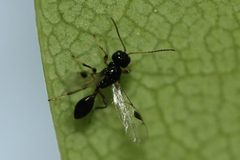
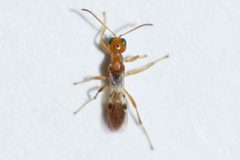
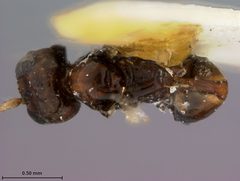
Leiophron is a of endoparasitoid in the Braconidae, Euphorinae. are known to parasitize plant bugs (Miridae), particularly nymphal and stages of Lygus species and related mirids. The genus has been taxonomically reviewed for Nearctic species, with multiple new species described and synonymies established. Leiophron species show distinct associations and geographic distribution patterns, with documented occurrence in the Nearctic, Palaearctic, and Old World tropics.
Pronunciation
How to pronounce Leiophron: /ˌlaɪoʊˈfrɒn/
These audio files are automatically generated. While they are not always 100% accurate, they are a good starting point.
Identification
Leiophron can be differentiated from the related Peristenus by morphological characters detailed in taxonomic keys; specific diagnostic features require examination of wing venation, , and genitalia. The two genera were historically confused, and species-level identification relies on detailed morphological study of reared specimens.
Images
Habitat
Agricultural including alfalfa fields, hay fields, cotton fields, and cashew plantations. In the Nearctic, are primarily associated with crop systems where Lygus plant bugs occur. In the Old World tropics, occurrence has been documented in cashew plantations with activity correlating with rainfall patterns.
Distribution
Nearctic region (North America), with established in southern Quebec and the northeastern United States; Palaearctic region including Turkey and northern and central India; Old World tropics; Argentina and Paraguay; Denmark, Norway, and Sweden.
Seasonality
Peak activity observed in June in Old World tropical cashew systems; activity patterns in temperate regions correlate with nymphal abundance in agricultural cropping cycles.
Host Associations
- Lygus lineolaris (Palisot de Beauvois) - nymphal stages; main for multiple Nearctic
- Lygus hesperus Knight - nymphal stages; readily parasitized by L. uniformis
- Lygus elisus Van Duzee - nymphal stages; readily parasitized by L. uniformis
- Lygus desertinus Knight - nymphal stages; previously unreported for L. uniformis
- Lygus spp. - nymphal stages; primary for Nearctic
- Creontiades pallidus (Rambur) - nymphal stages; by L. decifiens low (1.6–6.5%)
- Campylomma diversicornis (Reuter) - L. decifiens present in all sampled fields with this
- Helopeltis antonii Signoret - stages; rate 1.3% in cashew plantations
- Miridae - -level association for euphorine
- Adelphocoris - mirid reported as
Life Cycle
Endoparasitoid development occurs within nymphs or . For L. uniformis, larvae measure approximately 3.66 mm length by 1.31 mm breadth; pre- period averages 1.75 days. Host of has been documented as a host defense mechanism.
Behavior
Female exhibit acceptance that can be influenced by prior rearing experience. Leiophron uniformis shows reduced oviposition into L. lineolaris compared to other Lygus , apparently detecting host unsuitability. Some species demonstrate behavioral avoidance of hosts with strong abilities. activity shows significant positive correlation with rainfall in tropical systems.
Ecological Role
agent for plant bug pests in systems. Part of the endoparasitoid complex regulating mirid in agricultural . The introduced related Peristenus digoneutis has established in new regions, though impact on population levels may not be immediately evident.
Human Relevance
Similar Taxa
- PeristenusHistorically confused with Leiophron; both are euphorine braconid of mirid bugs. Distinguished by morphological characters including wing venation and genitalia structure. Peristenus digoneutis has been introduced for in regions where Leiophron occur.
More Details
Taxonomic History
The has undergone significant taxonomic revision. Two synonymies were established in recent Nearctic reviews: L. trigonotylidis Loan, 1974 was synonymized under Leiophron lygivorus (Loan 1970), and Brachistes nocturnus Viereck, 1905 was synonymized under Peristenus mellipes (Cresson 1872). Euphorus mellipes Cresson was removed from synonymy with P. pallipes (Curtis).
Host-Parasitoid Interactions
L. lineolaris exhibits a documented immune response to L. uniformis, successfully encapsulating most oviposited in them. This was the first demonstration of such in Heteroptera. The can partially detect this unsuitability, showing reduced oviposition frequency, though this behavioral avoidance is incomplete.
Sources and further reading
- BugGuide
- GBIF taxonomy match
- iNaturalist taxon
- NCBI Taxonomy
- Catalogue of Life
- Occurrence of Parasitoid, Leiophron Sp. (Hymenoptera: Braconidae), on Adults of Helopeltis antonii Signoret in Cashew
- Review of the Nearctic species of Leiophron and Peristenus (Hymenoptera: Braconidae: Euphorinae) parasitizing Lygus (Hemiptera: Miridae: Mirini)
- Two new species of the genera Leiophron Nees and Paroligoneurus Muesebeck (Hymenoptera: Braconidae) from northern India
- Host Preference and Acceptance by Leiophron uniformis (Hymenoptera: Braconidae): Effects of Rearing on Alternate Lygus (Heteroptera: Miridae) Species
- Plant Effects on Host-Finding by Leiophron pseudopallipes (Hymenoptera: Braconidae), a Parasitoid of the Tarnished Plant Bug 1
- Laboratory Biology and Rearing of Leiophron uniformis (Gahan) (Hymenoptera: Braconidae), a Parasite of Lygus spp. (Hemiptera: Miridae)
- Leiophron uniformis(Gahan) (Braconidae), a Parasitoid of the Cotton Fleahopperon Wild Hosts in Texas
- Behavioral Avoidance of Encapsulation by Leiophron uniformis (Hymenoptera: Braconidae), a Parasitoid of Lygus spp. (Hemiptera: Miridae): Relationship between Host Age, Encapsulating Ability, and Host Acceptance
- On the occurrence of a Palaearctic species of the genus Aphaereta Foerster (Braconidae, Alysiinae) and description of a new species of the genus Leiophron Nees (Braconidae, Euphorinae) from central India
- Encapsulation of Leiophron uniformis by Lygus lineolaris and its relationship to host acceptance behavior
- Biology of three species of Leiophron (Hymenoptera: Braconidae, Euphorinae) parasitic on Miridae on broom
- Factors affecting the distribution of two mirid bugs, <i>Creontiades pallidus</i> (Rambur) and <i>Campylomma diversicornis</i> (Reuter) (Hemiptera: Miridae) and notes on the parasitoid <i>Leiophron decifiens</i> Ruthe (Hymenoptera: Braconidae)
- <I>Leiophron argentinensis</I> Shaw (Hymenoptera: Braconidae): A New Species of Parasitoid from Argentina and Paraguay—Information on Life History and Potential for Controlling <I>Lygus</I> Bugs (Hemiptera: Miridae)