
Stenotus
plant bug
Species Guides
1- Stenotus binotatus(Two-spotted Grass Bug)
Stenotus is a of plant bugs in the Miridae, comprising that are primarily associated with grasses and cereal crops. The genus includes notable agricultural pests, particularly Stenotus rubrovittatus (sorghum plant or pecky rice bug), which causes significant damage to rice and other Poaceae. Species in this genus exhibit specialized plant relationships and distinct reproductive tied to plant .
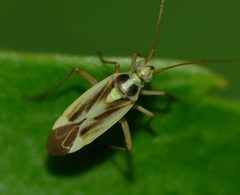
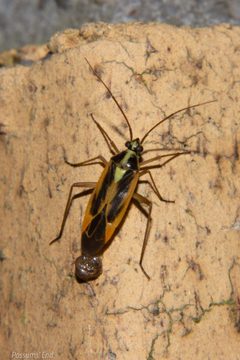
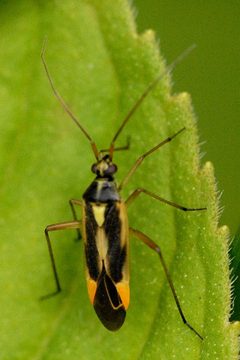
Pronunciation
How to pronounce Stenotus: //stɛˈnoʊtəs//
These audio files are automatically generated. While they are not always 100% accurate, they are a good starting point.
Identification
Members of Stenotus can be distinguished from similar mirid by their association with grass spikelets and the characteristic damage pattern (pecky rice) caused by feeding. Stenotus rubrovittatus specifically shows strict oviposition on spikelets rather than leaf , unlike the related genus Trigonotylus. Detailed morphological diagnostic features for the genus level are not documented in available sources.
Images
Habitat
Grasslands, paddy field margins, and agricultural areas dominated by Poaceae. Stenotus rubrovittatus has been observed in footpaths between paddy fields and areas with dense poaceous vegetation.
Distribution
Stenotus are recorded from Japan, with Stenotus rubrovittatus specifically documented at the NARO Kyushu Okinawa Agricultural Research Center. Broader geographic distribution for the requires additional sources.
Seasonality
present; activity patterns tied to plant , particularly rice and grass flowering periods.
Diet
Phloem feeding on poaceous plants. Stenotus rubrovittatus feeds on rice and various grasses including Poa annua, Anthoxanthum odoratum, Alopecurus aequalis, Digitaria violascens, and Digitaria ciliaris.
Host Associations
- Poa annua - Oviposition and feeding; laid between and inside florets
- Anthoxanthum odoratum - Oviposition and feeding
- Alopecurus aequalis - Oviposition and feeding
- Digitaria violascens - Oviposition and feeding
- Digitaria ciliaris - Oviposition and feeding; laid almost exclusively inside second floret
- Oryza sativa - Rice; causes pecky rice damage
Life Cycle
present. Nymphs emerge almost exclusively from plant spikelets. Oviposition occurs on spikelets with host-specific variation in internal placement (inside florets vs. between florets).
Behavior
Strictly spikelet-specific oviposition distinguishes Stenotus rubrovittatus from related mirids like Trigonotylus caelestialium. Mating behavior is correlated with female age and ovarian development; males court most actively toward 3-day-old females with developing ovaries, and females with undeveloped ovaries typically refuse courtship.
Ecological Role
Agricultural pest of rice and cereal crops; member of plant in grassland-paddy field . Associated with -like endosymbionts in at least one (Stenotus binotatus), though the functional relationship remains uncertain.
Human Relevance
Significant agricultural pest causing pecky rice damage, reducing grain quality and market value. Subject of extensive research on patterns, plant use, and mating to inform strategies.
Similar Taxa
- TrigonotylusRelated mirid with similar associations; distinguished by oviposition —Trigonotylus caelestialium can oviposit on leaf while Stenotus rubrovittatus is strictly spikelet-specific
More Details
Microbiome
Stenotus rubrovittatus harbors a high of Pantoea spp. in its associated . Stenotus binotatus -like microorganisms in epithelial , though their functional role is undetermined.
Research focus
The has been extensively studied for mating dynamics, oviposition , and patterns, particularly using Stenotus rubrovittatus as a model system for understanding plant movements in agricultural landscapes.
Sources and further reading
- BugGuide
- Wikipedia
- iNaturalist taxon
- NCBI Taxonomy
- Catalogue of Life
- cremastus_stenotus_dasch_holotype_female_ucrc_ent_283769_lateral.jpg | Entomology Research Museum
- Primary Type List | Entomology Research Museum
- Ultrastructure of rickettsia-like microorganisms in the midgut of a plant bug, Stenotus binotatus Jak. (Heteroptera: Miridae)
- Effects of Female Age and Ovarian Development on Mating Behavior in Stenotus rubrovittatus (Heteroptera: Miridae)
- Host plant use for oviposition by Trigonotylus caelestialium (Hemiptera: Miridae) and Stenotus rubrovittatus (Hemiptera: Miridae)
- Detecting crucial dispersal pathways using a virtual ecology approach: A case study of the mirid bug Stenotus rubrovittatus
- Pattern of immigration of the sorghum plant bug Stenotus rubrovittatus (Hemiptera: Miridae) into paddy fields from a large source habitat
- Effects of male age on the mating behavior of both sexes in the sorghum plant bug, Stenotus rubrovittatus (Hemiptera: Miridae)
- Feeding Behaviour of the Timothy Plant Bug, Stenotus binotatus F. (Hemiptera : Miridae) and the Effect of Its Feeding on Orchard Grass
- Mating Behavior and Oviposition of the Sorghum Plant Bug, Stenotus rubrovittatus (Matsumura), (Heteroptera: Miridae) under Laboratory Conditions
- Feeding behaviors of rice-ear bugs, Trigonotylus caelestialium and Stenotus rubrovittatus (Hemiptera: Miridae), in response to starch and its related substances
- High Prevalence of Pantoea spp. in Microbiota Associated with the Sorghum Plant Bug Stenotus rubrovittatus (Heteroptera: Miridae).