
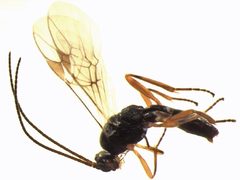
Meteorus rubens
(Nees, 1811)
Meteorus rubens is a gregarious larval in the Braconidae that attacks significant agricultural pests, particularly the black cutworm (Agrotis ipsilon). Female wasps demonstrate strong attraction to , with 94.3% responding to hexane extracts of their host compared to only 22.3% of males. The has been shown to carry Rioviridae viruses, a rare trait among parasitoids. It naturally coexists with other parasitoids such as Apanteles ruficrus, with which it exhibits partitioning based on host instar preference.
Pronunciation
How to pronounce Meteorus rubens: /mɛˈtɛ.oʊ.rəs ˈruː.bɛnz/
These audio files are automatically generated. While they are not always 100% accurate, they are a good starting point.
Identification
Distinguished from congeneric by its role as a gregarious of noctuid larvae and its specific attraction to -derived . in olfactory response is notable: females show strong attraction to host hexane extracts while males do not.
Images
Habitat
Agricultural fields, particularly corn fields with reduced tillage and associated flowering weeds. The thrives in agroecosystems where its Agrotis ipsilon occurs.
Distribution
Recorded from Denmark, Norway, and Sweden; broader distribution likely spans temperate regions of Europe and potentially North America given its association with widespread agricultural pests.
Seasonality
Naturally coexists with Apanteles ruficrus from end April to end May; activity period corresponds with larval availability of Agrotis ipsilon .
Host Associations
- Agrotis ipsilon - larval Black cutworm (Lepidoptera: Noctuidae); primary . Prefers 5th instar larvae over 4th instar when in competition with Apanteles ruficrus. Does not attack 1st, 2nd, 3rd, or late 6th instar larvae.
- Chrysodeixis includens - larval Soybean looper; demonstrated behavioral response to herbivore-induced plant volatiles in soybean agroecosystems.
Life Cycle
Gregarious larval ; multiple larvae develop within a single larva. timing and success influenced by competitor presence and host instar at oviposition.
Behavior
Female exhibit strong olfactory attraction to hexane extracts of larvae ( response), facilitating host location. When competing with Apanteles ruficrus on 4th instar hosts, early host death prevents progeny ; on 5th instar hosts, M. rubens outcompetes A. ruficrus. Susceptible to competitive displacement by Steinernema carpocapsae when host is exposed within 24 hours of .
Ecological Role
agent of noctuid crop pests, particularly in corn and soybean agroecosystems. Contributes to natural suppression of Agrotis ipsilon . Potential for integration with programs given -trapping capability.
Human Relevance
Significant biocontrol potential against agricultural pests. Easily collected using traps baited with mustard oils, enabling monitoring and potential mass-release programs. Competition with other agents (, other ) requires consideration in strategies.
Similar Taxa
- Apanteles ruficrusCoexists naturally with M. rubens; both are gregarious larval of Agrotis ipsilon. Distinguished by instar preference: A. ruficrus attacks 2nd, 3rd, and early 6th instars while M. rubens prefers 5th instar. When simultaneously exposed to 4th instar , competitive interference causes host death and no progeny .
- Meteorus stellatusCongeneric ; distinguished by unique star-shaped communal cocoon masses suspended on threads up to 1 meter long, whereas M. rubens produces individual or standard gregarious cocoons.
Sources and further reading
- BugGuide
- Wikipedia
- GBIF taxonomy match
- iNaturalist taxon
- NCBI Taxonomy
- Catalogue of Life
- Journal of Hymenoptera Research | Blog - Part 3
- biodiversity | Blog - Part 22
- new species | Blog - Part 15
- Bug Eric: Winter 'pillars
- Attractiveness of the parasitoid,meteorus rubens (nees) to hexane-extract ofagrotis ipsilon (hufn.)
- Influence of Flowering Weeds Associated with Reduced Tillage in Corn on a Black Cutworm (Lepidoptera: Noctuidae) Parasitoid, Meteorus rubens (Nees von Esenbeck)
- Interaction between Apanteles ruficrus Hal. and Meteorus rubens Nees on larvae on Agrotis ipsilon (Hufn.)
- Volatile Organic Compounds Induced by Herbivory of the Soybean Looper Chrysodeixis includens in Transgenic Glyphosate-Resistant Soybean and the Behavioral Effect on the Parasitoid, Meteorus rubens
- Competitive interaction between the braconid parasitoid, Meteorus rubens Nees and the entomogenous nematode, Steinernema carpocapsae (Weiser) on larvae of Agrotis ipsilon Hufn. (Lep., Noctuidae)