
Agrotis ipsilon
(Hufnagel, 1766)
dark sword-grass, ipsilon dart, black cutworm, greasy cutworm, floodplain cutworm
is a globally distributed noctuid whose larvae, known as , are serious agricultural pests. are medium-sized with distinctive black Y-shaped or epsilon-shaped markings on brown forewings. The exhibits seasonal , traveling north in spring and south in fall to avoid temperature extremes. Larvae feed on a wide range of vegetable crops and grains, cutting plants at or below the soil surface and causing significant economic damage.
Pronunciation
How to pronounce Agrotis ipsilon: /əˈɡroʊtɪs ˈɪpsɪˌlɒn/
These audio files are automatically generated. While they are not always 100% accurate, they are a good starting point.
Identification
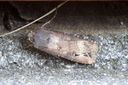
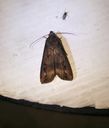
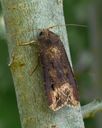
distinguished from similar Agrotis by the distinctive black Y-shaped or epsilon-shaped marking on forewings. Forewings also show first and second lines edged with dark fuscous, with spot followed by short black dash. Subterminal line obscure, usually preceded in middle by two fine black marks. Larvae lack band (present in some related cutworms); coloration highly variable but body covered with and with dark spots. Fourth instar and later become light-sensitive and hide underground during daylight, distinguishing from surface-feeding cutworms.
Images
Habitat
Agricultural fields, pastures, and disturbed areas with herbaceous vegetation. attracted to deciduous trees and shrubs including linden, wild plum, crabapple, and lilac. Larvae found in soil or at soil surface, particularly in fields with weeds or crop debris. Prefers areas with fencerow debris for oviposition early in season, later shifting to low, dense plants with multiple stems and basal leaves.
Distribution
Worldwide distribution including southern Canada, 48 United States plus Hawaii, Mexico, Central and South America, Australia, New Zealand, Pacific Rim, North Africa, Europe, and Asia. Absent from some tropical regions and colder areas; more widespread in Northern than Southern Hemisphere. in Azores (Corvo, Faial, Flores, Graciosa, Pico).
Seasonality
Seasonal migrant: travels north in spring, south in fall. In Canada, 1–2 per year; in United States, 2–4 generations. Abundant in warmer regions (e.g., Arkansas) during late spring (May–June) and early fall (September–October); in cooler regions (e.g., New York), more abundant during summer (June–July). Complete generation lasts 35–60 days.
Diet
Larvae feed on weeds including bluegrass, curled dock, lambsquarters, yellow rocket, and redroot pigweed before attacking crops. Favored crops: most vegetable plants, alfalfa, clover, cotton, rice, sorghum, strawberry, sugarbeet, tobacco, and occasionally grains and grasses. Each larva consumes over 400 cm² of foliage during development; after fourth instar, cuts plants at or below soil surface. feed on flower nectar; also of fetterbush lyonia.
Host Associations
- Zea mays - pestSerious pest of corn, especially at one-leaf stage
- Gossypium hirsutum - pestCotton damaged by larval feeding
- Nicotiana tabacum - pestTobacco is favored crop
- Beta vulgaris - pestSugarbeet damaged by activity
- Solanum lycopersicum - pestTomatoes among vegetable
- Helianthus annuus - pestSunflower damaged by larvae
- Oryza sativa - pestRice is important grain
- Sorghum bicolor - pestSorghum damaged by feeding
- Medicago sativa - pestAlfalfa is favored crop
- Trifolium - pestClover is favored crop
- Fragaria - pestStrawberry is favored crop
- Lyonia lucida - pollinate fetterbush
- Tilia - food source attracted to linden
- Prunus americana - food source attracted to wild plum
- Malus - food source attracted to crabapple
- Syringa - food source attracted to lilac
Life Cycle
Holometabolous complete . stage: 3–6 days; females oviposit in clusters on low-lying leaves or dead plant material, not on bare soil, with 1200–1900 eggs possible per female. Larval stage: 20–40 days, 5–9 instars; development optimized at 27°C, instars 1–5 most successful at higher humidities; by 4th instar becomes light-sensitive and . Pupal stage: 12–20 days, in soil 3–12 mm below surface. preoviposition period: 7–10 days. Total time: 35–60 days. ceases in fall before southward ; resumes in spring before northward migration.
Behavior
activity in . Seasonal : northward in spring, southward in fall, triggered by thermoperiod and changes. Female calling : releases to attract males, with calling increasing in first three days after then decreasing with age; older females call earlier to compensate for reduced production. Larvae cannibalistic. Fourth instar and later larvae hide underground during daylight, emerging at night to feed.
Ecological Role
Larvae function as herbivores and agricultural pests, consuming significant plant and cutting seedlings. serve as , particularly of fetterbush lyonia. Prey for diverse natural enemies including (Meteorus leviventris), tachinid flies (Archytas cirphis, Bonnetia comta, Gonia sequax, Eucelatoria armigera, Sisyropa eudryae), ground beetles, and ants (Lasius neoniger). for Hexamermis arvalis, which infects up to 60% of larvae in central United States and is lethal.
Human Relevance
Major agricultural pest causing significant economic damage worldwide. Larvae sever young plants at ground level, reducing crop stands; each larva consumes over 400 cm² of foliage. Particularly damaging to corn at one-leaf stage, also affects cotton, tobacco, sugarbeet, tomato, sunflower, rice, sorghum, alfalfa, clover, strawberry, and potato. Management includes soil (pre-plant, planting-time, or rescue treatments), cultural controls (weed destruction, seedbed preparation), and scouting for damaged plants. Subject of research on -based control and .
Similar Taxa
- Agrotis mundaBrown , similar larval damage pattern but differs in wing markings and distribution
- Euxoa auxiliaris, also Agrotis-related pest with different and climbing larval
- Peridroma sauciaVariegated cutworm, similar damage but with distinct coloration and larval stripes
More Details
Pheromone Biology
production and release in females, and male responsiveness, are regulated by juvenile hormone (JH) and biosynthesis activating neuropeptide (PBAN). JH acts on both ovaries and pheromone production through independent neuroendocrine systems. This hormonal control has been extensively studied for potential pest management applications.
Olfactory System
Possesses sensitive olfactory system with odorant binding proteins (OBPs), chemosensory proteins (CSPs), odorant receptors (ORs), ionotropic receptors (IRs), and proteins (SNMPs) expressed in , enabling detection of and plant volatiles.
Climate Change Research
Used as model for studying photoperiodic time measurement and seasonal in insects, with research on how physiological state and are modulated at transcriptional and translational levels to facilitate adaptability to changing environments.
Sources and further reading
- BugGuide
- Wikipedia
- GBIF taxonomy match
- iNaturalist taxon
- NCBI Taxonomy
- Catalogue of Life
- Congrats to Antoine Abrieux, Innovator Fellow Award | Bug Squad
- Antoine Brieux to Share PPTM Research on Fruit Fly | Bug Squad
- Occasional Pests - AgriLife Extension Entomology
- Encyrtid Holdings | Entomology Research Museum
- Stem- and Leaf- Feeding Insects - AgriLife Extension Entomology
- Insect-resistant Maize Could Increase Yields and Decrease Pesticide Use in Mexico