
Euxoa auxiliaris
Grote, 1873
Army Cutworm Moth, Miller Moth
, the , is a seasonal migrant and agricultural pest in the Great Plains of North America. The larval stage damages field crops by cutting stems and feeding on foliage, while undertake remarkable long-distance to alpine talus slopes in the Rocky Mountains to escape summer heat. These serve as a critical, high-calorie food source for grizzly bears during their pre-hibernation hyperphagia. Adults are commonly called 'miller moths' due to the fine, easily-shed wing that resemble flour dust.
Pronunciation
How to pronounce Euxoa auxiliaris: //juːkˈsoʊ.ə ɔːɡ.zɪlˈiː.ə.rɪs//
These audio files are automatically generated. While they are not always 100% accurate, they are a good starting point.
Identification
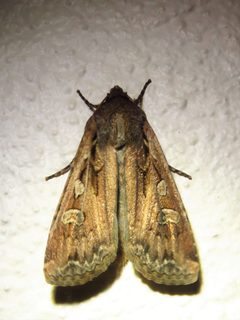
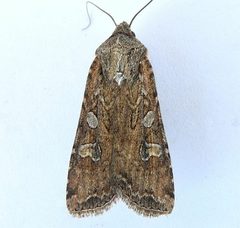
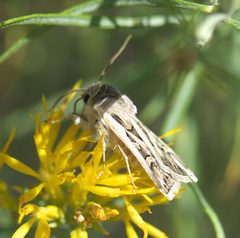
are recognized by their drab brown coloration and the distinctive dusty appearance from easily-shed wing . Larvae are identified by their shiny, greasy , C-shaped defensive posture when disturbed, and stem-cutting feeding damage at or near the soil surface. Distinguished from other cutworms by their surface-feeding and tendency to aggregate in large numbers. The is the most common attacking small grains in Texas.
Images
Habitat
Larvae inhabit agricultural fields, grassy areas, and weedy fields in the Great Plains, with highest densities in thin, late-planted, or poorly tillering crop stands. aggregate during summer in alpine talus slopes and rockslide interstices at high elevations in the Rocky Mountains, where they seek from extreme heat.
Distribution
North America: from Northwest Territories and Alberta south through Washington, Oregon, and Montana to Mexico, east to Minnesota, Nebraska, and Oklahoma. Scattered records include northern Michigan, Indiana, Missouri, Texas, and Florida. Summer documented in the Greater Yellowstone and, more recently, in the southern Canadian Rocky Mountains of British Columbia and Alberta.
Seasonality
laid in late summer and early autumn; hatching triggered by rains. Larvae feed through fall and winter on warmer days, with peak damage in February and March as grains green up. occurs in early spring; in late spring and early summer. Adults migrate to alpine sites for summer, returning to lowland plains in fall to reproduce.
Diet
Larvae are feeders on multiple plant , with cereal grasses especially vulnerable. They cut stems of young plants at or near the soil surface and consume foliage. feed nocturnally on flower nectar in alpine areas, accumulating substantial lipid reserves (approximately 70% body composition at summer peak).
Host Associations
- Copidosoma bakeri - Polyembryonic ; rates reached 61% in southern Alberta fields in 1990. Parasitized larvae feed longer and grow larger than unparasitized ones.
- Meteorus leviventris - Braconid of larvae in Oklahoma alfalfa fields
- Apanteles griffin - Braconid of larvae in Oklahoma alfalfa fields
- Ursus arctos horribilis - preyGrizzly bears forage on as critical summer food source
Life Cycle
cycle with one per year. Females lay 1,000–2,000 on bare soil, particularly in cultivated or overgrazed conditions. Eggs hatch in 2–14 days, triggered by rainfall. Larvae feed through fall and winter, becoming active on warmer days. They overwinter as small larvae in soil or grass clumps, resuming feeding in spring until in early summer. emerge after 3–4 weeks, then migrate westward to alpine sites. Sexual maturation occurs during alpine residency; females lack developed during (- ). After summer, adults remigrate to natal ranges for oviposition.
Behavior
Larvae are surface feeders, hiding under soil clods and debris near plant bases during daylight. When disturbed, they assume a tight C-shaped defensive posture. undertake remarkable seasonal : westward to alpine talus slopes following spring flower bloom, where they aggregate in prodigious numbers. They are diurnally inactive in rock interstices, emerging at night to feed on nectar. Adults can fly more than 50 miles at a time; one tethered individual flew 23 hours at 5.8 mph (equivalent to 133 miles). They detect approaching bats via thoracic tympanic organs and execute evasive . When disturbed at rest, adults spray a defensive liquid from the .
Ecological Role
As larvae: agricultural pest causing economic damage to small grains, alfalfa, and other field crops. As : critical summer food resource for grizzly bears in the Rocky Mountains, providing high-calorie nutrition (70% lipid, 25% protein) during pre-hibernation hyperphagia. The 's and supports bear in the Greater Yellowstone and southern Canadian Rockies.
Human Relevance
Significant agricultural pest of wheat, barley, oats, alfalfa, potato, and sugarbeet. Larval feeding can reduce stands and yield; suggest treatment at 4–5 larvae per square foot in conditions. Cultural controls include weed destruction, clean seedbed preparation, and delayed planting. are available but timing is complicated by larval activity. 'miller ' can become household nuisances around lights. The has developed resistance to some organophosphorous insecticides in certain regions.
Similar Taxa
- Agrotis spp.Other that damage sorghum and small grains; distinguished by 's surface-feeding and shiny, greasy larval appearance
- Pseudaletia unipuncta (True Armyworm)Also attacks small grains; distinguished by green to brown coloration with light stripes, lack of white inverted 'Y' on , and preference for cool, damp conditions
- Spodoptera frugiperda (Fall Armyworm)Also infests of grasses; distinguished by white inverted 'Y' between and four distinct black spots on eighth abdominal segment
- Euxoa mimallonis (Ruddy-winged Dart)Congeneric with similar appearance; distinguished by specific wing patterns and lack of mass migratory to alpine sites
More Details
Thermal Tolerance
Critical thermal maximum (CTLmax) of 44.13°C for lab-reared and 43.28°C for wild-caught ; critical thermal minimum (CTLmin) of approximately -2°C. This cold allows continued activity and feeding in chilly alpine environments.
Parasitism Complications
High rates of by Copidosoma bakeri can paradoxically increase crop damage because parasitized larvae feed longer and more abundantly than healthy larvae, potentially complicating control recommendations.
Sources and further reading
- BugGuide
- GBIF taxonomy match
- iNaturalist taxon
- NCBI Taxonomy
- Aboveground Pests - AgriLife Extension Entomology
- Stem- and Leaf- Feeding Insects - AgriLife Extension Entomology
- How Army Cutworm Moths Bounce Between Midwest Heat and Alpine Cool
- Bug Eric: Winter 'pillars
- Bug Eric: My Kind of Fourth of July
- Bug Eric: July 2019
- Critical thermal limits of the seasonal migrant, Euxoa auxiliaris (Lepidoptera: Noctuidae)
- First known observations of migratory Army Cutworm Moth (<i>Euxoa auxiliaris</i>) in the southern Canadian Rocky Mountains
- PARASITISM OF THE ARMY CUTWORM, EUXOA AUXILIARIS (GRT.) (LEPIDOPTERA: NOCTUIDAE), BY COPIDOSOMA BAKERI (HOWARD) (HYMENOPTERA: ENCYRTIDAE) AND EFFECT ON CROP DAMAGE
- The effects of temperature and barometric pressure on the wingbeat frequency of the seasonal migrant, Euxoa auxiliaris (Lepidoptera: Noctuidae).