
Euxoa
Hübner, 1821
miller moths, cutworm moths
Species Guides
152- Euxoa absona
- Euxoa adumbrata(Sordid Dart)
- Euxoa aequalis
- Euxoa albipennis(White-striped Dart)
- Euxoa annulipes(Ring-legged Cutworm)
- Euxoa antica
- Euxoa atomaris
- Euxoa atristrigata
- Euxoa auripennis
Euxoa is a of noctuid established by Jacob Hübner in 1821, comprising approximately 305 distributed primarily across dry and semi-dry regions of the northern hemisphere. The genus is notably absent from South-East Asia and Australia. Larvae are cutworms that feed on surface vegetation and occasionally climb plants. The genus includes the moth (), a significant agricultural pest whose serve as a critical food source for grizzly bears in the Greater Yellowstone .
Pronunciation
How to pronounce Euxoa: /juːkˈsoʊə/
These audio files are automatically generated. While they are not always 100% accurate, they are a good starting point.
Identification
Euxoa larvae are distinguished from other such as Agrotis by their typical C-shaped defensive posture when disturbed and their surface-feeding . -level identification requires examination of genitalia and wing patterns. In North America, seven subgenera are recognized: Chorizagrotis, Palaeoeuxoa, Heteroeuxoa, Longivesica, Pleuonectopoda, Orstagrotis, and Euxoa. The (E. auxiliaris) can be recognized by its greasy or shiny appearance in older larvae and its distinctive migratory behavior.
Images
Appearance
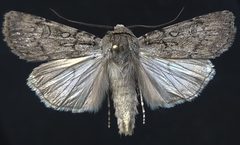
Euxoa are generally drab, brownish insects with typical noctuid . Larvae are plump, smooth-bodied caterpillars, grayish white to grayish black or brown depending on , with fully grown larvae reaching 1 to 2 inches in length. When disturbed, larvae characteristically curl into a tight C-shape.
Habitat
The is predominantly associated with dry and semi-dry in the northern hemisphere. Larval stages inhabit agricultural fields, grasslands, and weedy areas, living in soil but feeding at the surface. Some , notably E. auxiliaris, undergo seasonal altitudinal to alpine environments where aggregate in talus fields and rockslides during summer .
Distribution
Eurasia: 130 . Africa: few species. North America: 175 species, concentrated in western regions with four species to Mexico. Absent from South-East Asia and Australia. A single record from Chile is considered potentially erroneous due to possible mislabeling.
Seasonality
Most Euxoa exhibit autumn -laying with larvae hatching and undergoing summer before pupating when temperatures drop. E. auxiliaris emerge in late spring and early summer, migrating westward to alpine areas, then returning to lowlands in late summer and early autumn to reproduce.
Diet
Larvae feed on a wide variety of cultivated crops including wheat, barley, oats, alfalfa, potato, and sugarbeets, as well as broad-leaved weeds and cereal grasses. feed nocturnally on nectar.
Life Cycle
are laid in soil, particularly in cultivated or overgrazed areas with bare soil exposure. Hatching is triggered by rainfall. Larvae pass through multiple instars, feeding primarily at night and on overcast days, as larvae in soil or grass clumps. occurs in soil in early spring. emerge and, in some , undertake long-distance migratory .
Behavior
Larvae are surface feeders that hide in soil or under debris during daylight hours. When disturbed, they assume a characteristic C-shaped defensive posture. are strongly attracted to light. The (E. auxiliaris) performs an westward from the Great Plains to the Rocky Mountains, flying up to 50 miles per sustained and achieving distances exceeding 130 miles. Adults aggregate in high- clusters under rocks in alpine areas during summer days, emerging at night to feed on nectar. When disturbed, resting adults may spray a liquid substance from the as a defense mechanism.
Ecological Role
Larvae function as herbivores and agricultural pests, consuming plant and occasionally reducing crop stands. of E. auxiliaris serve as a crucial high-calorie, fat-rich food source for grizzly bears (Ursus arctos horribilis) during late summer hyperphagia, linking Great Plains agricultural with Rocky Mountain . The also transports nutrients and potentially between distant through migratory movements.
Human Relevance
Several Euxoa are significant agricultural pests, with larvae cutting stems of young plants and defoliating crops. The (E. auxiliaris) is particularly damaging to small grains, alfalfa, and other field crops. of E. auxiliaris, known as miller , can become household nuisances when attracted to artificial lights. The species is subject to extensive management in grain sorghum and wheat production systems. Research on E. auxiliaris thermal informs both pest management strategies and conservation efforts for grizzly bear .
Similar Taxa
- AgrotisAlso contains with similar larval and ; distinguished by subtle differences in genitalia and wing patterns, though field identification of larvae is often impractical without rearing
- SpodopteraContains with similar larval feeding damage; distinguished by larval coloration patterns and
More Details
Taxonomic Structure
North American Euxoa are classified into seven subgenera based on morphological and presumably phylogenetic criteria: Chorizagrotis, Palaeoeuxoa, Heteroeuxoa, Longivesica, Pleuonectopoda, Orstagrotis, and Euxoa.
Thermal Physiology
Laboratory studies of E. auxiliaris indicate maximum critical thermal limits of 43-44°C and minimum limits near freezing, enabling activity across the temperature range encountered during between Great Plains and alpine environments. Wingbeat frequency increases with temperature but is unaffected by barometric pressure.
Parasitoid Complex
Larvae of E. auxiliaris are attacked by braconid wasps including Meteorus leviventris and Apanteles griffin in alfalfa fields, contributing to natural .
Sources and further reading
- BugGuide
- Wikipedia
- GBIF taxonomy match
- iNaturalist taxon
- NCBI Taxonomy
- Catalogue of Life
- Aboveground Pests - AgriLife Extension Entomology
- Stem- and Leaf- Feeding Insects - AgriLife Extension Entomology
- Bug Eric: Winter 'pillars
- How Army Cutworm Moths Bounce Between Midwest Heat and Alpine Cool
- Bug Eric: My Kind of Fourth of July
- Bug Eric: July 2019
- The effects of temperature and barometric pressure on the wingbeat frequency of the seasonal migrant, Euxoa auxiliaris (Lepidoptera: Noctuidae).