
Peridroma saucia
Hübner, 1808
Variegated Cutworm, Pearly Underwing, False Black Cutworm Moth
Peridroma saucia is a highly noctuid with a nearly distribution across temperate and subtropical regions. The is a significant agricultural pest, with larvae feeding on numerous crop plants including vegetables, fruits, and field crops. are migratory, moving northward in spring and returning south in autumn, with 2–4 per year depending on latitude. Recent research has documented its role as a of apple and other crops, revealing ecological functions beyond its pest status.
Pronunciation
How to pronounce Peridroma saucia: //ˌpɛrɪˈdroʊmə ˈsaʊsiə//
These audio files are automatically generated. While they are not always 100% accurate, they are a good starting point.
Identification
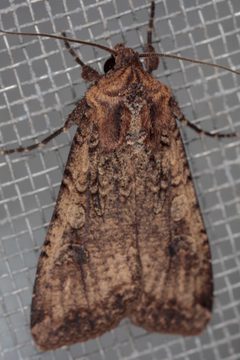
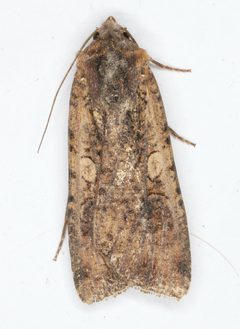
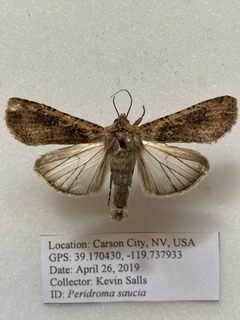
distinguished from similar noctuids by combination of: (1) seven short black marks on forewings, (2) opalescent to white hindwings with brown venation, and (3) moderate size (43–50 mm wingspan). Larvae identified by: (1) yellow or white spots on first 4–6 abdominal segments, (2) black W-shaped mark on 8th abdominal segment of final instar, and (3) black line above . Similar to Agrotis and Euxoa cutworms but with distinctive spot pattern and W-mark.
Images
Habitat
Agricultural farmlands, gardens, orchards, and disturbed open . Larvae found in soil, under debris, or on vegetation. attracted to light. Greenhouse established where food is abundant. range thought to extend from lower Mississippi valley to southern Great Plains in North America.
Distribution
Nearly : North America (southern Canada through United States, Mexico), South America, Europe (first recorded 1790), Asia (including Japan since 1970s, China, South Korea), Africa, and Hawaiian Islands. In North America, primarily inhabits southern Canada and northern United States, with seasonal to more northern areas.
Seasonality
active May through November depending on location. Multiple per year: two generations in colder regions (e.g., Canada), three to four in warmer areas. Migratory move north in spring, return south in autumn. Larvae feed primarily at night; adults .
Diet
Highly . Larvae feed on vegetables (including potato, sugarbeet, tomato, cabbage, lettuce), fruits (including apple, peach, strawberry), field crops (wheat, corn, barley, oats, alfalfa, soybean, tobacco), and weeds (Datura, Rumex, Eupatorium capillifolium, Ambrosia, Capsella bursa-pastoris). feed on nectar; documented as of apple.
Host Associations
- Solanum tuberosum - larval food plantMajor crop pest
- Beta vulgaris - larval food plantLarvae consume up to 125 cm² of foliage
- Malus domestica - nectar source; larval food plantDocumented pollination by ; larvae climb trees to feed on foliage
- Glycine max - larval food plant cause 30–60% yield reduction
- Nicotiana tabacum - larval food plantSignificant pest in tobacco-growing regions
- Zea mays - larval food plantField crop
- Triticum aestivum - larval food plantCereal crop
- Prunus persica - larval food plantStone fruit
- Fragaria - larval food plantSoft fruit
Life Cycle
Holometabolous with 2–4 annually. stage: 4–6 days at 20–30°C, up to 10 days at 15°C; developmental threshold 3.0–6.0°C. Larval stage: six instars with total duration variable; developmental threshold 2.6–6.7°C. Pupal stage: 13 days at 25°C, 33 days at 15°C; developmental threshold 4.3–8.5°C; formed in soil. longevity and temperature-dependent; females lay 1200–1400 eggs over lifetime, with higher total fecundity at 18–24°C than at 15°C due to extended oviposition period. Overwinters as larva or pupa; cannot survive more than 8 weeks at 0°C or 4 weeks at −2°C.
Behavior
feeding by larvae, which hide in soil or under shelter during daytime and move to foliage at night. Larvae capable of climbing trees to access foliage. At high densities, larvae exhibit -like , moving en masse between fields and causing extensive localized damage. migratory, moving from southwest to northeast in warmer months; decreases under unfavorable conditions. Adults attracted to light. Female produces (Z)-11-hexadecenyl acetate as major component and (Z)-9-tetradecenyl acetate as minor component (3:1 ratio) to attract males.
Ecological Role
Agricultural pest causing significant crop damage through larval defoliation and cutting of stems at soil surface. Documented as of apple and potentially other crops. Serves as for numerous and flies (Braconidae, Ichneumonidae, Eulophidae, Tachinidae), which account for majority of larval mortality. Functions as prey item in , though specific documentation limited beyond parasitoids.
Human Relevance
Major agricultural pest of vegetables, fruits, and field crops; described as one of the most damaging garden pests. Larval damage includes cutting plants at soil surface, defoliation, stripping of leaves and fruit, and bud/stem consumption. Control methods include , garden (weed and debris removal), physical barriers (trenches, tar bands, stem wraps), and using poultry (turkeys, guinea hens). Subject of research for monitoring and potential . Recent recognition of pollination services complicates simple pest classification.
Similar Taxa
- Agrotis spp.Similar larvae and ; distinguished by larval spot pattern and adult hindwing coloration
- Euxoa spp.Similar and ; Euxoa auxiliaris () shares winter activity pattern but differs in larval markings and appearance
- Mythimna unipuncta with similar pollination documented in same apple pollination study; distinguished by different larval and wing pattern
More Details
Pheromone Biology
Female gland contains (Z)-11-hexadecenyl acetate and (Z)-9-tetradecenyl acetate in ratio of 2.1:1 to 2.4:1. -binding protein PsauPBP3, predominantly expressed in male , shows high binding affinity for both components; five key residues (Thr-10, Phe-13, Ile-53, Ile-95, Phe-119) identified as critical for binding.
Parasitoid Complex
Documented include: Apanteles xylinus, Chelonus insularis, C. militaris, Meteorus autographae, M. leviventris, Microplitis feltiae, Rogas perplexus, R. rufocoxalis, Campoletis sonorensis, Enicospilus merdarius, Nepiera fuscifemora, Ophion flavidus, Dibrachys canus, Archytas aterrimus, A. cirphis, Bonnetia comta, Carcelia spp., Chaetogaedia monticola, Clausicela opaca, Eucelatoria armigera, Euphorocera claripennis, E. omissa, Gonia longipulvilli, G. porca, G. sequax, Lespesia archippivora, Madremyia saundersii, Peleteria texensis, Periscepsia helymus, P. laevigata, Voria ruralis, Winthemia leucanae, W. quadripustulata, and W. rufopicta.
Ecological Duality
Research published 2021 documented significant pollination contribution to apple production in Arkansas, where P. saucia was among the nocturnal visitors. This finding illustrates that 'pest' insects provide services, complicating management decisions and supporting approaches that preserve beneficial functions while limiting damage.
Sources and further reading
- BugGuide
- Wikipedia
- GBIF taxonomy match
- iNaturalist taxon
- NCBI Taxonomy
- Catalogue of Life
- P.M. Pollinators: Study Shines Light on Nocturnal Insects' Role in Apple Production
- Bug Eric: National Moth Week 2024 Recap from Kansas City
- Peridroma saucia Archives - Entomology Today
- Bug Eric: Winter 'pillars
- Binding Mechanism of PsauPBP3 to Sex Pheromones in Peridroma saucia: Insights from Computational and Experimental Approaches.