
Thyridanthrax
Osten Sacken, 1886
bee flies
Species Guides
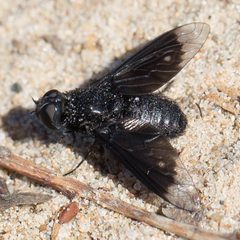
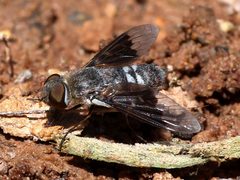
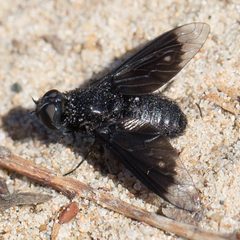
8Thyridanthrax is a of bee flies ( Bombyliidae) comprising approximately 12-50 described distributed across Eurasia, Africa, North America, and South America. Species within this genus are with documented associations with various including crabronid and calliphorid flies. The genus exhibits diverse strategies, with some species capable of facultative switching between idiobiont and koinobiont modes.
Pronunciation
How to pronounce Thyridanthrax: //ˌθɪrɪˈdænθræks//
These audio files are automatically generated. While they are not always 100% accurate, they are a good starting point.
Images
Habitat
vary by : Thyridanthrax fenestratus occurs in old Lipara-induced galls on common reed (Phragmites australis); Thyridanthrax abruptus has been found in stream-bed sand of dry-season breeding sites of .
Distribution
Eurasia, Africa, North America, and South America. Specific records include: Northern Nigeria (Zaria and Bauchi Provinces), East Africa, and Scandinavian countries (Denmark, Norway, Sweden).
Host Associations
- Pemphredon fabricii (Hymenoptera: Crabronidae) - Thyridanthrax fenestratus parasitizes this crabronid ; larvae feed on after winter
- Rhyncomyia pictifacies (Calliphoridae) - puparial Thyridanthrax abruptus emerges from of this calliphorid fly in Nigeria
- Glossina morsitans - puparial Thyridanthrax abruptus is a widespread puparial in East Africa
Life Cycle
Thyridanthrax fenestratus: larvae overwinter as young larvae and begin feeding on fully developed, defecated of Pemphredon fabricii only after cold-induced winter ends; larval development takes several times longer than , causing parasitized prepupae to remain paralyzed until feeding is complete. Thyridanthrax abruptus: emerge from host .
Behavior
Female Thyridanthrax sp. have been observed hovering over open nests of and depositing into tunnels. Thyridanthrax fenestratus exhibits facultative switching between idiobiont (killing immediately) and koinobiont (killing host at later developmental stage) strategies; uniquely able to block host in defecated stage and prevent following cold-induced .
Ecological Role
of solitary and flies; contributes to of including Pemphredon fabricii and various calliphorid flies.
More Details
Parasitism Strategy Diversity
The modes in Bombyliidae and Thyridanthrax spp. are not uniform. Thyridanthrax fenestratus demonstrates facultative parasitism strategy switching, a trait also reported in several Anthrax spp. The ability to block in the defecated stage and prevent following cold-induced is reported for the first time in this .
Taxonomic Note
count estimates vary: Wikipedia reports about 12 described species, while other sources suggest approximately 50 described species. This discrepancy may reflect ongoing taxonomic revision or differences in species concept application.
Sources and further reading
- BugGuide
- Wikipedia
- GBIF taxonomy match
- iNaturalist taxon
- NCBI Taxonomy
- Catalogue of Life
- Bug Eric: Wasp Wednesday: Ammophila aberti
- Bug Eric: 2010
- Rearing Thyridanthrax fenestratus (Diptera, Bombyliidae) on Pemphredon fabricii (Hymenoptera, Crabronidae) prepupae
- A Calliphorid Host of Thyridanthrax abruptus (Lw.) in Nigeria (Diptera, Bombyliidae)