
Anthracinae
bee flies
Tribe Guides
5- Anthracini
- Aphoebantini
- Exoprosopini(bee flies)
- Villini(banded bee flies)
- Xeramoebini
Anthracinae is a of bee flies ( Bombyliidae) comprising more than 80 and at least 380 described . The subfamily includes well-known genera such as Anthrax and Hyperalonia, many of which are of other insects. Larval stages are typically or of soil-dwelling including tiger beetles, ground-nesting bees, and . flies are often -mimics in appearance and are commonly observed hovering or feeding at flowers.
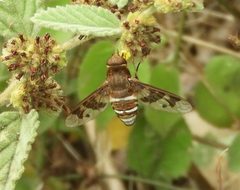
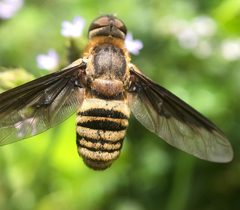
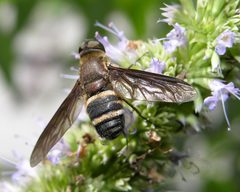
Pronunciation
How to pronounce Anthracinae: //ænˈθræsɪniː//
These audio files are automatically generated. While they are not always 100% accurate, they are a good starting point.
Identification
Distinguished from other Bombyliidae by combination of and larval . Within the , Anthracinae is placed in the 'S-clade' of higher bombyliids. -level identification relies on wing venation, body hair patterns, and male genitalia. -level identification often requires examination of puparial characters.
Images
Habitat
frequent open including grasslands, barren soils, and areas with exposed ground suitable for nesting. Many associated with sandy or clay soils where hosts construct burrows.
Distribution
Worldwide distribution with strong representation in arid and semi-arid regions. Documented from North America, South America (Brazil, Rica), and other regions. Specific records include Belo Horizonte, Minas Gerais, Brazil; Missouri, USA; and Virginia, USA.
Seasonality
activity coincides with availability; in temperate regions, primarily active during spring and summer when ground-nesting hosts are active.
Host Associations
- Tiger beetles (Cicindelidae) - Anthrax analis (now A. georgicus) and related parasitize larvae of Cicindela, Cicindelidia, Ellipsoptera, and Tetracha. Larvae attach externally to and feed until host approaches maturity, then kill and consume it.
- Ground-nesting bees (Hymenoptera) - Most Anthrax with known parasitize ground-nesting bees. deposited at burrow entrances; larvae locate and enter hosts.
- Sand wasps (Crabronidae) - Thraxan are of Pison simillimum larvae found in mud nests.
- Rubrica nasuta - Confirmed for Hyperalonia morio morio.
Life Cycle
Females deposit at or near burrow entrances. First-instar larvae () are mobile and locate hosts. Larvae may be ectoparasitic or endoparasitic depending on . Development is typically synchronized with host maturity; larvae accelerate development and kill the host prior to . Pupation occurs in soil or within host remains.
Behavior
females of Anthrax have been observed flying backward and downward while thrusting the forward to deposit near burrow entrances. Adults avoid active host burrows to reduce risk. Larvae of some species attach externally to host and remain attached throughout development.
Ecological Role
Important regulating of ground-nesting insects including tiger beetles, bees, and . May influence microhabitat selection and nesting .
Human Relevance
Some studied as agents or indicators of health. Anthrax analis/ georgicus has been subject of detailed ecological study due to its impact on tiger .
Similar Taxa
- MythicomyiinaeAlso in Bombyliidae S-clade; distinguished by smaller size and different associations including lions and orthopteran masses.
- ExoprosopinaeAnother bombyliid ; Exoprosopini (within Anthracinae in some classifications) contains like Hyperalonia with distinct pupal .
- TachinidaeDipteran often mistaken for bombyliids; distinguished by different and typically endoparasitic rather than ectoparasitic larval habits.
Misconceptions
Bee flies are frequently assumed to parasitize only bees; however, Anthracinae includes parasitizing tiger beetles, , and other soil-dwelling insects. The 'bee fly' refers to appearance, not larval .
More Details
Taxonomic uncertainty
records for many Anthracinae remain unknown; most observations are serendipitous. The Anthrax includes approximately 70 species with documented hosts out of a larger total.
Revised nomenclature
Anthrax analis has been synonymized with A. georgicus in recent literature; earlier sources may use the former name.
Sources and further reading
- BugGuide
- Wikipedia
- iNaturalist taxon
- NCBI Taxonomy
- Catalogue of Life
- Bee Fly Parasitism of Tetracha virginica | Beetles In The Bush
- ID Challenge #11 | Beetles In The Bush
- Description of five Anthrax Scopoli puparia (Diptera, Bombyliidae, Anthracinae, Anthracini)
- Redescription of the pupae of Hyperalonia morio morio (Fabricius), 1775 (Diptera, Bombyliidae, Anthracinae, Exoprosopini)
- A new species of Anthrax Scopoli, 1763 from Brazil, with description of its puparium (Diptera, Bombyliidae, Anthracinae, Anthracini)
- Sand wasp (Hymenoptera: Crabronidae) parasites emerging from mud wasp nests (Hymenoptera: Sphecidae)—a reliable host record of Thraxan Yeates & Lambkin (Diptera: Bombyliidae: Anthracinae) with description of the pupal exuviae of three Thraxan species