
Amobia
Robineau-Desvoidy, 1830
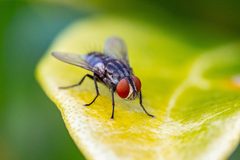
Amobia is a of satellite flies in the Sarcophagidae, Miltogramminae. These dipterans are obligate kleptoparasites of solitary and bees, with females depositing larvae directly into nests rather than laying . The genus occurs across multiple continents including Australia, Asia, Europe, and the Americas, with demonstrating specificity toward particular host such as eumenid wasps (Anterhynchium, Orancistrocerus) and various solitary bees and wasps.
Pronunciation
How to pronounce Amobia: /æˈmoʊ.bi.ə/
These audio files are automatically generated. While they are not always 100% accurate, they are a good starting point.
Images
Distribution
Australia ( including A. serpenta, A. auriceps, A. burnsi); Indian subcontinent (A. quatei); Japan (A. distorta); Europe (A. signata); North America (A. floridensis, A. erythrura); records from Denmark, Norway, Sweden. Species distributions are partially documented with new records continuing to emerge.
Host Associations
- Anterhynchium flavomarginatum - kleptoparasiteDocumented for A. distorta and A. quatei
- Anterhynchium gibbifrons - kleptoparasiteDocumented for A. distorta in Japan
- Orancistrocerus drewseni - kleptoparasiteDocumented for A. distorta
- Monobia quadridens - kleptoparasiteA. erythrura larvae consume caterpillar prey stored for larva, starving it
- Pachodynerus nasidens - kleptoparasiteA. floridensis documented as
- Symmorphus spp. - kleptoparasite documented as for Amobia
- Sceliphron caementarium - kleptoparasiteDocumented for Amobia
- Trypoxylon politum - kleptoparasiteDocumented for Australian Amobia
- Various solitary bees (Apoidea) - kleptoparasiteGeneral association documented
Behavior
Females exhibit kleptoparasitic by depositing larvae directly into nests (larviposition), a characteristic trait of the Miltogramminae. The larvae then consume the food stores (paralyzed prey such as caterpillars) intended for the host's offspring, effectively starving the host larva. Host defensive behaviors include responses when flies approach nests. Spatial patterns show -dependent relationships: at low and medium parasitism rates, parasitism increases with host density, while at high parasitism rates the relationship becomes density-independent due to from high-density patches.
Ecological Role
Acts as a mortality agent for Hymenoptera, particularly solitary and bees. Functions as a that exploits the provisioning efforts of , potentially influencing host and nest success rates. May contribute to regulation of solitary wasp and .
Similar Taxa
- SenotainiaPhylogenetically sister to Amobia based on molecular analysis; both belong to Miltogramminae and share kleptoparasitic
- MetopiaAnother in Miltogramminae with similar satellite fly and larviposition
More Details
Taxonomic history
The has undergone revision with integrated morphological and molecular approaches. A new , A. serpenta, was described from Australia in 2020. The proposed synonymisation of A. pelopei and A. auriceps has been refuted based on evidence.
Molecular phylogenetics
Phylogenetic analysis using COI, ND4, CYTB, and EF1α loci places Australian Amobia together with the Palaearctic A. signata in a clade sister to Senotainia.
Sources and further reading
- BugGuide
- GBIF taxonomy match
- iNaturalist taxon
- NCBI Taxonomy
- Catalogue of Life
- Bug Eric: Wasp Wednesday: Symmorphus
- Bug Eric: Wasp Wednesday: Black & Yellow Mud Dauber
- Bug Eric: February 2011
- Bug Eric: October 2012
- First record of Amobia quatei (Diptera: Sarcophagidae: Miltogramminae) from the Indian subcontinent as kleptoparasite of Anterhynchium flavomarginatum (Hymenoptera: Vespidae: Eumeninae)
- Taxonomic revision of Australian Amobia Robineau-Desvoidy, 1830 (Sarcophagidae: Miltogramminae): integrating morphology and genetics finds a new species and tackles old problems
- Parasitic behavior of Amobia distorta (Diptera: Miltogramminae) and defensive behavior of its hosts, Anterhynchium spp. (Hymenoptera: Vespidae: Eumeninae)
- The spatial patterns of parasitism of eumenid wasps, Anterhynchium flavomarginatum and Orancistrocerus drewseni by the miltogrammine fly Amobia distorta