
Pachodynerus nasidens
(Latreille, 1812)
Keyhole Wasp
Pachodynerus nasidens, commonly known as the keyhole , is a solitary mason wasp in the Vespidae, Eumeninae. Native to the Neotropics, it has been introduced to Hawaii, Micronesia, Australia, and the northern United States. The exhibits remarkable nesting plasticity, utilizing abandoned insect galleries, human-made cavities, and even aircraft pitot tubes. Females provision nests with paralyzed caterpillars as food for their larvae. The species has gained notoriety for causing aviation safety incidents by blocking pitot probes with mud nests, leading to unreliable airspeed readings.
Pronunciation
How to pronounce Pachodynerus nasidens: /ˌpæ.kəʊˈdaɪ.nərəs ˈnæ.sɪˌdɛnz/
These audio files are automatically generated. While they are not always 100% accurate, they are a good starting point.
Identification
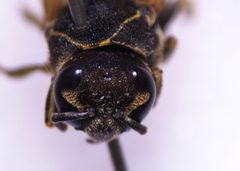
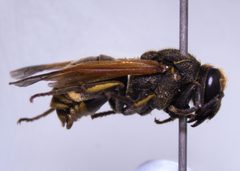
Can be confused with Brachygastra mellifica (Mexican Honey Wasp) due to nearly identical markings; distinguished by solitary and subtle differences in petiole structure. Distinguished from Pachodynerus guadulpensis by lacking an extra yellow stripe across the front of the . The short, nearly vertical petiole is difficult to detect in live specimens but separates it from more elongate mason wasps.
Images
Appearance
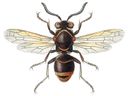
Small to medium-sized with yellow and black markings essentially identical to the Mexican Honey Wasp (Brachygastra mellifica). The has a short, nearly vertical petiole creating a subtle 'wasp waist.' Color pattern includes yellow bands on a black background. Distinguished from the similar Pachodynerus guadulpensis by the absence of an extra yellow stripe across the front of the abdomen.
Habitat
In native range: grasslands and swamps dominated by grasses and sedges, from sea level to high altitudes (1120 m) with cool wet seasons and frosts. Highly adaptable to human-modified environments. In introduced range: urban areas, airports, and any location providing suitable cavities for nesting. At Brisbane Airport, nesting concentrated in areas with higher proportion of grassed surroundings within 1000 m.
Distribution
Native to tropical Central and South America, the Caribbean, and southern USA (Florida, Texas, Arizona). Introduced to Hawaii, Micronesia, Polynesia, Japan, and Australia (first detected 2010 in Brisbane, 2012 at Brisbane Airport). Established in Pacific islands and Australia.
Seasonality
Peak nesting activity occurs in summer months. In native range, nesting recorded from January to April (Brazil). Nesting success optimal between 24-31°C. In temperate introduced areas, active during warmer months.
Diet
feed on nectar and pollen. Larvae are fed paralyzed caterpillars, primarily from Pyralidae, Olethreutidae, Alucitidae, and Thyrididae.
Host Associations
- Sceliphron caementarium - nest reuseabandoned mud dauber nests
- Trypoxylon politum - nest reuseabandoned pipe organ mud dauber nests
- Polistinae - nest reuserare use of abandoned paper wasp nests documented in Brazil
- Chrysis - cuckoo wasp lays in nests
- Melittobia chalybii - eulophid parasitic wasp infests nests
- Amobia floridensis - sarcophagid satellite fly deposits larvae in nests
- Crematogaster - acrobat ants prey on stages
- Macrosaigon - wedge-shaped beetles in Ripiphoridae develop in nests
Life Cycle
Females construct mud in pre-existing cavities. Each cell is provisioned with 5-20+ paralyzed caterpillars. A single is laid per cell. Cells are sealed with mud. Larvae consume the paralyzed prey, spin a cocoon, and pupate. In linear nests, innermost cells contain females and outermost cells males (proterandry), with males emerging first to avoid climbing over sisters. Development time longer for females. One female may construct several nests.
Behavior
Highly plastic nesting using abandoned nests, wood-boring insect galleries, human-made cavities (window crevices, keyholes, electrical sockets), ground nests, and plant-attached mud nests. Rapid nest construction documented (partial nest in 30 minutes). Females clean and inspect potential nest sites before acceptance. Males have been observed participating in nest maintenance in related Trypoxylon , but this behavior is unconfirmed for P. nasidens. Sex ratio of offspring may be influenced by cavity volume, with female-biased sex ratios in smaller cavities.
Ecological Role
agent of caterpillar . through nectar feeding. Prey base for various and . Nutrient cycling through use of abandoned nests and cavities.
Human Relevance
Aviation safety risk: nesting in aircraft pitot probes causes serious safety incidents by blocking airspeed measurement. Management strategies include modification near airports, alternate nest sites, pitot covers between , and regular inspections. Beneficial as of caterpillar pests in gardens and landscapes. Can be attracted to gardens with appropriate nectar sources.
Similar Taxa
- Brachygastra mellificaNearly identical yellow and black markings; distinguished by being social with large paper nests, versus solitary cavity-nesting of P. nasidens
- Pachodynerus guadulpensisSimilar size and general appearance; distinguished by extra yellow stripe across front of in P. guadulpensis
- Trypoxylon spp.Also called 'keyhole wasps' and nest in pre-existing cavities; distinguished by long, slender, club-shaped with blunt tip and
Misconceptions
The 'keyhole ' is sometimes applied to multiple unrelated wasp , including Trypoxylon species, causing confusion. Not all mud-nesting wasps in cavities are P. nasidens.
More Details
Aviation Safety Management
At Brisbane Airport, P. nasidens was identified as the sole responsible for pitot probe blockage. Probes with apertures >3 mm diameter are preferred. Nesting is unevenly distributed across airport landscapes. Successful management involved integrated approach of modification, alternate nesting sites, physical barriers, and monitoring.
Nesting Plasticity
The demonstrates exceptional behavioral flexibility in nest site selection, having been documented using: abandoned mud dauber nests, paper wasp nests, wood-boring insect galleries, hollow twigs, human-made holes in wood, window tracks, electrical sockets, keyholes, ground burrows, and mud nests attached to vegetation. This plasticity facilitates of novel environments including urban and industrial areas.
Sex Allocation Strategy
Proterandry (male before females) is achieved by placing male in outer and female eggs in inner cells of linear nests. This spatial arrangement prevents males from having to climb over or bore through slower-developing sisters. Sex ratio varies with nest cavity size, with female in smaller traps and approximately unity in longer traps.
Sources and further reading
- BugGuide
- Wikipedia
- GBIF taxonomy match
- iNaturalist taxon
- NCBI Taxonomy
- Catalogue of Life
- Paralyzing prey in Paradise: Keyhole wasp, Pachodynerus nasidens — Bug of the Week
- Bug Eric: Wasp Wednesday: Pachodynerus
- On the prowl to paralyze pests here in the DMV: Four-toothed mason wasps, Monobia quadridens — Bug of the Week
- Bug Eric: Wasp Wednesday: Trypoxylon
- Archive — Bug of the Week
- Bug Eric: February 2011
- Factors controlling the distribution in Jamaica of Pachodynerus nasidens (Latr.) (Hymenoptera: Eumenidae)
- Nesting of the keyhole wasp Pachodynerus nasidens (Latreille, 1812) (Vespidae, Eumeninae) in a nest of a paper wasp (Vespidae, Polistinae)
- Inventive nesting behaviour in the keyhole wasp Pachodynerus nasidens Latreille (Hymenoptera: Vespidae) in Australia, and the risk to aviation safety
- Inventive nesting behaviour in the keyhole wasp Pachodynerus nasidens Latreille (Hymenoptera: Vespidae) in Australia, and the risk to aviation safety
- Biologic aspects of different species of Pachodynerus (Hymenoptera; Vespidae; Eumeninae)
- The biology of the eumenid mud‐wasp Pachodynerus msidens in trapnests