
Monobia
de Saussure, 1852
Four-toothed Mason Wasp (for M. quadridens), Carpenter Wasp, Mason Wasp
Species Guides
3- Monobia arizonensis
- Monobia quadridens(Four-toothed Mason Wasp)
- Monobia texana
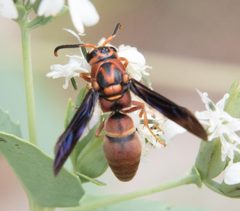
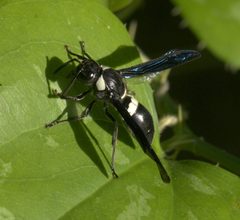
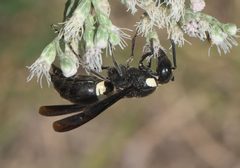
Monobia is a of medium-sized to large potter wasps in the Eumeninae, distributed primarily across the Neotropical region from the United States to Argentina. The genus is closely related to Montezumia. The most well-documented , Monobia quadridens (Four-toothed ), is a solitary that provisions nests with paralyzed caterpillars and constructs mud partitions between .
Pronunciation
How to pronounce Monobia: /mɒˈnoʊbiə/
These audio files are automatically generated. While they are not always 100% accurate, they are a good starting point.
Identification
Monobia are medium to large in size with black and white coloration. Males of M. quadridens can be distinguished from females by a prominent white spot on the (), while females have entirely black faces. The features a broad white band encircling the portion. The can be confused with Pseudodynerus quadrisectus, which is slightly smaller, more slender, and has more extensive white markings including a white band across the middle of the abdomen rather than at the front.
Images
Habitat
Monobia utilize pre-existing cavities in wood for nesting, including abandoned tunnels bored by carpenter bees (Xylocopa virginica), unused galleries of mason bees (Osmia spp.), old nests of Black and Yellow Mud Daubers, and occasionally burrows of ground-nesting bees. They also use human-made structures such as holes in wooden blocks, hollow stems, and even weep-holes in vinyl window frames. are frequently observed at flowers including goldenrod (Solidago spp.), thoroughwort (Eupatorium spp.), mountain mint (Pycnanthemum), and spotted horsemint (Monarda).
Distribution
Primarily Neotropical, occurring from the United States to Argentina. Monobia quadridens ranges across eastern North America from southern Ontario and the entire eastern U.S. west to Kansas, New Mexico, and Wisconsin, with records in northern Mexico. Monobia texana occurs in Arizona and Texas.
Seasonality
of M. quadridens are active from summer through fall, commonly seen at flowers during this period. The appears to have two per year in some regions, with winter passed in a pre-pupal larval stage.
Diet
feed on nectar and pollen from flowers. Females provision nests with paralyzed caterpillars as food for their larvae. Documented prey includes leafrollers such as Sciota uvinella (Sweetgum Leafroller), Epipaschia superatalis (Dimorphic Macalla Moth), Pococera asperatella (Maple Webworm Moth), Desmia funeralis (Grape Leaf-folder), Antaeotricha schlaegeri (Schlaeger's Fruitworm Moth), Psilocorsis spp., Platynota spp. (tortrix moths), and gelechiid caterpillars.
Life Cycle
Solitary females select nest locations and construct multi-celled nests in pre-existing cavities. Each is provisioned with several paralyzed caterpillars, followed by deposition of a single . Cells are separated by mud partitions, with empty 'intercalary cells' between cells that may serve as decoys for . The sequence from bottom to top is: brood cell, intercalary cell, brood cell, intercalary cell, with a final 'vestibular cell' nearest the nest closure sealed with a mud plug. Eggs hatch in approximately two days; larvae consume caterpillars over 4-8 days, then secrete a varnish-like substance on cell walls before entering pre-pupal stage for about five days. occurs 3 days later (summer ), with emerging after 10-21 days. Males develop faster than females. New adults remain in cells 2-3 days for hardening before chewing through mud partitions to emerge.
Behavior
Females hunt caterpillars on flowers, foliage, vegetables, and fruit, paralyzing prey with venom and flying them back to nests. They have been observed evicting mason bees from wood borings, killing the , larvae, and pupae in the process. Males patrol nesting areas seeking mating opportunities and may be found 'sleeping' singly, curled around stems or twigs. Females may create multiple nests during their lifetime. The are generally docile and rarely sting unless physically grabbed or cornered.
Ecological Role
provide pollination services while foraging for nectar and pollen. As of caterpillars, they function as agents for various plant-eating pests, particularly leafrolling caterpillars that are difficult to reach with chemical applications. They serve as for various including cuckoo wasps (Chrysis spp.), chalcidoid wasps (Leucospis affinis), bee flies (Anthrax aterrimus), satellite flies (Amobia erythrura), and parasitic (Melittobia chalybii).
Human Relevance
Generally beneficial to humans through pollination and pest control. Non-aggressive; stings are rare and typically occur only when are physically restrained. Occasionally nest in structural wood or human-made houses, where they may compete with or evict mason bees. Their presence in gardens and landscapes is considered desirable for natural pest management.
Similar Taxa
- Pseudodynerus quadrisectusSimilar black and white coloration and use of pre-existing wood cavities. Distinguished by smaller size, more slender build, more extensive white markings, and white band across middle of rather than at portion.
- MontezumiaClosely related with similar and ; taxonomic separation based on structural characters not readily visible to observers.
- Dolichovespula maculata (Bald-faced Hornet)Similar black and white appearance but social, building paper nests rather than using cavities; lacks white band at front of and has white markings on tail segments.
Misconceptions
The 'Four-toothed ' for M. quadridens is of uncertain origin and not officially standardized; the has also been called 'Carpenter ' and simply 'mason wasp.' Despite appearance, these solitary wasps are not aggressive and pose minimal sting risk compared to social wasps like yellowjackets and hornets.
More Details
Sex determination in nest provisioning
Females exhibit remarkable control over offspring sex, laying male near nest openings (due to faster male development) and female eggs deeper in galleries, preventing emerging males from having to navigate past slower-developing sisters.
Bacterial associates
Spiroplasma monobiae MQ-1^T, a member of the Apis clade of Spiroplasma with the smallest in that group, was isolated from the of Monobia quadridens in Maryland.
Nest architecture
The use of intercalary and vestibular —empty chambers between cells and at the nest entrance—is thought to confuse into believing the nest is unoccupied, though this function remains incompletely demonstrated.
Sources and further reading
- BugGuide
- Wikipedia
- GBIF taxonomy match
- iNaturalist taxon
- NCBI Taxonomy
- Catalogue of Life
- Humans help wasps, wasps help humans: Four-toothed mason wasp, Monobia quadridens — Bug of the Week
- Watch out monarda munchers, a wicked wasp is coming to get you: Four-toothed mason wasp, Monobia quadridens — Bug of the Week
- On the prowl to paralyze pests here in the DMV: Four-toothed mason wasps, Monobia quadridens — Bug of the Week
- Bug Eric: The Wasp Wall
- Bug Eric: Wasp Wednesday: Pseudodynerus quadrisectus
- Bug Eric: Wasp Wednesday: Four-toothed Mason Wasp
- Complete Genome Sequence of Spiroplasma monobiae MQ-1 T (ATCC 33825), a Bacterium Isolated from the Vespid Wasp (Monobia quadridens)