
Pseudodynerus quadrisectus
(Say, 1837)
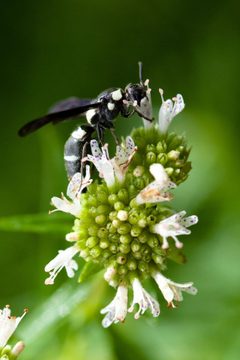
Pseudodynerus quadrisectus is a solitary mason wasp native to eastern North America. First described by Thomas Say in 1837, this is frequently mistaken for the similar Four-toothed Mason Wasp (Monobia quadridens). Females construct multi-celled nests in pre-existing wood cavities, provisioning each with paralyzed caterpillars as food for their larvae. The species is considered beneficial in gardens due to its pollination activity and caterpillar .
Pronunciation
How to pronounce Pseudodynerus quadrisectus: //sjuːdoʊˈdaɪnərəs kwɒdrɪˈsɛktəs//
These audio files are automatically generated. While they are not always 100% accurate, they are a good starting point.
Identification
Distinguished from the similar Monobia quadridens by its slightly smaller size, more slender build, and more extensive white markings—particularly the white band across the middle of the . Also differs from Euodynerus by its larger size and more robust build. The combination of black ground color with ivory markings, medium size, and use of pre-existing wood cavities helps confirm identification.
Images
Appearance
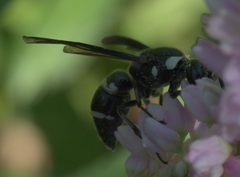
A mid-to-large sized with predominantly black coloration and conspicuous ivory markings. Females have forewing length of 12–16 mm, while males are slightly smaller at 10.5–13 mm. The white markings are more prominent in females than males. Overall body form is slender compared to related mason wasps. The white band across the middle of the is a key identifying feature distinguishing it from similar .
Habitat
Occupies a variety of where suitable nesting sites occur. Requires pre-existing cavities in wood, including abandoned tunnels of carpenter bees (Xylocopa virginica), borings, and other hollows in structural timbers, dead standing trees, or logs. Readily uses artificial nesting resources such as drilled wooden blocks and bundled hollow twigs.
Distribution
Eastern United States from New Jersey south to Florida and west to Texas, with additional records from Mexico and Rica. Northern limits include eastern Pennsylvania and northern Ohio. Western records extend to Kansas and Colorado. Recent observations from southeast Nebraska and southwest Iowa suggest potential range expansion or previously unrecognized distribution.
Seasonality
are active from approximately early June through late August. Two occur per year. The overwinters as pre-pupal larvae within their sealed nest .
Diet
feed on flower nectar and pollen. Larvae are , consuming paralyzed caterpillars provisioned by the mother .
Life Cycle
Solitary nesting with two annually. Females partition pre-existing wood cavities into multiple using mud partitions, working from the bottom up. Each cell is provisioned with paralyzed caterpillars, then receives a single before being sealed. An empty decoy cell is typically constructed at the nest entrance, potentially to confuse . Larvae develop through summer and overwinter in a pre-pupal state, resuming development the following spring.
Behavior
Females demonstrate remarkable gender control, placing male near nest openings (due to shorter developmental time) and female eggs deeper within the tunnel. Nest construction involves creating mud partitions between and a final mud plug sealing the entrance. are docile and rarely sting even when handled; they have been observed tolerating close human presence without defensive .
Ecological Role
Functions as both and agent. nectar-feeding contributes to pollination of summer- and fall-blooming wildflowers including goldenrod (Solidago) and thoroughwort (Eupatorium). Caterpillar helps regulate herbivorous insect . Occupies vacant wood cavities, contributing to nutrient cycling in dead wood .
Human Relevance
Considered beneficial in gardens and landscapes. Can be attracted by planting nectar-rich wildflowers and providing artificial nesting resources such as drilled wooden blocks or hollow twig bundles. Non-aggressive nature makes it safe to observe closely. Occasionally encountered near human structures when nesting in tunnels in outdoor beams.
Similar Taxa
- Monobia quadridensFour-toothed Mason Wasp is larger, more robust, and lacks the distinct white band across the middle of the ; white markings are less extensive overall
- Euodynerus speciesGenerally smaller and less common than P. quadrisectus, with more subdued markings
More Details
Nesting Behavior
Observations indicate females construct empty decoy at both the bottom of the tunnel and between the final cell and nest closure, potentially as a defense against that breach the nest
Pronunciation
The is pronounced 'Sue-doe-DIN-ner-us kwad-ri-SEK-tus'