
Monobia quadridens
(Linnaeus, 1763)
Four-toothed Mason Wasp, Carpenter Wasp
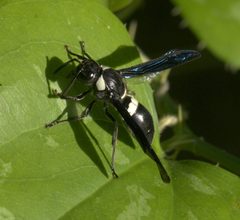
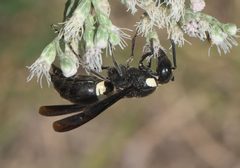
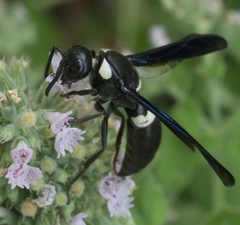
Monobia quadridens is a solitary potter wasp in the Eumeninae, native to eastern North America. are striking black-and-white insects with a distinctive broad ivory band across the first abdominal tergite. The is , producing two annually, with one generation as pupae. Females construct multi-celled nests in pre-existing cavities, provisioning each with paralyzed caterpillars for their larvae.
Pronunciation
How to pronounce Monobia quadridens: /mɔˈnoʊ.biə ˈkwɑː.drɪˌdɛnz/
These audio files are automatically generated. While they are not always 100% accurate, they are a good starting point.
Identification
Distinguished from similar Euodynerus bidens by the single broad white band at the rather than markings. Differs from Pseudodynerus quadrisectus by more robust build, larger size, and white band position (first tergite vs. middle of abdomen). Males readily identified by white facial spot absent in females. Lacks the white tail markings of the Bald-faced Hornet (Dolichovespula maculata).
Images
Appearance
Medium-sized with entirely black except for a broad ivory-white band encircling the first tergite. Wingspan 11.0–14.5 mm in males, 14–18 mm in females. Males distinguished by a prominent white spot on the (); females have entirely black faces. Body robust with typical vespid wasp .
Habitat
Utilizes pre-existing cavities in wood, including abandoned tunnels of carpenter bees (Xylocopa virginica), old mud dauber nests, hollow plant stems, and human-made structures such as holes in firewood, houses, and even weep-holes in vinyl window frames. Nests recorded in diverse substrates including wood, bamboo, and aluminum chair tubes.
Distribution
Eastern North America from southern Ontario and the Eastern Seaboard west to Wisconsin, Kansas, and New Mexico. In Mexico, recorded from Tamaulipas and Nuevo León. Northern range limit in Canada confirmed by specimens in entomological collections.
Seasonality
active primarily June through August or September. Two per year: summer generation emerges and completes development rapidly; second generation overwinters as pupae and emerges the following spring. Males may congregate near nesting sites in late season seeking mating opportunities.
Diet
feed on nectar and pollen from flowers including goldenrod (Solidago), thoroughwort (Eupatorium), mountain mint (Pycnanthemum), spotted horsemint (Monarda), and sumac. Larvae provisioned with paralyzed caterpillars of microlepidoptera, specifically leafrollers (Pyralidae: Phycitinae, Epipaschiinae), webworms (Crambidae: Pyraustinae), and in Elachistidae, Amphisbatidae, Gelechiidae, and Tortricidae. Up to 19 caterpillars recorded per .
Host Associations
- Caterpillars of microlepidoptera - preySpecifically leafrollers, webworms, and related small caterpillars
- Carpenter bee (Xylocopa virginica) - nest site providerUses abandoned tunnels; has been observed evicting mason bees (Osmia spp.) from active nests
- Spiroplasma monobiae - bacterial associateBacterium isolated from of in Maryland
Life Cycle
Solitary nesting in pre-existing cavities. Female constructs 2–5 per nest, each separated by mud partitions and empty intercalary cells that may confuse . Each cell provisioned with paralyzed caterpillars and a single ; eggs hatch in ~2 days. Larval development 4–8 days, followed by pre-pupal stage (~5 days) and . Summer emerge in 10–21 days; males develop faster than females. Second generation overwinters as pupae. Larvae secrete varnish-like substance coating cell walls rather than spinning cocoons.
Behavior
Females hunt caterpillars on vegetation, sting to paralyze, and transport prey to nest. Mud for nest construction gathered and formed into balls carried beneath the body. Nests sealed with mud plugs upon completion. Copulation lasts approximately 30 minutes, notably longer than most . Males patrol nesting sites seeking females and may be aggressive toward competitors but cannot sting. generally docile; females sting only when handled or trapped.
Ecological Role
Important agent of caterpillar pests, particularly leaf-rolling inaccessible to other . Provides pollination services through nectar and pollen feeding. Serves as for parasitic insects including cuckoo wasps (Chrysis spp.), chalcidoid wasps (Leucospis affinis), bee flies (Anthrax aterrimus), sarcophagid flies (Amobia erythrura), and parasitic (Melittobia chalybii).
Human Relevance
Generally beneficial in gardens and landscapes for pest caterpillar control and pollination. Occasionally nests in structural cavities, causing minimal concern due to non-aggressive nature. Sting painful but rarely delivered; females sting only when directly threatened, males deliver non-venomous jab with abdominal tip. Frequently mistaken for more aggressive social . Can be attracted to gardens with appropriate flowers and nesting substrates.
Similar Taxa
- Euodynerus bidensSimilar size and coloration; distinguished by abdominal band position and other subtle morphological differences
- Pseudodynerus quadrisectusAlso black-and-white mason wasp using similar nest sites; smaller, more slender, with white band at middle rather than
- Dolichovespula maculata (Bald-faced Hornet)Similar color pattern but social with white tail markings; builds paper nests rather than using cavities
Misconceptions
"Four-toothed Mason Wasp" origin uncertain and possibly unofficial; also called "Carpenter Wasp" despite not boring wood. Frequently misidentified as aggressive social ; actually solitary and docile. Male wasps sometimes perceived as stinging threats, but males lack stingers entirely and deliver only non-venomous abdominal jabs.
More Details
Nesting biology
Intercalary (empty chambers between cells) and vestibular cell (empty chamber at nest entrance) are distinctive features thought to confuse nest . Female may produce multiple nests in a season if physically able.
Sex determination in nest
Females exhibit protandry control: male placed in outer (emerge first), female eggs in inner cells, preventing conflicts due to faster male development.
Associated mites
Two mite , Tortonia quadridens and Monbiocarus quadridens, described from nests; presumed scavengers on caterpillar remains rather than .
Sources and further reading
- BugGuide
- Wikipedia
- GBIF taxonomy match
- iNaturalist taxon
- NCBI Taxonomy
- Catalogue of Life
- Humans help wasps, wasps help humans: Four-toothed mason wasp, Monobia quadridens — Bug of the Week
- Watch out monarda munchers, a wicked wasp is coming to get you: Four-toothed mason wasp, Monobia quadridens — Bug of the Week
- On the prowl to paralyze pests here in the DMV: Four-toothed mason wasps, Monobia quadridens — Bug of the Week
- Bug Eric: Wasp Wednesday: Four-toothed Mason Wasp
- Bug Eric: The Wasp Wall
- Bug Eric: Wasp Wednesday: Pseudodynerus quadrisectus
- Complete Genome Sequence of Spiroplasma monobiae MQ-1 T (ATCC 33825), a Bacterium Isolated from the Vespid Wasp (Monobia quadridens)