
Pseudodynerus
de Saussure, 1855
mason wasps, potter wasps
Species Guides
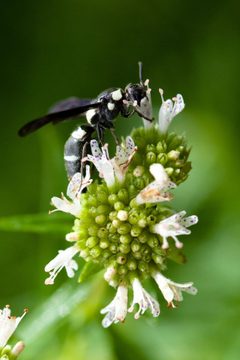
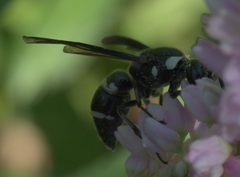
1Pseudodynerus is a small Neotropical of potter wasps (Eumeninae) currently containing 16 recognized . These solitary mason wasps are characterized by their striking black and white coloration and their habit of nesting in pre-existing cavities in wood. Females provision their nests with paralyzed caterpillars as food for their developing larvae. The genus extends northward into the eastern United States, where at least one species, P. quadrisectus, is well-documented.
Pronunciation
How to pronounce Pseudodynerus: /ˌpsuː.doʊˈdaɪ.nə.rəs/
These audio files are automatically generated. While they are not always 100% accurate, they are a good starting point.
Images
Distribution
Native to the Neotropical region, with 16 described distributed across Central and South America. At least one species, Pseudodynerus quadrisectus, ranges northward through the eastern United States from Florida to New Jersey, eastern Pennsylvania, and northern Ohio, westward to eastern Texas, Kansas, and Colorado. Recent observations suggest possible range expansion into southeast Nebraska and southwest Iowa.
Seasonality
activity varies by and latitude. In the eastern United States, Pseudodynerus quadrisectus is on the wing from approximately early June through late August. The species appears to have two per year in this region, with winter spent in a pre-pupal larval stage.
Life Cycle
Solitary nesting . Females utilize pre-existing cavities in wood, including abandoned nests of carpenter bees (Xylocopa virginica) and borings. Nests are partitioned with mud into multiple constructed from the bottom up. Each cell is provisioned with paralyzed caterpillars, with observations indicating up to 19 caterpillers per cell in related mason wasps. A single is laid per cell, with male eggs typically placed nearer the nest entrance and female eggs deeper within. The nest is sealed with a mud plug, often with an empty decoy cell between the last provisioned cell and the closure. Two per year occur in temperate regions; winter is passed as a pre-pupal larva.
Behavior
Females hunt caterpillars on flowers and foliage, using venom to paralyze prey. feed on flower nectar, particularly from summer- and fall-blooming plants such as goldenrod (Solidago spp.) and thoroughwort (Eupatorium spp.). They demonstrate remarkable gender control in offspring placement, positioning male closer to nest entrances due to shorter developmental time. The creation of empty decoy at nest closures may serve as a defense against .
Ecological Role
of caterpillars, contributing to natural pest suppression in gardens and natural . function as while foraging for nectar. They serve as occupants of secondary cavities created by wood-boring insects, contributing to cavity-nesting dynamics. Their nesting habits make them vulnerable to , driving the evolution of defensive strategies such as decoy .
Human Relevance
Beneficial insects in gardens and agricultural settings due to caterpillar . Non-aggressive; females rarely sting even in self-defense. Can be attracted to gardens by planting nectar sources and providing artificial nesting sites such as drilled wooden blocks or hollow twig bundles. Sometimes mistaken for the more aggressive bald-faced hornet (Dolichovespula maculata) or the similar four-toothed mason wasp (Monobia quadridens).
Similar Taxa
- Monobia quadridensFour-toothed mason wasp with similar black and white coloration and shared nesting habits. Pseudodynerus quadrisectus is slightly smaller, more slender, and features more extensive white markings including a distinct white band across the middle of the . Both use pre-existing wood cavities and abandoned nests.
- Euodynerus spp.Some resemble Pseudodynerus in general appearance but are generally smaller and less commonly encountered. Distinguished by subtle differences in markings and body proportions.
- Dolichovespula maculataBald-faced hornet, a social that shares black and white coloration. Distinguished by larger size, social colony , and paper nest construction rather than solitary cavity nesting.
More Details
Taxonomic history
The was established by de Saussure in 1855 and currently comprises 16 recognized . Species have been described by various authors including Bertoni, Brèthes, Fox, Saussure, Zavattari, Bequaert, and more recently Hermes & Melo.
Conservation and research needs
Basic natural history remains poorly documented for most , including specific prey preferences, exact nest architecture details, and geographic distribution boundaries. The northern range limits of Neotropical species and potential climate-driven range shifts warrant continued observation.