
Euodynerus
Blüthgen, 1938
potter wasps, mason wasps
Species Guides
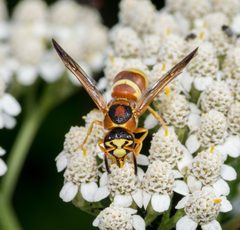
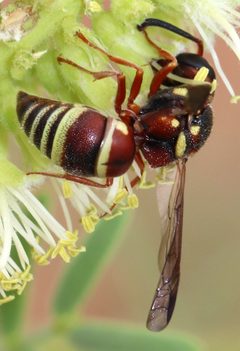
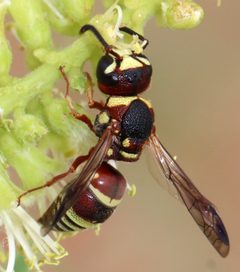
24Euodynerus is a of solitary potter wasps in the Eumeninae, characterized by diverse nesting including the use of pre-existing cavities, mud construction, and in some , burrow excavation with distinctive mud chimneys. The genus has a primarily Holarctic distribution with extensions into tropical regions. Females provision nests with paralyzed caterpillars as food for their larvae. Several species are widespread across North America and have been documented using artificial nest blocks.
Pronunciation
How to pronounce Euodynerus: /juːoʊˈdaɪnərəs/
These audio files are automatically generated. While they are not always 100% accurate, they are a good starting point.
Identification
Members of Euodynerus can be distinguished from similar Eumeninae by a combination of thoracic and abdominal characters. The propodeum (hindmost thoracic segment) varies in angulation between . The hind margins of the first and second abdominal segments (tergites) may be clear and reflexed (turned up) or not, depending on species. Males typically have hooked tips on the and a less robust appearance than females. Many species exhibit a blocky or 'chunky' with angular edges. Coloration and markings vary considerably among species and .
Images
Habitat
vary by . Euodynerus annulatus excavates burrows in both hard and soft soils, often near water sources where females can regurgitate water to soften soil during nest construction. Euodynerus hidalgo nests in pre-existing cavities including abandoned mud dauber nests, old solitary burrows, and even holes where rusted nails have fallen out of old buildings. Euodynerus dantici in Mongolia nests in on sun-exposed, wind-sheltered walls of ancient monasteries and uses artificial trap nests in pine wood. Euodynerus foraminatus occupies bee blocks and other wooden cavities with holes of suitable diameter.
Distribution
Primarily Holarctic, with extensions through the Indomalayan, Australasian, Afrotropical, and northern Neotropical regions. One is reported from Hawaii. In North America, multiple species range coast to coast across the United States and into Canada and Mexico. Euodynerus annulatus occurs from coast to coast in the United States, south to Mexico, and in the Canadian provinces of British Columbia, Alberta, Saskatchewan, and Ontario. Euodynerus hidalgo ranges across the United States from Atlantic to Pacific coasts with three . Euodynerus dantici is distributed across the Palearctic region including Mongolia.
Seasonality
Euodynerus dantici shows protandry with males emerging in mid-June and females in early July; females disappear by late August. Euodynerus hidalgo produces at least two per year in eastern North America, with nesting activity observed into October. General activity period for the in temperate regions spans late spring through summer.
Diet
feed on nectar from flowers. Females hunt caterpillars to provision nests for their larvae. Documented prey include Crambidae, Pyralidae, Noctuidae, Oecophoridae, Tortricidae, and Gelechiidae. Euodynerus foraminatus specializes on caterpillars that conceal themselves in rolled or tied leaves. Euodynerus dantici provisions with 1-11 caterpillars, averaging 4.3 for male-producing outer cells and 7.1 for female-producing inner cells. Caterpillars are typically paralyzed but in some may remain weakly ambulatory.
Host Associations
- Chrysis ignita - nest Reared from 38% of E. dantici nests in Mongolia; first record from this
- Pseudoxenos hookeri - of Strepsipteran 'twisted-wing ' causing abdominal bulges in E. annulatus; no nest parasites recorded for this
Life Cycle
Solitary with or multivoltine depending on and latitude. Euodynerus dantici is univoltine, as . Euodynerus hidalgo produces at least two annually in eastern North America. Nests contain one to multiple . are suspended from the cell wall or ceiling by a thin stalk. Larvae progress through four instars, complete feeding in approximately 14 days, then enter a prepupal . duration is sexually dimorphic in E. dantici: males 37-61 days, females 53-66 days. Cocoons are brown, delicate, and incomplete, attached to cell walls.
Behavior
Nesting are diverse and -specific. Euodynerus annulatus excavates burrows and constructs curved mud chimneys aboveground, later deconstructing the turret to seal the nest flush with soil. Euodynerus hidalgo uses pre-existing cavities, partitioning with mud or sand. Euodynerus foraminatus uses blocks, sealing completed tunnels with mud plugs. Euodynerus dantici exhibits 14 distinct behavioral elements including temperature testing before departure, basking, mud collection from 2.5-4 m range, aggressive defense against to the death, and 'floating' behavior when searching for their own nest. Some species are gregarious, with multiple females nesting in proximity. Males of some species actively dig to reach pre-emergent females.
Ecological Role
of caterpillars, particularly those of containing agricultural and garden pests. through nectar-feeding. for including cuckoo wasps (Chrysididae) and twisted-wing parasites (Strepsiptera). Nest architecture diversity in some may represent evolutionary response to parasitoid pressure.
Human Relevance
Beneficial insects for gardens and agriculture due to on pest caterpillars. Readily use artificial nest blocks (' blocks' or 'bee condos'), providing opportunities for citizen science and backyard observation. Euodynerus foraminatus and related have been documented nesting in wooden structures including IKEA furniture, sometimes causing minor concern but generally harmless. Educational value for demonstrating solitary and natural pest control.
Similar Taxa
- AncistrocerusBoth are Eumeninae with similar mason wasp habits; Euodynerus typically distinguished by thoracic and abdominal segment characters including propodeum shape and tergite margins
- SymmorphusRelated Eumeninae with potter wasp habits; Euodynerus generally have different nest architecture and abdominal markings
- Euodynerus hidalgo vs. E. annulatusThese sympatric can be confused; E. hidalgo has more angulate propodeum and clear, reflexed hind margins of first and second tergites, while E. annulatus has less angulate propodeum and non-reflexed tergite margins
More Details
Nest Architecture Diversity
Euodynerus dantici exhibits remarkable nest architecture diversity with 16 distinct types observed, hypothesized as an evolutionary response to pressure from Chrysis ignita. This represents one of the most architecturally variable nest structures documented in solitary .
Sex Determination System
Euodynerus foraminatus has single-locus complementary sex determination (sl-CSD), where heterozygous develop as females and homozygous genotypes develop as males. Despite this system normally being incompatible with inbreeding, 55-77% of matings in one Michigan occurred between siblings.
Sexual Dimorphism in Provisioning
In Euodynerus dantici, females develop in longer inner provisioned with more caterpillars (mean 7.1), while males develop in shorter outer cells with fewer prey items (mean 4.3). This represents a form of sex ratio manipulation through differential provisioning.
Sources and further reading
- BugGuide
- Wikipedia
- GBIF taxonomy match
- iNaturalist taxon
- NCBI Taxonomy
- Catalogue of Life
- Bug Eric: Wasp Wednesday: Euodynerus annulatus
- Bug Eric: Wasp Wednesday: Euodynerus hidalgo
- Bug Eric: The Mason Wasp Euodynerus foraminatus Endorses Bee Blocks
- Bug Eric: August 2012
- Nesting Biology and Behavior of Euodynerus dantici(Rossi, 1790) (Hymenoptera: Vespidae: Eumeninae) in Central Mongolia
- Description of mature larvae of Allodynerus rossii (Lepeletier), Ancistrocerus auctus (Fabricius), Euodynerus dantici (Rossi) and Symmorphus murarius (Linnaeus) (Hymenoptera, Vespidae)
- Inbreeding in a natural population of Euodynerus foraminatus (Hymenoptera: Vespidae), a solitary wasp with single‐locus complementary sex determination