
Euodynerus annulatus
(Say, 1824)
mason wasp
Species Guides
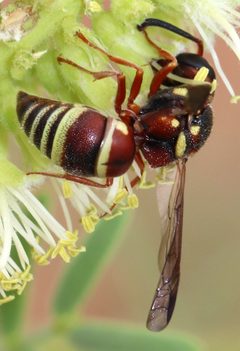
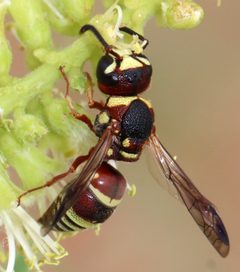
2Euodynerus annulatus is a solitary mason wasp in the Eumeninae, notable for its unusual nesting among its relatives. Unlike most mason wasps that use pre-existing cavities, females excavate their own burrows in soil and construct distinctive curved mud chimneys aboveground. The is widespread across North America with five recognized showing considerable variation in coloration and markings. It provisions nests with paralyzed caterpillars from several for its larval offspring.
Pronunciation
How to pronounce Euodynerus annulatus: /juːəʊˈdaɪnərəs ænˈjuːlætəs/
These audio files are automatically generated. While they are not always 100% accurate, they are a good starting point.
Identification
Distinguished from the very common Euodynerus hidalgo by the less angulate propodeum and by hind margins of the first and second tergites that are not clear and reflexed. Males can be recognized by hooked tips and less robust build. The five (E. a. annulatus, E. a. arvensis, E. a. evectus, E. a. imperialis, E. a. sulphureus) show considerable color and marking variation, with three subspecies having western distributions.
Images
Appearance
A fairly large mason wasp with forewing length of 8.5–10.5 millimeters. Coloration and markings vary considerably among the five . The propodeum (hindmost thoracic segment) is less angulate than in the similar Euodynerus hidalgo. Hind margins of the first and second abdominal segments (tergites) are not clear and reflexed (turned up) as they are in E. hidalgo. Males have hooked tips on the and a less robust appearance than females.
Habitat
Found in situations close to water, as females regurgitate water to soften soil during nest construction. Nests are excavated in various soil types from hard to soft. Observed at Florissant Fossil Beds National Monument in Colorado at approximately 8,500 feet elevation, foraging on early-blooming rabbitbrush (Ericameria sp.).
Distribution
Transcontinental in the United States, from coast to coast; south to Mexico. Canadian records include British Columbia, Alberta, Saskatchewan, and Ontario (Ontario record from 1954, Saskatchewan record recent). Five recognized, three with western distributions.
Diet
Host Associations
- Loxostege - major (caterpillars provisioned for larvae)Alfalfa Webworm and relations abundant along Colorado Front Range
- Crambidae - (larval food)caterpillars provisioned for offspring
- Pyralidae - (larval food)caterpillars provisioned for offspring
- Noctuidae - (larval food)caterpillars provisioned for offspring
- Ericameria - nectar source observed feeding on early-blooming rabbitbrush
Life Cycle
Females excavate burrows in soil and construct curved mud chimneys aboveground. Several individual branch from the main burrow underground. A single is suspended from a short thread attached to the cell wall before the cell is stocked with several caterpillars. When all cells are provisioned, the nest entrance is sealed and the female begins a new nest. The chimney is eventually deconstructed entirely and the nest entrance made flush with surrounding soil. Developmental timing not documented for this .
Behavior
Females excavate their own burrows rather than using pre-existing cavities, unusual among mason wasps. They extend tunnels aboveground as curved mud chimneys, which may aid in nest defense and provide mud for final nest closure. visit flowers for nectar. Males and females may be found together at nectar sources.
Ecological Role
of caterpillars ( larvae), potentially providing of herbivorous moth including some agricultural pests. contribute to pollination as flower visitors. Serves as for twisted-wing Pseudoxenos hookeri.
Human Relevance
May contribute to suppression of caterpillar including agricultural pests such as Alfalfa Webworm. Unusual nesting makes it of interest for natural history observation. No nest recorded, suggesting potentially effective agent.
Similar Taxa
- Euodynerus hidalgoVery common and widespread; distinguished by more angulate propodeum and reflexed, clear hind margins on first and second tergites; uses pre-existing cavities rather than excavating burrows
More Details
Nesting Biology
Described as Odynerus geminus in Rau and Rau (1918) pages 300–312. Chimney construction and later deconstruction to hide nest entrance is well-documented but functionally enigmatic—may aid defense against and provide material for final closure.
Parasites
No nest recorded. vulnerable to twisted-wing parasite Pseudoxenos hookeri; parasitized individuals show abdominal bulges with extrusions between segments.
Subspecies
Five : E. a. annulatus (Say, 1824), E. a. arvensis (de Saussure, 1869), E. a. evectus (Cresson, 1872), E. a. imperialis (Bohart, 1945), E. a. sulphureus (de Saussure, 1858). Three western subspecies show considerable color and marking variation.