
Odynerus
Latreille, 1802
potter wasps, mason wasps
Species Guides
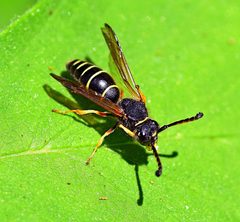
4Odynerus is a primarily Holarctic of potter wasps in the Eumeninae. The genus has been widely used as a root for constructing names of other potter wasp genera with non-petiolated metasoma, including Euodynerus, Acarodynerus, Stenodynerus, Parodontodynerus, and Incodynerus. within this genus are solitary that construct nests using mud or soil, often with distinctive turrets or chimneys. The genus contains hundreds of species, with Odynerus spinipes being particularly notable for exhibiting exceptional intrasexual cuticular hydrocarbon dimorphism in females.
Pronunciation
How to pronounce Odynerus: /oʊˈdaɪ.nɛr.əs/
These audio files are automatically generated. While they are not always 100% accurate, they are a good starting point.
Images
Habitat
Nesting sites vary by : some utilize pre-existing cavities such as borings in wood, hollow plant stems, or crevices in walls; others construct free-standing mud nests on exposed surfaces including twigs, rocks, or walls; some excavate vertical burrows in horizontal ground surfaces surmounted by turrets. Species nesting in soil often favor situations close to water, using regurgitated water to soften soil during construction.
Distribution
Primarily Holarctic; recorded from Denmark, Norway, Sweden, Germany (Kaiserstuhl region), Ukraine (Crimea), Canada (Alberta, British Columbia, Saskatchewan, Ontario), and the United States. The has a Palearctic distribution with some extending into the Nearctic.
Diet
Host Associations
- Hypera postica - -preyalfalfa weevil larvae provisioned as prey in Alberta and Utah
- Phytonomus - -preyweevil larvae carried as prey by O. reniformis
- Loxostege - -preycaterpillars recorded as major for some
Life Cycle
Solitary nesting; females construct nests and provision individually. Nests typically contain 1-10 cells depending on . Females lay a single suspended from a short thread attached to the cell wall before stocking with prey. Larvae feed on provisioned prey, then pupate. Completed nests are sealed with mud, sometimes using demolished turret material.
Behavior
Females exhibit advanced parental care through nest construction and provisioning. Some practice . Nest construction involves building distinctive turrets or chimneys from mud pellets; turret shape varies by species (curved and sideward-opening versus straight and upward-opening). Females have been observed to deconstruct turrets entirely when sealing nests, making entrances nearly invisible. Some species exhibit gregarious nesting, with multiple females nesting in close proximity. Males of some species actively dig to reach pre-emergent females and may form sleeping clusters.
Ecological Role
of agricultural pests including alfalfa weevil; potential agent in programs. As solitary , they contribute to regulation of herbivorous insect through larval provisioning.
Human Relevance
Studied for potential against alfalfa weevil (Hypera postica). Some may be confused with common such as Euodynerus hidalgo, requiring careful identification for monitoring purposes.
Similar Taxa
- EuodynerusFormerly classified under Odynerus; distinguished by non-petiolated metasoma and other structural features
- StenodynerusDerived name from Odynerus root; shares non-petiolated metasoma characteristic
- Euodynerus hidalgoSimilar appearance but with more angulate propodeum and clear, reflexed hind margins on first and second tergites
More Details
Chemotype dimorphism
Odynerus spinipes exhibits exceptional intrasexual cuticular hydrocarbon (CHC) dimorphism, with females expressing one of two distinct chemotypes. This dimorphism appears to have evolved in response to cleptoparasitic pressure from cuckoo wasps (Chrysididae), which mimic CHC profiles to evade detection.
Taxonomic influence
The name Odynerus has been extraordinarily influential in potter wasp , serving as the root for numerous derived genus names indicating non-petiolated metasoma .
Sources and further reading
- BugGuide
- Wikipedia
- GBIF taxonomy match
- iNaturalist taxon
- NCBI Taxonomy
- Catalogue of Life
- Bug Eric: Wasp Wednesday: Euodynerus annulatus
- Bug Eric: August 2012
- Nesting Biology of Odynerus albopictus calcaratus (Morawitz, 1885) and Odynerus femoratus de Saussure, 1856 (Hymenoptera: Vespidae: Eumeninae)
- Landing- and Take-off Flight Behaviour of the Potter wasp Odynerus reniformis at its Nesting Tube With and Without a Load (Hymenoptera: Eumenidae)
- OBSERVATIONS ON NESTING BEHAVIOR AND TURRET CONSTRUCTION BYODYNERUS DILECTUS(HYMENOPTERA: EUMENIDAE)
- A WEEK WITH A MINING EUMENID: AN ECOLOGICO BEHAVIOR STUDY OF THE NESTING HABITS OF ODYNERUS DORSALIS FAB
- Cuticular Hydrocarbons on Old Museum Specimens of the Spiny Mason Wasp, Odynerus spinipes , (Hymenoptera: Vespidae: Eumeninae) Shed Light on the Distribution and on Regional Frequencies of Distinct Chemotypes
- Striking cuticular hydrocarbon dimorphism in the mason waspOdynerus spinipesand its possible evolutionary cause (Hymenoptera: Chrysididae, Vespidae)
- Cuticular hydrocarbons on old museum specimens of the spiny mason wasp, Odynerus spinipes (Hymenoptera: Vespidae: Eumeninae), shed light on the distribution and on regional frequencies of distinct chemotypes