
Hypera postica
(Gyllenhal, 1813)
Alfalfa Weevil
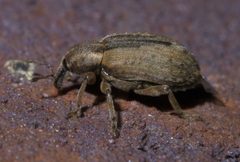
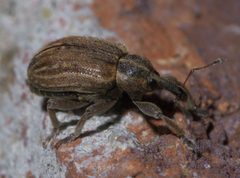
, the alfalfa weevil, is a small curculionid native to Europe and a major pest of alfalfa in North America following accidental introductions. measure 4–5.5 mm and are brown with a dark mid- stripe; larvae are yellowish-green with a black and white dorsal stripe, reaching about 1 cm before . The causes significant economic damage through larval skeletonization of alfalfa foliage, with yield reductions up to 15%. Multiple agents, particularly in the Bathyplectes, have been introduced to manage .
Pronunciation
How to pronounce Hypera postica: /haɪˈpɪərə ˈpɒstɪkə/
These audio files are automatically generated. While they are not always 100% accurate, they are a good starting point.
Identification
Distinguished from the closely related clover leaf weevil (Hypera punctata) by its smaller size (H. punctata is nearly twice as large) and the black of its larvae (H. punctata larvae have tan heads). may be separated from other small brown weevils in alfalfa by the combination of short broad rostrum, half as wide as rostrum, and the dark mid- stripe. Sweep net sampling or beat bucket methods are standard for detection; larvae are found between folded terminal leaves when young, and on open leaflets when older.
Images
Habitat
Primarily associated with alfalfa (Medicago sativa) cropping systems. overwinter in alfalfa crowns, coarse vegetation in ditches, fence lines, or nearby woodland edges. Larvae develop within alfalfa stems and on foliage. In summer, adults undergo in protected areas away from fields, returning in fall.
Distribution
Native to Europe, with established across much of the continent including Britain, France, Germany, Italy, Spain, and Scandinavia. Introduced and established in North America (United States, Canada), where it is a major pest. Also recorded in Asia (Afghanistan, India, Iran, Iraq, Israel, Lebanon, Pakistan, Saudi Arabia, Turkey), North Africa (Algeria, Egypt, Libya, Morocco, Tunisia), and the Canary Islands.
Seasonality
Activity varies by region. In Illinois and similar temperate zones: become active in March–April after . laid in alfalfa stems in batches up to 25. Larval feeding occurs over 3–4 weeks with three . lasts 1–2 weeks, with new adults emerging in late spring. Adults feed briefly then enter summer , returning to fields in fall. Some oviposition occurs in late fall or winter when weather permits. In the southern United States, larvae may be present from early February through March, with activity extending over 6–8 weeks.
Diet
Both larvae and feed on alfalfa foliage. Young larvae feed on terminal leaf buds and between folded leaflets, creating puncture marks. Older larvae skeletonize leaves by feeding between , leaving a grayish-white appearance from a distance. Adults feed on leaf edges, producing a characteristic feathery appearance. Also recorded feeding on clover (Trifolium spp.) and vetch.
Host Associations
- Medicago sativa - primary alfalfa; main economic
- Trifolium spp. - secondary clover
Life Cycle
Complete with four stages. laid in batches of up to 25 inside alfalfa stems. Larvae pass through three instars over 3–4 weeks, feeding on foliage. Mature larvae drop to ground and spin silken cocoons in leaf litter. Pupal stage lasts 1–2 weeks. emerge, feed briefly, then may enter summer with dampened metabolic, respiratory, and activity. adults resume activity in spring. Some fall/winter egg-laying occurs in mild conditions.
Behavior
feeding activity for both larvae and . Adults demonstrate summer (summer dormancy) in response to hot, dry conditions, seeking shelter in protected vegetation. When disturbed, adults may drop from plants. Cocoons of the Bathyplectes anurus (associated with this ) can 'jump' several centimeters when disturbed, though this is a parasitoid trait rather than of the weevil itself.
Ecological Role
Major herbivore in alfalfa agroecosystems. Larval feeding significantly reduces plant and forage quality. Serves as for multiple introduced agents including Bathyplectes anurus, B. curculionis, and Microctonus aethiopoides. Larvae may be killed by the fungus Zoophthora phytonomi, particularly in warm, humid weather.
Human Relevance
Significant agricultural pest of alfalfa, a major forage crop for dairy and livestock industries. Yield reductions up to 15% documented. Management relies on including early cutting, with introduced , and application when thresholds are exceeded. guide treatment decisions: approximately 0.5–2.0 larvae per stem depending on plant height and proximity to harvest. Insecticide resistance has been documented in western United States . Subject of ongoing research for improved resistance management.
Similar Taxa
- Hypera punctataClover leaf weevil; nearly twice as large as H. postica, with tan-headed larvae versus black-headed larvae of H. postica; seldom causes significant alfalfa damage
More Details
Biological Control History
Multiple accidental introductions to North America occurred, followed by deliberate introduction of several agents. Bathyplectes anurus is generally considered superior to B. curculionis due to higher reproductive rate. The jumping of B. anurus cocoons aids in avoiding .
Insecticide Resistance
in the western United States have developed resistance to certain , prompting ongoing research into resistance monitoring and management strategies.
Sources and further reading
- BugGuide
- Wikipedia
- GBIF taxonomy match
- iNaturalist taxon
- NCBI Taxonomy
- Catalogue of Life
- Who's Speaking at the UC Davis Entomology/Nematology Seminars? | Bug Squad
- Alfalfa Insects - AgriLife Extension Entomology
- Bohart Museum Virtual Open House: Think Pests of Alfalfa and Rice | Bug Squad
- Ian Grettenberger Targets a Variety of Pests | Bug Squad
- Jasmin Ramirez Bonilla: Targeting Cucumber Beetles on Melons | Bug Squad
- Ag Pests, Spiders, and California Dogface Butterflies Stealing the Spotlights | Bug Squad
- Hypera postica . [Distribution map].
- Hypera postica . [Distribution map].
- Crop seeding manipulation affects densities of the alfalfa weevil, Hypera postica,and its introduced parasitoid, Bathyplectes anurus
- Spatial Distribution Patterns of Hypera postica in Kentucky Alfalfa Fields
- Mating behavior ofBathyplectes curculionis [Hym.: Ichneumonidae] a parasitoid of the alfalfa weevil,Hypera postica Col.: Curculionidae]
- Effect of Spatial Distribution on Determining the Number of Samples Required to Estimate Populations of Hypera postica, Sitona hispidulus , and Hypera punctata1 for Specified Probability and Accuracy Levels 2
- Notes on the Biology of the Alfalfa Weevil, Hypera postica, in Alabama
- Further Studies of the Physical Ecology of the Alfafa Weevil, Hypera Postica (Gyllenhal)
- Recovery of Oomyzus incertus (Hymenoptera: Eulophidae), a Larval Parasitoid of Hypera postica (Coleoptera: Curculionidae), in Virginia
- Notes on the Biology of Hemiteles graculus (Hymenoptera: Ichneumonidae) Parasitizing the Alfalfa Weevil, Hypera postica
- Field Studies on the Biology of the Alfalfa Weevil, Hypera postica,1 in Northeast Mississippi2
- Biology of Microctonus aethiopoides , 1 a Parasite of the Alfalfa Weevil, Hypera postica , 2 in Ontario 3
- Hypera postica 1 and Bathyplectes curculionis : 2 Encapsulation of Parasite Eggs by Host Larvae in Missouri and Arkansas