
Hypera
Germar, E.F., 1817
clover weevils, alfalfa weevils
Species Guides
10- Hypera brunnipennis(Egyptian alfalfa weevil)
- Hypera compta
- Hypera diversipunctata
- Hypera eximia
- Hypera meles(Clover Head Weevil)
- Hypera nigrirostris(lesser clover leaf weevil)
- Hypera paludicola
- Hypera postica(Alfalfa Weevil)
- Hypera quadricollis(hibiscus flea beetle)
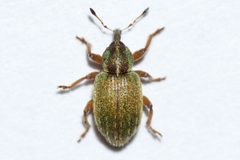
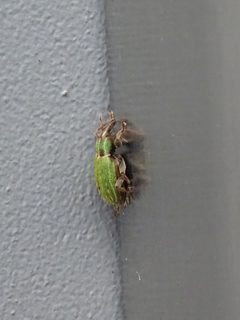
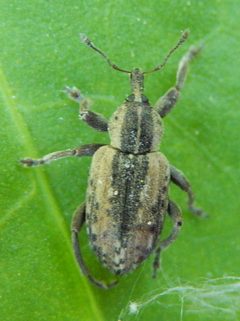
Hypera is a large of weevils in the Curculionidae, tribe Hyperini, containing at least 280 described . The genus includes several economically significant agricultural pests, notably the alfalfa weevil (Hypera postica), which is the most problematic insect pest for alfalfa growers in the western United States. Species in this genus are associated with leguminous plants, particularly clovers (Trifolium spp.) and alfalfa (Medicago sativa).
Pronunciation
How to pronounce Hypera: /haɪˈpɛrə/
These audio files are automatically generated. While they are not always 100% accurate, they are a good starting point.
Identification
Hypera are distinguished from other Curculionidae by their elongate body form and association with leguminous plants. The subgenus Dapalinus, for example, can be identified by characteristic coloration patterns on the , with specific intervals showing dark and pale banding. Species-level identification typically requires examination of genitalia structure and detailed elytral coloration patterns.
Images
Habitat
Agricultural fields, particularly alfalfa and clover stands; also found in natural and semi-natural supporting Fabaceae plants.
Distribution
Widespread across the Palearctic region including Europe, North Africa, and Asia; introduced and established in North America (all lower 48 states of the USA and Canada). Distribution records exist from Denmark, Norway, Sweden, and Vermont, USA.
Host Associations
- Medicago sativa - primary alfalfa/lucerne
- Trifolium spp. - primary clovers
- Vicia spp. - vetches
- Vicia palaestina - larval documented for H. kayali
Life Cycle
Complete with , larval, pupal, and stages. In Hypera postica, eggs are laid in alfalfa stems; larvae feed for two to four weeks through four instars before pupating; adults feed for one to two weeks. The larval stage causes the most damage to plants.
Ecological Role
Herbivores of leguminous plants; serve as for including Bathyplectes spp. and Oomyzus incertus.
Human Relevance
Several are major agricultural pests. Hypera postica (alfalfa weevil) causes significant yield and quality losses in alfalfa production. Management requires approaches including , cultural controls, and selective use. Some species have been subject to programs using introduced .
Similar Taxa
- SitonaAlso weevils associated with leguminous plants; Sitona hispidulus (clover root curculio) is a related pest of alfalfa and clover but belongs to a different with distinct larval feeding habits (root feeding versus foliar feeding)
- PhytonomusHistorical confusion exists; Phytonomus variabilis has been used as a synonym for Hypera postica in some literature
More Details
Taxonomic diversity
The contains at least 280 described , with subgenera including Dapalinus. New species continue to be described, such as Hypera kayali from Syria (2006).
Biological control context
Hypera postica has been extensively studied for , with multiple introduced to North America including Bathyplectes curculionis, Bathyplectes anurus, and Oomyzus incertus.
Sources and further reading
- BugGuide
- Wikipedia
- GBIF taxonomy match
- iNaturalist taxon
- NCBI Taxonomy
- Catalogue of Life
- Who's Speaking at the UC Davis Entomology/Nematology Seminars? | Bug Squad
- Shedding New Light on Honey Bee Chromosomes | Bug Squad
- Waxy lady beetles come to the rescue of pest-plagued crapemyrtles, Hyperaspis spp. — Bug of the Week
- Alfalfa Weevil: New Integrated Pest Management Guide Available
- Clover Root Curculio: Historic Perspectives Guide Modern Management
- Uncategorized | Blog - Part 23
- Hypera postica . [Distribution map].
- Hypera postica . [Distribution map].
- Effect of Spatial Distribution on Determining the Number of Samples Required to Estimate Populations of Hypera postica, Sitona hispidulus , and Hypera punctata1 for Specified Probability and Accuracy Levels 2
- Hypera kayali sp. nov. (Coleoptera: Curculionidae, Hyperini) from Syria, with bionomic data
- Unusual Host Records for Gymnaetron pascuorum, Hexarthrum ulkei, Chalcodermus aeneus, and Hypera nigrirostris (Coleoptera: Curculionidae)
- Crop seeding manipulation affects densities of the alfalfa weevil, Hypera postica,and its introduced parasitoid, Bathyplectes anurus
- Mating behavior ofBathyplectes curculionis [Hym.: Ichneumonidae] a parasitoid of the alfalfa weevil,Hypera postica Col.: Curculionidae]
- Spatial Distribution Patterns of Hypera postica in Kentucky Alfalfa Fields
- Recovery of Oomyzus incertus (Hymenoptera: Eulophidae), a Larval Parasitoid of Hypera postica (Coleoptera: Curculionidae), in Virginia
- The Rediscovery and Life History of the Enigmatic Weevil Hypera libanotidis (Coleoptera: Curculionidae): A Description of the Mature Larva and Pupa After More than a Century.