
Zeta argillaceum
(Linnaeus, 1758)
Potter wasp
Zeta argillaceum is a common native to South America, ranging from southern South America north to Mexico and the southern United States. The builds distinctive spherical mud nests, typically attached to vertical surfaces such as building walls. Females provision each nest with paralyzed geometrid larvae as food for their offspring. The species has been observed to adapt readily to urban environments and its nests are frequently reused by other potter wasp species.
Pronunciation
How to pronounce Zeta argillaceum: /ˈzɛ.ta ar.giˈla.ki.um/
These audio files are automatically generated. While they are not always 100% accurate, they are a good starting point.
Identification
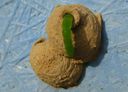
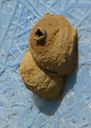
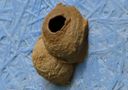
Identified by its spherical mud nest approximately 18 mm in diameter with a single small entrance hole, typically attached to vertical surfaces in small groups. Distinguished from similar potter wasps by nest architecture and geographic range; -level identification of requires examination of morphological characters not detailed in available sources.
Images
Appearance
Medium-sized with typical eumenine . The nest is roughly spherical, up to 18 mm in diameter, with a single small entrance hole—this distinctive nest architecture is often the most visible sign of the ' presence.
Habitat
Highly adaptable to anthropogenic environments; nests commonly found on walls of buildings in urban areas. Occurs in both natural and modified landscapes throughout its range.
Distribution
Native to South America, found throughout the continent from southern regions to Mexico. Present in southern United States (Florida and likely other southern states), where it is thought to have been accidentally introduced. Documented in southern Florida, U.S. through nesting studies.
Diet
females hunt paralyzed living geometrid larvae to provision nest for offspring; adult diet not specified.
Host Associations
- Melittobia australica - Eulophid that parasitizes Z. argillaceum
- Geometridae - preyLarvae used as food for developing offspring
- Pachodynerus spp. - nest commensalOther potter wasps that reuse abandoned Z. argillaceum nests
Life Cycle
Solitary with single- nest use. Female constructs spherical mud nest , lays single , and provisions cell with paralyzed larvae. Larva feeds on stored prey, pupates within cell, and emerges. Nest is used only once by Z. argillaceum but frequently reused by other .
Behavior
Nests in small groups on vertical surfaces. Stocks nest with living but paralyzed prey. Demonstrates behavioral plasticity in use, readily colonizing urban structures.
Ecological Role
of geometrid larvae; provides nest substrate for other through nest reuse; serves as for .
Human Relevance
Common in urban areas where nests on buildings may be conspicuous. No documented negative impacts; may provide incidental of . Nests sometimes mistaken for those of other .
Similar Taxa
- Pachodynerus spp.Similar potter wasps that reuse Z. argillaceum nests; distinguished by different nest architecture and direct observation of nesting
- Other EumeninaeMany potter wasps build mud nests; Z. argillaceum identified by specific spherical shape, 18 mm diameter, and geographic distribution
More Details
Nesting biology
Nests are constructed from mud and attached to substrates by a narrow stalk. The spherical shape and entrance hole structure are distinctive. Nests are built de novo each rather than expanded or maintained across generations.
Sources and further reading
- BugGuide
- Wikipedia
- GBIF taxonomy match
- iNaturalist taxon
- Catalogue of Life
- Insects that feed on developing grain in the head - AgriLife Extension Entomology
- Insects and mites that feed on leaves - AgriLife Extension Entomology
- A Great Day for Vacaville Kids to Learn About Bees | Bug Squad
- An Eyewitness to the Fall of Saigon and a Glance at Mosquitoes and Malaria | Bug Squad
- Forage Sorghum Insects - AgriLife Extension Entomology
- Hay and Pasture Insects - AgriLife Extension Entomology
- NESTING BIOLOGY OF ZETA ARGILLACEUM (HYMENOPTERA: VESPIDAE: EUMENINAE) IN SOUTHERN FLORIDA, U.S.