
Pachodynerus
Saussure, 1875
potter wasps
Species Guides
5- Pachodynerus californicus
- Pachodynerus erynnis(Red-marked Pachodynerus Wasp)
- Pachodynerus guadulpensis
- Pachodynerus nasidens(Keyhole Wasp)
- Pachodynerus pulverulentus(Keyhole wasp)
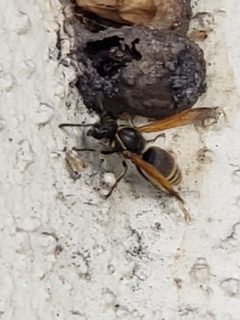
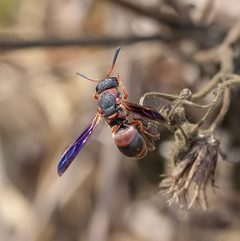
Pachodynerus is a of approximately 50 of solitary potter wasps in the Eumeninae. The genus exhibits highest diversity in central South America, with species distributed across the Neotropical and Nearctic regions. These are cavity-nesters that construct mud in pre-existing holes, including abandoned insect burrows, plant stems, and human-made structures. Several species have been introduced beyond their native ranges, including P. nasidens which has established on oceanic islands and caused aviation safety incidents in Australia by nesting in aircraft pitot probes.
Pronunciation
How to pronounce Pachodynerus: //ˌpækoʊˈdaɪnərəs//
These audio files are automatically generated. While they are not always 100% accurate, they are a good starting point.
Identification
Pachodynerus can be distinguished from the closely related Euodynerus by subtle morphological differences. Pachodynerus nasidens has yellow and black coloration essentially identical to the Mexican honey wasp (Brachygastra mellifica), serving as a convincing mimic. P. guadulpensis (formerly P. praecox) is distinguished from P. nasidens by an extra yellow stripe across the front of the . Species-level identification typically requires examination of collected specimens.
Images
Habitat
Grassland areas, Araucaria forest, and swamp areas. occupy diverse including wet cool temperate zones with hoar frosts, heterogeneous sites with mixed forests and grasslands, and tropical regions. Nesting occurs in pre-existing cavities including hollow twigs, borings in dead standing trees, vacated insect galls, abandoned mud dauber nests, paper wasp nests, and human-made structures such as wooden posts with holes, electrical sockets, and keyholes.
Distribution
Neotropical and Nearctic regions with highest diversity in central South America. Native range extends from southern United States (Arizona, Texas, Florida) through Mexico and Central America to South America. P. nasidens introduced to Hawaii, Micronesia, several Atlantic and Pacific islands, and Australia (arrived 2010). P. erynnis occurs on Ascension Island and in North America. recorded from Brazil (Paraná), Jamaica, and throughout the American continent.
Seasonality
Nesting activity varies by and region. In southern Brazil: P. guadulpensis, Pachodynerus sp., and P. argentinus nest from December to March (P. guadulpensis with one October nest); P. ca guadulpensis in March; P. nasidens from January to April. In Australia, peak nesting occurs in summer months (November–March), with nesting success optimal between 24–31°C.
Life Cycle
Solitary. Females construct linear series of cylindrical mud forming continuous tubes, with cell partitions of mud thick at extremities and thinner at middle. Closure plug consists of thick mud layer. attached to upper of cell by thin short peduncle. Larvae develop within silvery cocoons adhered to cell walls. Development includes during winter (295 days observed in P. guadulpensis). Proterandry observed: innermost cells contain females, outermost cells males. Female immatures larger, take more time to develop, and receive more provisions than males.
Behavior
Females are solitary and seek natural cavities for nesting. They inspect, clean, and accept nest sites before provisioning. Prey (caterpillars) are paralyzed with venom and stuffed into galleries; are laid within the chamber, which is sealed with mud. Females demonstrate gender control, placing male eggs near openings and female eggs deeper in galleries to prevent conflicts. Some show plasticity in nesting , utilizing abandoned insect burrows, excavated soil nests, or mud constructions attached to plants or rocks.
Ecological Role
Predatory that function as agents of caterpillar pests. P. erynnis specifically preys upon armyworms (Spodoptera spp.), cutworms (Agrotis spp.), and loopers (Noctuoidea), and has been associated with increased pest control in managed landscapes. provide pollination services while foraging for nectar and pollen.
Human Relevance
Highly beneficial for of agricultural and landscape caterpillar pests. P. nasidens has become an of concern: in Australia, nesting in aircraft pitot probes caused serious aviation safety incidents by obstructing airspeed measurements. Management strategies include modification near airports, provision of alternative nest sites, covering pitots between , and regular inspections. Can be encouraged in gardens by providing trap-nests (wooden blocks with drilled holes 0.7 cm diameter, 77–124 mm depth) and flowering plants such as mountain mint (Pycnanthemum) and spotted horsemint (Monarda).
Similar Taxa
- EuodynerusMost closely related ; Pachodynerus distinguished by subtle morphological characters
- Brachygastra mellifica (Mexican honey wasp)P. nasidens is a convincing mimic with essentially identical yellow and black markings; distinguished by solitary vs. social and different nesting habits
- TrypoxylonAlso called 'keyhole wasps' and nest in pre-existing cavities; distinguished by long slender , single submarginal in forewing, and
- Monobia quadridens (four-toothed mason wasp)Related eumenine with similar cavity-nesting and caterpillar ; occurs in eastern North America including DMV region
More Details
Nest Architecture
Nests comprise linear series of cylindrical fitting perfectly into continuous tubes. Cell partitions are thick at extremities and thinner at middle. Vestibular cells are common, especially in P. nasidens where they occupy almost all trap length. Intercalary cells present in some nests. All studied Brazilian used only 0.7 cm diameter trap-nests.
Sex Allocation and Parental Investment
Sex ratio varies with trap length: female-biased in short traps, approximately unity in longer traps. Female have slightly higher volume than male cells. The greater cost to produce females (larger size, longer development, more provisions) leads to strategic sex placement by females.
Natural Enemies
Nests are besieged by diverse enemies including cuckoo wasps (Chrysis), parasitic (Melittobia chalybii, Eulophidae), sarcophagid satellite flies (Amobia floridensis), acrobat ants (Crematogaster), wedge-shaped beetles (Macrosaigon, Ripiphoridae), and Strepsiptera (Pseudoxenos).
Sources and further reading
- BugGuide
- Wikipedia
- GBIF taxonomy match
- iNaturalist taxon
- NCBI Taxonomy
- Catalogue of Life
- Paralyzing prey in Paradise: Keyhole wasp, Pachodynerus nasidens — Bug of the Week
- Bug Eric: Wasp Wednesday: Pachodynerus
- On the prowl to paralyze pests here in the DMV: Four-toothed mason wasps, Monobia quadridens — Bug of the Week
- Bug Eric: Wasp Wednesday: Trypoxylon
- Archive — Bug of the Week
- Red and black mason wasp, Pachodynerus erynnis (Lepeletier)
- Biologic aspects of different species of Pachodynerus (Hymenoptera; Vespidae; Eumeninae)
- Factors controlling the distribution in Jamaica of Pachodynerus nasidens (Latr.) (Hymenoptera: Eumenidae)
- The biology of the eumenid mud‐wasp Pachodynerus msidens in trapnests
- Inventive nesting behaviour in the keyhole wasp Pachodynerus nasidens Latreille (Hymenoptera: Vespidae) in Australia, and the risk to aviation safety
- Nesting of the keyhole wasp Pachodynerus nasidens (Latreille, 1812) (Vespidae, Eumeninae) in a nest of a paper wasp (Vespidae, Polistinae)
- Inventive nesting behaviour in the keyhole wasp Pachodynerus nasidens Latreille (Hymenoptera: Vespidae) in Australia, and the risk to aviation safety
- New records of interaction between Pseudoxenos (Strepsiptera) and the solitary wasp Pachodynerus grandis in Brazil (Hymenoptera, Vespidae, Eumeninae) with an updated worldwide checklist of eumenine host species of Pseudoxenos