
Brachygastra mellifica
(Say, 1837)
Mexican Honey Wasp
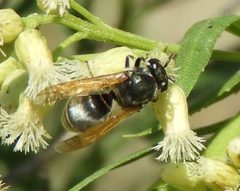
Brachygastra mellifica is a neotropical social and one of the few wasp known to produce and store honey. are small, measuring 7–9 mm in length, with and males displaying alternating yellow and black abdominal bands while queens are dark reddish-brown. The species constructs large paper nests in tree that may persist for years in favorable climates. Colonies are exceptionally large, housing 3,500–18,700 individuals with multiple queens. The species has significant economic value as a of avocados and as a agent for the Asian citrus psyllid (Diaphorina citri), a major citrus pest.


Pronunciation
How to pronounce Brachygastra mellifica: /ˌbrækɪˈɡæstrə mɛˈlɪfɪkə/
These audio files are automatically generated. While they are not always 100% accurate, they are a good starting point.
Identification
Distinguished from the similar Brachygastra lecheguana by geographic distribution (B. mellifica ranges from Texas to Panama, B. lecheguana occurs further south). Easily confused with the solitary mason wasp Pachodynerus nasidens, which shares nearly identical yellow and black banding; B. mellifica can be separated by its social , nest structure, and short, nearly vertical petiole. The very broad, short and high projecting scutellum are diagnostic for the Brachygastra.
Images
Appearance
Small social with body length of 7–9 mm. and males have alternating yellow and black abdominal bands. Queens are distinguished by dark reddish-brown abdominal coloration. The is characteristically short and broad, nearly as wide as long, with a very high scutellum that often projects over the . The petiole (wasp waist) is short and nearly vertical, making it difficult to detect in live specimens. Only females possess stingers; external reproductive organs distinguish males from females.
Habitat
Builds nests in the of shrubs or trees, typically 1–9 m above ground. Nests are well-covered in surrounding foliage. Frequently reported in suburban settings near human habitation. Found in subtropical and tropical climates; nests can be occupied year-round in favorable conditions. Nests are vulnerable to urban development pressures.
Distribution
Native range extends from northern Panama through subtropical Central America and Mexico. In the United States, occurs in southeastern Arizona and southern Texas. The only Brachygastra present in the US. Absent from Florida despite suitable and presence of mimics in that region.
Seasonality
abundant during July and September, coinciding with plentiful citrus groves and large populations of the Diaphorina citri. nearly disappear when D. citri nymphs are scarce, returning the following spring.
Diet
feed on nectar and honeydew. Preys on Diaphorina citri (Asian citrus psyllid), particularly 4th and 5th instar nymphs, with secondary preference for 2nd and 3rd instars. Occasionally consumes adults. Also feeds on larvae of the weevil Anthonomus aeneoulus and in the Alucitidae. feed larvae with captured prey; adults do not consume prey directly but feed on sugars. (regurgitation of nectar) observed on nest surface.
Host Associations
- Diaphorina citri - -preyMajor prey item; preferential on 4th and 5th instar nymphs. Critical for of this citrus pest.
- Persea americana (avocado) - Significant ; carries pollen on hairy , , legs, and in thoracic cavities.
- Citrus spp. - /resourceAssociated with citrus groves where Diaphorina citri are abundant.
Life Cycle
Colonies are in tropical and subtropical climates. New colonies founded via swarming, with clusters of colonies common suggesting short-distance . Queens may reproduce in original colony or split off with to found new colonies. Cyclical pattern: new queens produced only when single remains in colony. Colonies contain hundreds of fertilized queens. Males remain in natal colonies and do not disperse to seek matings.
Behavior
Social with complex colony organization. and males share nest defense; colonies can mount mass attacks when disturbed. Foragers search tree flushes for prey. Exhibits on nest surface. Workers police to ensure queens produce most males. Split-sex ratio pronounced due to and asymmetrical relatedness. Preferential on specific life stages of Diaphorina citri.
Ecological Role
of native plants including avocados, potentially historically important before European honeybee introduction. of agricultural pests, particularly Diaphorina citri, contributing to natural in citrus . Prey for robber flies (Diogmites angustipennis), orb-weaving spiders, opossums, and golden-fronted woodpeckers.
Human Relevance
Honey production: one of few non- insects to produce honey, harvested by peoples in Mexico (Popoloca name: Cuchii; Spanish: Panal Miniagua). Honey and larvae consumed as delicacy, harvested during specific lunar phases when nests are full. agent for Diaphorina citri in citrus agriculture; nests can be translocated to establish . of avocado crops. Risk of toxic honey if nectar collected from toxic plants such as Datura (Jimsonweed).
Similar Taxa
- Brachygastra lecheguanaVery similar ; distinguished primarily by geographic distribution (B. lecheguana occurs south of B. mellifica range)
- Pachodynerus nasidensSolitary mason wasp with nearly identical yellow and black banding; distinguished by solitary , mud nest construction, and lack of social colony structure
More Details
Nest structure
Paper nests 40–50 cm in diameter composed of up to 50,000 . Construction begins as single irregular cell layer attached to branch, extended into hanging layers that spiral outward. Surface blotchy brown or grey with rough cardboard texture, not . Honey stored in uncapped cells, unlike honeybee wax-capped cells.
Genetic relatedness
related to queens at r=0.37; worker-worker relatedness r=0.23. High -queen relatedness within colonies consistent with production of new queens only during single-queen periods. Workers favor female siblings over males due to (maximum 3/4 gene sharing with sisters vs. 1/2 with brothers).
Toxic honey risk
Honey may be toxic if collect nectar from toxic plants such as Datura (Jimsonweed). Traditional harvesting by peoples involves risk assessment; fully capped honey may reduce compared to uncapped nectar stores.
Sources and further reading
- BugGuide
- Wikipedia
- GBIF taxonomy match
- iNaturalist taxon
- NCBI Taxonomy
- Catalogue of Life
- 'Insects Unlocked': How You Can Make It Happen | Bug Squad
- Bug Eric: Wasp Wednesday: Brachygastra mellifica
- Bees vs wasps: what's the difference? - Buglife Blog - Buglife
- Bug Eric: Wasp Wednesday: Pachodynerus
- Brachygastra mellifica (Hymenoptera: Vespidae): Predation preference and feeding behavior on Diaphorina citri (Hemiptera: Psyllidae) in Mexico
- Kin selection, relatedness, and worker control of reproduction in a large-colony epiponine wasp, Brachygastra mellifica
- Brachygastra mellifica(Hymenoptera: Vespidae): Feeding Behavior and Preferential Predation onDiaphorina citri(Hempitera: Liviidae) Life Stages in México