
Diaphorina citri
Kuwayama, 1907
Asian citrus psyllid, ACP
, the , is a small hemipteran insect and one of two confirmed of Huanglongbing (HLB), also known as , caused by the bacterium Candidatus Liberibacter asiaticus. Native to southern Asia, it has spread to citrus-growing regions worldwide including the Americas, Middle East, and Oceania, posing a severe threat to global citrus production. The insect feeds on phloem sap of new citrus growth and has become the focus of intensive , monitoring, and genomic research efforts due to its economic impact.
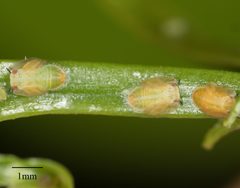
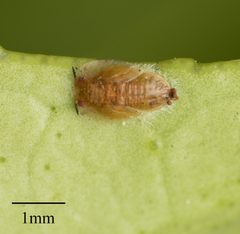
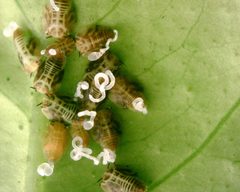
Pronunciation
How to pronounce Diaphorina citri: //ˌdaɪəfəˈraɪnə ˈsɪtraɪ//
These audio files are automatically generated. While they are not always 100% accurate, they are a good starting point.
Identification
Distinguished from the African citrus (Trioza erytreae) by wing shape and color pattern. Separated from aphids by jumping , ten-segmented , and absence of abdominal cornicles. The waxy secretion and mottled coloration separate it from other psyllid . Nymphs lack abdominal spots present in some related species.
Images
Habitat
Citrus orchards and residential citrus plantings; specifically associated with new flush growth of citrus and related Rutaceae. Found in tropical, subtropical, and warm temperate climates where citrus occurs.
Distribution
Native to southern Asia; established in Middle East, South and Central America, Mexico, Caribbean, and United States (Florida since 1998, California since 2008, plus Louisiana, Georgia, Arizona, South Carolina, Texas, Hawaii). Present in Oceania (American Samoa, Guam, Northern Mariana Islands, Papua New Guinea). Under programs in some California regions.
Seasonality
Activity coincides with citrus flush growth periods; in California, major flushes occur spring and fall with young trees and lemons producing periodic growth during warm weather. Development cycle takes 2–7 weeks depending on temperature.
Diet
Feeds on phloem sap of new leaf growth (feather flush) of citrus and related plants in Rutaceae; specifically targets tender new shoots and unfolding leaves.
Host Associations
- Citrus spp. - primary All commercial citrus including oranges, lemons, mandarins, grapefruit
- Murraya paniculata - alternate Orange jessamine; highly attractive for oviposition
- Murraya koenigii - alternate Curry leaf plant; fastest completion observed
- Citrus aurantifolia - Himalayan lime
- Citrus reticulata - Mandarin
Life Cycle
laid on tips of growing shoots between and near unfolding leaves; female may lay up to 800 eggs over several months. Nymph passes through five instars. Whole development cycle completed in 2–7 weeks depending on temperature and season. Eggs hatch into nymphs that develop through five before becoming winged .
Behavior
Adopts characteristic -down, tail-up posture while feeding. Highly mobile, jumping insect compared to sedentary aphids. Aggregated distribution pattern on flushes within trees. Does not avoid plants with predatory mites even after experiencing . Attracted to yellow color and UV wavelengths; probing stimulated by formic acid and acetic acid on leaf surface.
Ecological Role
Primary of Candidatus Liberibacter asiaticus, the causal agent of Huanglongbing (), one of the most devastating citrus globally. Also implicated in transmitting Tristeza virus. Serves as prey for various agents including and predatory insects.
Human Relevance
Major economic pest threatening multibillion-dollar citrus industries worldwide. Subject to restrictions and programs in multiple jurisdictions. Intensive research focus for RNAi , -based trapping systems, and . California Department of Food and Agriculture maintains hotline (1-800-491-1899) for public reporting.
Similar Taxa
- Trioza erytreaeAfrican citrus ; distinguished by different wing shape and color pattern
- Aphids (Aphididae)Often co-occur on citrus; distinguished by sedentary , 4–6 segmented , and presence of cornicles
More Details
Genomic resources
Complete sequenced (Diaci v3.0 -level assembly released 2023–2024); transcriptome identifies over 25,600 predicted genes. Genome enabled development of RNAi and antisense oligonucleotide control strategies.
Endosymbionts
Houses specialized bacteriome organ containing Candidatus Carsonella ruddii (nutrition) and Candidatus Profftella armatura (nutrition, defense toxins, ). Also associated with and can harbor Candidatus Liberibacter asiaticus.
Biological control agents
Primary Tamarixia radiata successfully established in multiple countries; Diaphorencyrtus aligarhensis less successful due to competition. Predatory mites (Amblyseius herbicolus), lady beetles, and fungal entomopathogens (Isaria fumosorosea, citriformis) also used.
Pheromone discovery
identified by Walter Leal team (2017); acetic acid-based lures capture approximately three times more individuals than standard yellow sticky traps, particularly effective at low densities.
Sources and further reading
- BugGuide
- Wikipedia
- GBIF taxonomy match
- iNaturalist taxon
- NCBI Taxonomy
- Catalogue of Life
- Deadly Citrus Greening Disease: A Better Lure for Asian Citrus Psyllids | Bug Squad
- Targeting the Asian Citrus Psyllid | Bug Squad
- Targeting the Asian Citrus Psyllid | Bug Squad
- Molecular Biologist Michelle Heck: Challenges of Citrus Greening Disease | Bug Squad
- Check Your Citrus Trees for Signs of This Pest | Bug Squad
- Walter Leal: Special Award for Citrus Pest Research | Bug Squad
- PSILÍDEO DO CITROS (DIAPHORINA CITRI) CITRUS PSYLID (DIAPHORINA CITRI)
- Diaphorina citri . [Distribution map].
- Diaphorina citri . [Distribution map].
- Asian citrus psyllid, Diaphorina citri (Kuwayama)
- Diaphorina citri . [Distribution map].
- The Asian Citrus Psyllid Genome (Diaphorina citri, Hemiptera)
- Effect of calcium polysulfide on Diaphorina citri (Hemiptera: Liviidae) and its primary parasitoids
- Endosymbionts associated with Diaphorina citri, vector of Candidatus Liberibacter asiaticus
- Evaluation of Host Plant Preferred by Asian Citrus Psyllid – Diaphorina citri
- Potential of the predatory mite Amblyseius herbicolus as biological control agent of Diaphorina citri on plants
- Biología y tabla de vida de Diaphorina citri (Hemitera: Liviidae) en Zona Bananera, Magdalena, Colombia Biology and life table of Diaphorina citri Kuwayama (Hemiptera: Liviidae) in Zona Bananera, Magdalena, Colombia
- Functional characteristics of endosymbiotic picornia-like virus in Diaphorina citri.
- Characterising the Associated Virome and Microbiota of Asian Citrus Psyllid (Diaphorina citri) in Samoa.
- Fabrication of nanogels to improve the toxicity and persistence of cycloxaprid against Diaphorina citri, the vector of citrus huanglongbing.
- Neuropeptide Ecdysis-Triggering Hormone and Its Receptor Mediate the Fecundity Improvement of 'Candidatus Liberibacter Asiaticus'-Infected Diaphorina citri Females and CLas Proliferation.
- Spatial and temporal detection of 'Candidatus Liberibacter asiaticus' in Diaphorina citri through optimized scouting, sampling, DNA isolation, and qPCR amplification in California citrus groves.
- α-Copaene is a potent repellent against the Asian Citrus Psyllid Diaphorina citri.
- Continuous cell lines derived from the Asian citrus psyllid, Diaphorina citri, harbor viruses and Wolbachia.
- Diaci v3.0: chromosome-level assembly, de novo transcriptome, and manual annotation of Diaphorina citri, insect vector of Huanglongbing.
- The conserved role of miR-2 and novel miR-109 in the increase in fecundity of Diaphorina citri induced by symbiotic bacteria and pathogenic fungi.
- Longitudinal Transcriptomic, Proteomic, and Metabolomic Response of Citrus sinensis to Diaphorina citri Inoculation of Candidatus Liberibacter asiaticus.
- Repellency, Toxicity, and Chemical Composition of Plant Essential Oils from Myrtaceae against Asian Citrus Psyllid, Diaphorina citri Kuwayama (Hemiptera Liviidae).
- Adipokinetic hormone signaling mediates the enhanced fecundity of Diaphorina citri infected by 'Candidatus Liberibacter asiaticus'.
- Distribution and dynamic changes of Huanglongbing pathogen in its insect vector Diaphorina citri.