
Brachygastra
Perty, 1833
Honey Wasps, Mexican Honey Wasps
Species Guides
1- Brachygastra mellifica(Mexican Honey Wasp)
Brachygastra is a of 17 of social paper wasps in the Vespidae, commonly known as honey . The genus is notable for being one of the few non- insects that produce and store honey in substantial quantities. Species are distributed throughout Central and South America, with one species (B. mellifica) extending into the southwestern United States. The genus exhibits pronounced morphological differentiation, with queens typically larger than . Nests are arboreal, constructed from chewed plant fibers, and can persist for multiple years in tropical climates.

Pronunciation
How to pronounce Brachygastra: //ˌbrækɪˈɡæstrə//
These audio files are automatically generated. While they are not always 100% accurate, they are a good starting point.
Identification
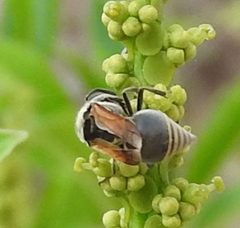
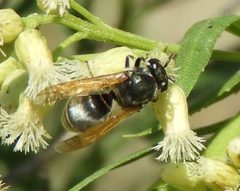
The combination of a highly elevated, angular scutellum projecting over the with a , short-bellied is diagnostic for the . -level identification relies on male genitalia features (for B. lecheguana vs. B. mellifica), punctation and patterns on the and mesosoma (B. borellii), and the structure of the occipital carina (smithii group). The short, nearly vertical petiole distinguishes Brachygastra from superficially similar solitary vespids. identification within colonies is possible based on size, with queens being larger and more fecund than .
Images
Habitat
Primarily humid forested environments, particularly tropical and subtropical forests. Nests are always arboreal and , constructed in trees. Some occupy open vegetation: B. augusti, B. mouleae, B. moebiana, and B. lecheguana. Two species (B. borellii and B. baccalaurea) inhabit upland areas. The lecheguana group occurs in Atlantic rainforest and Nearctic regions; the scutellaris group mostly in Atlantic forest; the smithii group is confined to Amazon rainforest. B. azteca occurs in Mexico.
Distribution
Widely distributed in Central and South America from Mexico to central Argentina, absent only from Chile, Uruguay, and central and southern Argentina. One , B. mellifica, extends into the southwestern United States (Texas and Arizona). The originated in Amazonian rainforest approximately 32 million years ago, with subsequent diversification influenced by Andean uplift and the separation of Atlantic and Amazon forests.
Seasonality
In tropical and subtropical climates, colonies are and can persist for years. Activity patterns follow resource availability, with foraging for nectar and insect prey occurring year-round in suitable climates. No specific seasonal dormancy is reported for tropical ; temperate-edge populations (B. mellifica in Texas/Arizona) likely exhibit seasonal variation in activity.
Diet
Broad diet consisting of floral nectar and insect protein. obtained from nectar and honeydew (particularly from cercopids and nymphal membracids); protein from on beetles, weevils, lepidopterans, aphids, and various larvae. Several (B. mellifica, B. lecheguana, B. azteca) store nectar in uncapped as honey, a trait shared with few other non- insects. B. mellifica and B. lecheguana are particularly noted for large honey stores.
Life Cycle
Social colonies with morphological differentiation. Queens are larger and more fecund than ; larger queens are generally more . Colonies can contain thousands of individuals (3,000-18,000+ workers in large B. mellifica nests). Nests are in tropical climates, with continuous production. Nests contain multiple combs with shallow arranged in planar or spherical configurations constructed in spiral sequence. involves -worker conflict over reproduction, with worker control of reproduction documented in B. mellifica.
Behavior
Colonial social organization with cooperative nest construction, care, and foraging. construct arboreal paper nests from chewed plant fibers. Foraging includes nectar collection from flowers, honeydew collection from hemipterans, and active on insects. B. mellifica exhibits preferential predation on 4th and 5th instar nymphs of Diaphorina citri, with discrimination against smaller prey stages. Nests can be aggressive in defense, with colonies capable of mass attack when disturbed. Honey stores are maintained in uncapped accessible to colony members.
Ecological Role
Pollination services through nectar foraging, particularly for Myrtaceae in the Cerrado, sunflower, mesquite, and avocado. of herbivorous insects through , including documented predation on Asian citrus psyllid (Diaphorina citri), tomato leafminer (Tuta absoluta), cotton boll weevil larvae (Anthonomus grandis), and white larvae (Perileucoptera coffeella). Attraction to damaged plants via volatile chemical cues released by herbivore activity. Prey for spiders, opossums, and woodpeckers.
Human Relevance
Honey harvesting by peoples in Brazil and Mexico since ancient times; rural peoples may transplant nests to gardens for honey production, routing colonies with smoke and destroying combs. Honey consumption carries risk of when nectar is collected from toxic plants such as Jimsonweed (Datura). Potential for use in programs for agricultural pests, particularly citrus management. Stings are reportedly fierce, limiting human interaction. Conservation importance for maintaining pollination and pest control services.
Similar Taxa
- Pachodynerus nasidensNear-identical color pattern mimicking B. mellifica; distinguished by solitary lifestyle, mud-nest construction in cavities, and slightly broader range including Arizona and Florida where B. mellifica is unconfirmed
- Polybia speciesOther known to store honey; distinguished by nest architecture and geographic distribution
- Apis melliferaHoneybee with which B. mellifica shares honey-production trait; distinguished by wax-capped honey , barbed sting, and fundamentally different nest structure
More Details
Taxonomic History
The name Brachygastra, introduced by Perty in 1833, was initially confused with Brachygaster (Evaniidae). It was changed to Nectarina, only to be confused with the bird Nectarinia. Misspellings in publications compounded confusion. The genus has been placed in various phylogenetic positions relative to Chartergus, Protonectarina, and Polybia based on morphological, nest architecture, and molecular data.
Species Groups
The comprises three main groups: the lecheguana group (B. mellifica, B. lecheguana, B. borellii) in Atlantic rainforest and Nearctic regions; the smithii group (B. baccalaurea, B. bilineolata, B. smithii, B. propodealis, B. buyssoni) confined to Amazon rainforest; and the scutellaris group (B. augusti, B. mouleae, B. fistulosa, B. cooperi, B. myersi, B. scutellaris) in Atlantic forest. B. azteca is sister to all other and occurs in Mexico.
Evolutionary History
Ancestral diversification began approximately 32 million years ago in diverse Amazonian rainforest extending to the Caribbean coast. The GAARlandia land bridge (Greater Antilles and Aves Ridge) preceded the Isthmus of Panama and allowed of B. azteca and lecheguana group ancestors between North, Central, and South America. Andean uplift from 23-10 million years ago fragmented via the Pebas wetland system, driving speciation between Atlantic and Amazon forest lineages.
Sources and further reading
- BugGuide
- Wikipedia
- GBIF taxonomy match
- iNaturalist taxon
- NCBI Taxonomy
- Catalogue of Life
- 'Insects Unlocked': How You Can Make It Happen | Bug Squad
- Bug Eric: Wasp Wednesday: Brachygastra mellifica
- Bees vs wasps: what's the difference? - Buglife Blog - Buglife
- Bug Eric: Wasp Wednesday: Pachodynerus
- Biogeography of the social wasp genus Brachygastra (Hymenoptera: Vespidade: Polistinae)
- Brachygastra mellifica (Hymenoptera: Vespidae): Predation preference and feeding behavior on Diaphorina citri (Hemiptera: Psyllidae) in Mexico
- Kin selection, relatedness, and worker control of reproduction in a large-colony epiponine wasp, Brachygastra mellifica
- Brachygastra mellifica(Hymenoptera: Vespidae): Feeding Behavior and Preferential Predation onDiaphorina citri(Hempitera: Liviidae) Life Stages in México