
Diogmites angustipennis
Loew, 1866
prairie robber fly
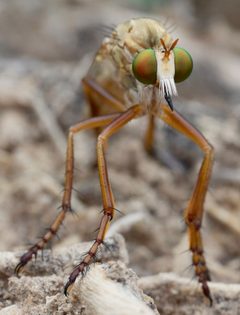
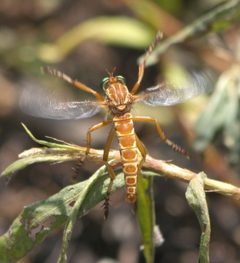
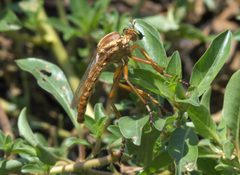
Diogmites angustipennis, commonly known as the prairie robber fly, is a widespread of robber fly in the Asilidae. It was first described by Loew in 1866 and has been subject to taxonomic revision, with three former species now synonymized with it. The species is known to prey on other insects, including . It occurs across the south-central and southwestern United States.
Pronunciation
How to pronounce Diogmites angustipennis: /diːˈɒɡmɪtiːz ænˌɡʌstɪˈpɛnɪs/
These audio files are automatically generated. While they are not always 100% accurate, they are a good starting point.
Identification
Distinguished from the recently described D. bilobatus by subtle morphological differences; the two are closely similar in overall appearance. Specific diagnostic characters would require examination of the primary literature.
Images
Habitat
Observed in prairie and grassland , including alkaline flats and trail edges. One documented occurrence was at Salt Plain National Wildlife in Oklahoma, where an individual was photographed on a trail.
Distribution
Widespread in the Nearctic region, occurring across the south-central and southwestern United States and northern Mexico. Specific documented locations include northwestern Oklahoma, northern Arizona, southern Utah, southern Nevada, and northeastern New Mexico.
Seasonality
Observed in early September in northwestern Oklahoma, suggesting late-season activity.
Diet
Predatory on other insects. Documented prey includes , specifically Clitemnestra bipunctata ( Crabronidae).
Behavior
Perches on exposed surfaces such as trails, where it presumably waits for passing prey. One individual was observed posing on a trail, suggesting relatively calm perching that allows close approach for photography.
Ecological Role
Aerial of other insects, including beneficial such as Clitemnestra bipunctata. Functions as a natural control agent for of other predatory and herbivorous insects.
Human Relevance
Of interest to entomologists and naturalists; its habit of perching conspicuously makes it a subject for nature photography. No documented economic importance or pest status.
Similar Taxa
- Diogmites bilobatusRecently described with close resemblance to D. angustipennis; distinguished by subtle morphological characters detailed in the primary taxonomic literature.
More Details
Taxonomic History
Formerly included three now synonymized: D. grossus, D. pulcher, and D. symmachus. Lectotypes have been designated for D. angustipennis and D. symmachus to stabilize .