
Clitemnestra bipunctata
(Say, 1824)
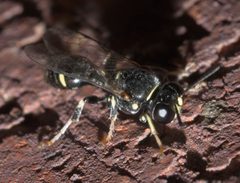
Clitemnestra bipunctata is a small sand wasp in the Crabronidae, measuring approximately 5-6 millimeters in body length. The was formerly classified under the Ochleroptera, but was merged into Clitemnestra by Bohart in 2000. It is widely distributed across North America and has been recorded from Cuba.
Pronunciation
How to pronounce Clitemnestra bipunctata: /ˌklaɪˈtɛm.nɛs.trə baɪˌpʌŋkˈtɑː.tə/
These audio files are automatically generated. While they are not always 100% accurate, they are a good starting point.
Identification
Distinguished from similar small crabronid by its diminutive size (5-6 mm body length) and the two-spotted pattern suggested by its specific epithet. Formerly placed in Ochleroptera, now recognized as Clitemnestra based on morphological revisions by Bohart (2000).
Images
Habitat
Found in association with colonies where feed on honeydew. Nests are excavated in bare soil, typically near the top of vertical banks.
Distribution
North America (widespread across most of the United States) and Cuba (Middle America).
Diet
feed on honeydew from aphids. Females hunt planthoppers, leafhoppers, treehoppers, and psyllids to provision nests.
Life Cycle
Nests are burrows dug in bare soil to depths of 9-20 cm, with 1-3 branching from the main tunnel. Each cell measures approximately 6 x 10 mm and is provisioned with 6-18 paralyzed prey items.
Behavior
frequently observed feeding on honeydew. Females are solitary nesters that hunt and paralyze homopteran prey.
Ecological Role
of various Hemiptera including leafhoppers (Cicadellidae), spittlebugs (Clastopteridae), treehoppers (Membracidae), and related . Provides natural pest control in agricultural and natural settings.
Similar Taxa
- Other Clitemnestra speciesSimilar small size and general ; identification requires examination of specific markings and genitalia.
- Formerly Ochleroptera bipunctataSame under previous classification; literature prior to 2000 may use this name.
Sources and further reading
- BugGuide
- Wikipedia
- GBIF taxonomy match
- iNaturalist taxon
- NCBI Taxonomy
- Catalogue of Life
- Bembicid Holdings | Entomology Research Museum
- Meloidae Holdings | Entomology Research Museum
- Bug Eric: January 2012
- Tabloid Sensationalism Aside, Lady Bugs Are Still Fascinating
- The mini grasshoppers that outlived dinosaurs: the fascinating world of Tetrigidae | Blog