
Clitemnestra
Spinola, 1851
Species Guides
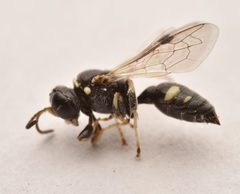
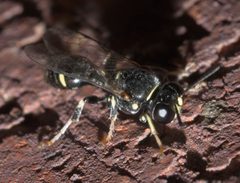
1Clitemnestra is a of small sand wasps in the Crabronidae, containing at least 60 described . Members of this genus are predatory that hunt various sap-feeding insects, particularly planthoppers, leafhoppers, and related Hemiptera. The genus was revised by Bohart in 2000, which included the merger of the former genus Ochleroptera into Clitemnestra. These wasps are generally inconspicuous due to their small size, with some species measuring only 5–6 millimeters in body length.
Pronunciation
How to pronounce Clitemnestra: /ˌklɪtɛmˈnɛstra/
These audio files are automatically generated. While they are not always 100% accurate, they are a good starting point.
Identification
Clitemnestra are distinguished from other Bembicini by subtle morphological characters, particularly in wing venation and male genitalia structure. The small body size and association with sap-feeding insect colonies can aid in field recognition. Formerly placed in Ochleroptera, species in this were reassigned based on phylogenetic revisions by Bohart (2000). Specific identification to species level requires examination of microscopic characters.
Images
Appearance
Small to minute , with body lengths typically ranging from 5–10 millimeters. Coloration and detailed vary among . The is characterized by features of the wing venation and genitalia that distinguish it from related genera in the tribe Bembicini.
Habitat
Open with bare soil suitable for nesting, including vertical banks and earthen exposures. Often found in association with colonies of aphids, leafhoppers, planthoppers, and other sap-feeding insects that provide food resources.
Distribution
Widespread across North America, with records from the United States, Mexico, and the Caribbean (including Cuba). The has a Nearctic distribution with some extending into the Neotropics.
Seasonality
activity period varies by and latitude. In temperate regions, active primarily during the warmer months. Specific data for most species is limited.
Diet
feed on honeydew, the sugary liquid waste excreted by sap-feeding insects such as aphids. Females provision nests with paralyzed prey, primarily adult planthoppers, leafhoppers ( Cicadellidae), treehoppers, psyllids, and related Hemiptera from families Cixiidae, Dictyopharidae, Flatidae, and Tropiduchidae.
Host Associations
- Aphidoidea - food sourcehoneydew consumption
- Cicadellidae - preyparalyzed and stored in nests; includes Coelidia olitoria, Colladonus clitellarius, Japananus hyalinus, Macrosteles fascifrons, Orientus ishidae, Paraphlepsius irroratus, Prescottia lobata
- Aphrophoridae - preyspittlebugs including Clastoptera obtusus, Philaenus leucophthalmus, P. lineatus
- Membracidae - preytreehoppers including Cyrtolobus acutus
- Cixiidae - prey
- Dictyopharidae - prey
- Flatidae - prey
- Tropiduchidae - prey
- Psyllidae - prey
Life Cycle
Females excavate burrows in bare soil, typically near the top of vertical banks, reaching depths of 9–20 centimeters. Nests contain one to three lateral measuring approximately 6 × 10 millimeters. Each cell is provisioned with 6–18 paralyzed prey items. An is laid on the prey, and the larva feeds on the stored food. Developmental timing from egg to is not well documented.
Behavior
Females are solitary nesters that dig burrows in soil. are frequently observed at colonies where they consume honeydew. Hunting females capture adult hoppers more frequently than nymphs. Nesting may occur where soil conditions are favorable.
Ecological Role
of sap-feeding insects, potentially contributing to of leafhoppers, planthoppers, and related agricultural pests. serve as prey for predatory insects including robber flies (e.g., Diogmites angustipennis). Nests are parasitized by satellite flies (Miltogramminae), including Phrosinella aurifacies and Metopia argyrocephala, whose larvae consume stored prey and often destroy or larvae.
Human Relevance
Minimal direct economic impact. Potential incidental benefit through on some agricultural pest among leafhoppers and planthoppers. Too small to be considered a nuisance or stinging hazard.
Similar Taxa
- BembixBoth are small to medium sand wasps in Bembicini, but Bembix are generally larger, nest in more open sandy areas, and provision nests with flies rather than sap-feeding insects
- OchleropteraFormerly recognized as separate ; merged into Clitemnestra by Bohart (2000) based on morphological and phylogenetic analysis
More Details
Taxonomic History
The Ochleroptera was synonymized with Clitemnestra by R.M. Bohart in 2000. formerly placed in Ochleroptera, such as O. bipunctata, are now treated as Clitemnestra bipunctata.
Prey Records
A single study from Cuba documented 424 prey records for C. bipunctata, demonstrating the breadth of use within sap-feeding Hemiptera and the preference for over prey.