
Bembix
Fabricius, 1775
sand wasps
Species Guides
10- Bembix americana(American Sand Wasp)
- Bembix amoena(sand wasp)
- Bembix belfragei
- Bembix dentilabris
- Bembix nubilipennis
- Bembix occidentalis(sand wasp)
- Bembix pallidipicta
- Bembix rugosa
- Bembix sayi(sand wasp)
Bembix is a of approximately 380 of solitary predatory sand wasps in the Crabronidae. These are characterized by their large size, often bright coloration, and specialized nesting in sandy substrates. Females excavate burrows in loose sand and provision them with paralyzed flies for their larvae, exhibiting where prey is delivered as the larva develops. The genus has been documented across North America, Europe, southern Africa, and Australia, with species showing varying degrees of geographic restriction from widespread to narrowly .
Pronunciation
How to pronounce Bembix: /ˈbɛm.bɪks/
These audio files are automatically generated. While they are not always 100% accurate, they are a good starting point.
Identification
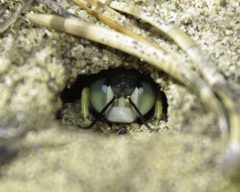
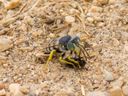
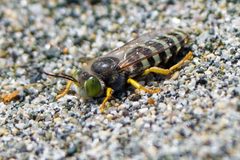
Bembix are large, robust wasps with bright coloration often including yellow, black, or metallic markings. They possess a distinctive tarsal rake—spines on the front legs used for rapid sand excavation when digging burrows. Burrow entrances are round with coarse, piled diggings that distinguish them from tiger burrows, which have fanned diggings. Males participate in conspicuous rituals called 'sun dances' low over the ground, flying erratically at high speed to locate emerging females.
Images
Habitat
Deep, loose sand deposits including dunes, beaches, sand prairies, and barren sand exposures. In North America, they are particularly associated with sand prairie remnants and riparian sand deposits. In southern Africa, some show coastal specialization while others occupy inland sandy .
Distribution
distribution spanning North America (21+ north of Mexico), Europe (at least 15 documented species), southern Africa (37 recognized species with varying ), and Australia. Distribution patterns range from narrowly to widespread across the Afrotropical Region and into Egypt.
Seasonality
Active primarily during warmer months; in temperate regions, two annually with as . Fall activity observed in sand prairies when cooler temperatures limit other insect activity. Males typically emerge before females.
Diet
feed on nectar from flowers, particularly composites (Asteraceae). Larvae are provisioned with true flies (Diptera, excluding ), with females capturing 10–20 or more flies per larva depending on .
Life Cycle
Females excavate oblique, nearly horizontal burrows 19–57 cm long and 5–28 cm deep, often with curved tunnels ending in terminal . Some construct short dead-end burrows nearby to confuse . are laid either on the first prey item or in empty cells before hunting begins. Larvae receive —prey delivered sequentially as they grow. Mature larvae spin cocoons incorporating sand grains, forming hardened capsules. occurs as within cocoons.
Behavior
Females use subtle landmarks to locate concealed burrow entrances when returning with prey. Males engage in 'sun dances'—erratic, high-speed 1–2 inches above ground to detect virgin females. Mated pairs leave sites to complete mating elsewhere. Both sexes are rapid, energetic fliers rarely seen perching. Females exhibit active parental care through , a trait more typical of birds and mammals than most insects.
Ecological Role
of dipteran flies, contributing to fly . Nesting create heterogeneity in sandy . Serve as prey for robber flies (Asilidae), cuckoo wasps (Chrysididae), velvet ants (Mutillidae), satellite flies (Sarcophagidae), bee flies (Bombyliidae), and parasitic thick-headed flies (Conopidae). function as when visiting flowers for nectar.
Human Relevance
Generally harmless to humans; stings are not dangerously venomous to healthy individuals and stingers are not left embedded. One Australian , Bembix variabilis, has been documented as a pest of native hives (Tetragonula carbonara). Often observed and photographed by naturalists due to conspicuous nesting . Sometimes mistaken for bees or more dangerous , leading to unnecessary concern.
Similar Taxa
- Cicada killers (Sphecius)Formerly classified together in Sphecidae; both are large, solitary, ground-nesting with similar burrowing , but Sphecius provision nests with cicadas rather than flies and lack the tarsal rake structure.
- Tiger beetles (Cicindela)Create similar burrows in sandy ; distinguished by fanned (rather than piled) diggings at burrow entrances and by being beetles rather than .
- AmmophilaAnother sphecid with thread-waisted appearance that nests in sandy areas, but provisions nests with caterpillars rather than flies and lacks the bright coloration and tarsal rake of Bembix.
Misconceptions
Often called 'sand bees' due to nesting in sand, but they are , not bees. Stings are frequently attributed to these wasps when other insects are responsible; they rarely sting humans due to their rapid and escape .
More Details
Taxonomic history
Formerly placed in Sphecidae, now classified in Crabronidae (Bembicinae) based on phylogenetic revisions.
Nesting deception
Some construct decoy burrows or furrows near real nests, likely as anti- strategy.
Sources and further reading
- BugGuide
- Wikipedia
- iNaturalist taxon
- NCBI Taxonomy
- Catalogue of Life
- Bembicid Holdings | Entomology Research Museum
- Bug Eric: Sand Wasps, Genus Bembix
- A sand prairie autumn | Beetles In The Bush
- Nesting behaviour and provisioning in Bembix merceti and Bembix zonata (Hymenoptera: Crabronidae)
- Figure 2 from: Gess S, Gess F (2014) Geographical distributions of Bembix (Hymenoptera, Crabronidae, Bembicinae) in southern Africa, with notes on biology. Journal of Hymenoptera Research 36: 53-130. https://doi.org/10.3897/jhr.36.6491
- Figure 9 from: Gess S, Gess F (2014) Geographical distributions of Bembix (Hymenoptera, Crabronidae, Bembicinae) in southern Africa, with notes on biology. Journal of Hymenoptera Research 36: 53-130. https://doi.org/10.3897/jhr.36.6491
- Figure 12 from: Gess S, Gess F (2014) Geographical distributions of Bembix (Hymenoptera, Crabronidae, Bembicinae) in southern Africa, with notes on biology. Journal of Hymenoptera Research 36: 53-130. https://doi.org/10.3897/jhr.36.6491
- Figure 14 from: Gess S, Gess F (2014) Geographical distributions of Bembix (Hymenoptera, Crabronidae, Bembicinae) in southern Africa, with notes on biology. Journal of Hymenoptera Research 36: 53-130. https://doi.org/10.3897/jhr.36.6491
- Figure 7 from: Gess S, Gess F (2014) Geographical distributions of Bembix (Hymenoptera, Crabronidae, Bembicinae) in southern Africa, with notes on biology. Journal of Hymenoptera Research 36: 53-130. https://doi.org/10.3897/jhr.36.6491
- Figure 16 from: Gess S, Gess F (2014) Geographical distributions of Bembix (Hymenoptera, Crabronidae, Bembicinae) in southern Africa, with notes on biology. Journal of Hymenoptera Research 36: 53-130. https://doi.org/10.3897/jhr.36.6491
- Figure 17 from: Gess S, Gess F (2014) Geographical distributions of Bembix (Hymenoptera, Crabronidae, Bembicinae) in southern Africa, with notes on biology. Journal of Hymenoptera Research 36: 53-130. https://doi.org/10.3897/jhr.36.6491
- Figure 13 from: Gess S, Gess F (2014) Geographical distributions of Bembix (Hymenoptera, Crabronidae, Bembicinae) in southern Africa, with notes on biology. Journal of Hymenoptera Research 36: 53-130. https://doi.org/10.3897/jhr.36.6491
- Figure 6 from: Gess S, Gess F (2014) Geographical distributions of Bembix (Hymenoptera, Crabronidae, Bembicinae) in southern Africa, with notes on biology. Journal of Hymenoptera Research 36: 53-130. https://doi.org/10.3897/jhr.36.6491
- Figure 8 from: Gess S, Gess F (2014) Geographical distributions of Bembix (Hymenoptera, Crabronidae, Bembicinae) in southern Africa, with notes on biology. Journal of Hymenoptera Research 36: 53-130. https://doi.org/10.3897/jhr.36.6491
- Figure 11 from: Gess S, Gess F (2014) Geographical distributions of Bembix (Hymenoptera, Crabronidae, Bembicinae) in southern Africa, with notes on biology. Journal of Hymenoptera Research 36: 53-130. https://doi.org/10.3897/jhr.36.6491
- Figure 1 from: Gess S, Gess F (2014) Geographical distributions of Bembix (Hymenoptera, Crabronidae, Bembicinae) in southern Africa, with notes on biology. Journal of Hymenoptera Research 36: 53-130. https://doi.org/10.3897/jhr.36.6491
- Figure 15 from: Gess S, Gess F (2014) Geographical distributions of Bembix (Hymenoptera, Crabronidae, Bembicinae) in southern Africa, with notes on biology. Journal of Hymenoptera Research 36: 53-130. https://doi.org/10.3897/jhr.36.6491
- Figure 10 from: Gess S, Gess F (2014) Geographical distributions of Bembix (Hymenoptera, Crabronidae, Bembicinae) in southern Africa, with notes on biology. Journal of Hymenoptera Research 36: 53-130. https://doi.org/10.3897/jhr.36.6491